 A K
A K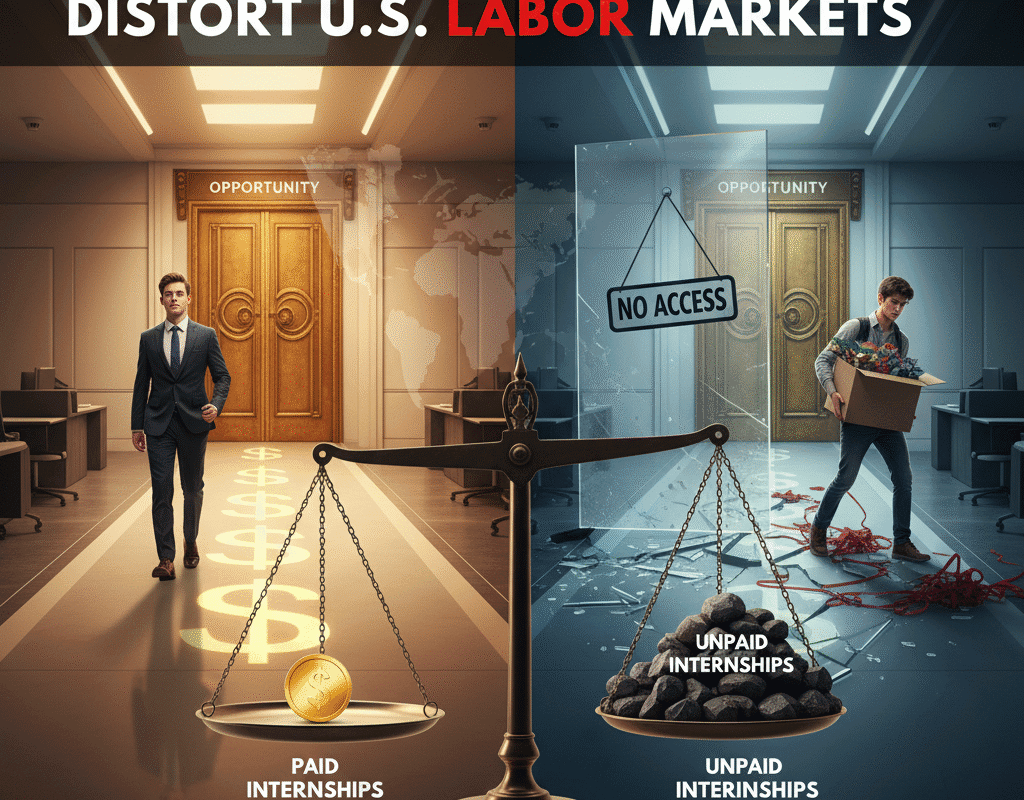
Why Unpaid Internships Distort U.S. Labor Markets?
Why Unpaid Internships Distort U.S. Labor Markets?
Unpaid internships are becoming a common aspect of the early professional landscape in the modern U.S. labor market. Unpaid internships have broader ramifications that affect the entire workforce, even though they are frequently justified as a means of gaining experience, networking, and career entry. These jobs, which are usually given to recent graduates or college students, frequently impede fair wage practices, maintain inequality, and skew the labor market in ways that can limit opportunities for economic mobility.
HSBC Cashback Credit Card 2025 – Benefits, Rewards & How to Apply?

The Increase in Unpaid Internships
Unpaid internships have increased dramatically over the last 20 years in a variety of fields, including non-profits, politics, media, and law. Nearly 43% of internships in the United States are unpaid, with a higher concentration in competitive industries, according to the National Association of Colleges and Employers (NACE). Although these internships offer significant experience and CV credentials, their unpaid nature creates serious issues with equity and accessibility.
Many students find it financially impossible to participate in an unpaid internship. Interns are frequently forced to rely on parental support, student loans, or part-time work due to the lack of income. As a result, only those from wealthy families are able to engage in unpaid labor.
Access to the Labor Market and Economic Inequality
Unpaid internships exacerbate already-existing labor market disparities. According to research, students who can afford unpaid jobs have a higher chance of landing a full-time job after graduation with a higher beginning salary. A self-sustaining cycle of economic inequality results from the exclusion of students from lower-income families from these crucial turning points.
Employers can extract high-value workers at no cost, which leads to labor market distortion. Unpaid interns frequently carry out crucial duties for companies that are comparable to those of paid workers. Companies can rely on free labor instead of investing in employing paid staff, which decreases entry-level employment possibilities for fresh graduates and creates a competitive imbalance.
Effects on the Development of Workers
Unpaid internships have long-term effects that go beyond short-term economic disparity. Fair access to professional experience is essential for workforce development, but unpaid internships focus opportunities on a specific group of people. As a result, sectors such as journalism, law, and political advocacy often see a homogenized workforce dominated by individuals from affluent backgrounds. This lack of diversity hinders innovation, creativity, and representation, ultimately weakening organizational performance and societal progress.
Moreover, unpaid internships can skew the perception of career readiness. Employers may mistakenly equate unpaid internship experience with higher skill levels, thereby disadvantaging qualified candidates who could not afford to intern without compensation. This reinforces systemic biases within hiring practices and further entrenches economic inequality.
Regulatory and Legal Environment
In response to the growing concern over unpaid internships, federal and state labor laws have attempted to define when internships must be paid. The U.S. Department of Labor applies the “primary beneficiary test” to determine whether an intern is truly learning or serving as free labor for the employer. If the employer benefits disproportionately, the intern must be compensated at least the minimum wage.
Despite these regulations, enforcement remains inconsistent. Many companies circumvent labor laws by labeling positions as “training opportunities” or “academic experiences,” even when interns perform work integral to the organization. The lack of stringent oversight allows unpaid internships to persist, continuing to distort labor market dynamics and undermine fair employment practices.
Social Consequences
Unpaid internships have social repercussions in addition to economic ones. Unpaid internships restrict upward mobility and perpetuate social inequality by favoring those with financial resources. In terms of networking, job progression, and mentorship, young professionals from lower-income homes encounter significant challenges. A workforce that is less inclusive, diverse, and egalitarian is the result.
Unpaid internships may also result in long-term psychological stress. Interns frequently put in lengthy, unpaid shifts while balancing their professional and financial obligations. Young professionals’ mental health issues are exacerbated by this stress, making the shift from school to work even more difficult.
The Path Forward: Why Unpaid Internships Distort U.S. Labor Markets?
Unpaid internships are more than a rite of passage for young professionals—they are a structural element that distorts the U.S. labor market. By privileging wealthier students, undercompensating labor, and narrowing access to career advancement, unpaid internships exacerbate inequality and undermine the principles of a fair and meritocratic workforce.
Policymakers, educators, and employers must recognize the broader economic and social consequences of unpaid internships. Paid internships, transparent regulations, and equitable access are not just ethical imperatives—they are economic necessities. A labor market that truly reflects merit and talent, rather than financial privilege, benefits both individuals and society at large.
How Rising American Farmland Values Are Shaping Rural Wealth
How Rising American Farmland Values Are Shaping Rural Wealth