 A K
A K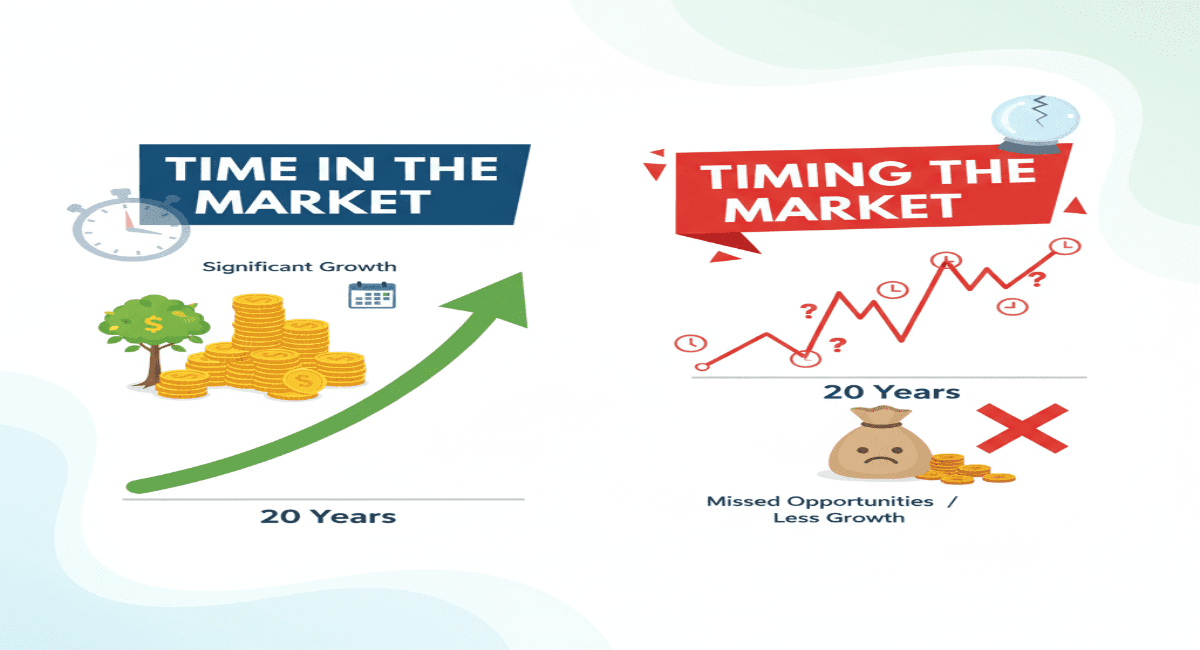
Why Time in the Market Beats Timing the Market?
Why Time in the Market Beats Timing the Market?
Time in the market versus timing the market is one of the most contentious arguments in the world of investing. In order to optimize profits, investors frequently question whether they should try to forecast short-term highs and lows or stick with their investments for the long term. Despite the allure of timing the market—buy low, sell high—even seasoned traders frequently struggle with it.
One of the most effective wealth-building tenets is the old proverb, “It’s not about timing the market, it’s about time in the market.” Long-term investing regularly performs better than attempts to outsmart market volatility, according to data. This article examines the reasons, supported by data, history, and professional opinions, that staying invested is more successful than attempting to time the market.
HSBC Cashback Credit Card 2025 – Benefits, Rewards & How to Apply?

The Main Distinction Between Timing the Market and Time in the Market
- Holding investments for years or even decades allows compound growth, dividends, and long-term positive trends to work in your advantage. This is known as “time in the market.”
- Attempting to forecast when stock prices will rise or fall and adjusting trades accordingly is known as “timing the market.” This frequently leads to greater risks and lost opportunities.
- To put it simply, timing the market involves prediction, whereas time in the market involves patience.
The Power of Compounding
Compound interest was once referred to as the “eighth wonder of the world” by Albert Einstein. Staying invested allows your money to compound over time, turning modest investments into substantial wealth.
For instance:
- If you invest $10,000 at 8% annual returns and stay invested for 30 years, your investment grows to over $100,000.
- Missing just a few of the best growth years can cut this amount in half.
This is why time, not timing, is the investor’s greatest ally.
Market Performance as Historical Evidence
Examining the history of the US stock market offers convincing proof:
- Despite pandemics, wars, recessions, and inflation, the S&P 500 has returned an average of 9–10% every year over the last century.
- The best recovery years after downturns were frequently missed by investors who attempted to time the market.
- According to a JPMorgan analysis, missing the market’s top ten days over a 20-year span decreased total returns by more than 50%.
This shows that staying invested—even during downturns—dramatically improves outcomes compared to attempting to trade in and out.
Why Market Timing Fails
- Unpredictability – Even economists and hedge funds cannot consistently predict short-term movements.
- Emotional Biases – Fear and greed cause investors to sell during crashes and buy during peaks, the exact opposite of success.
- Opportunity Cost – Sitting on the sidelines waiting for “the right time” often leads to missing rallies.
- Transaction Costs & Taxes – Frequent buying and selling increase expenses and tax liabilities, eating into profits.
In short, market timing relies on perfect predictions, which are nearly impossible.
The Battle of the Mind
Investing involves more than simply math; it also involves psychology. Although it satisfies our need for control, timing the market frequently results in emotional decisions:
- Selling during downturns out of fear.
- Purchasing out of greed during market peaks.
Long-term investors, on the other hand, keep their eyes on future growth and ignore short-term noise.
Techniques That Promote Market Time
- Investing in high-quality stocks or index funds and keeping them for years is known as the “buy and hold” strategy.
- Dollar-Cost Averaging (DCA) is the practice of consistently investing a set sum of money, independent of market fluctuations. This reduces risk and ensures steady participation.
- Diversification – Spreading investments across sectors and asset classes to reduce risk.
- Reinvestment of Dividends – Compounding grows faster when dividends are reinvested.
- Retirement Accounts (401k, IRA) – Tax-advantaged accounts encourage long-term investing
Long-Term Gains from Continued Investing
- Accumulation of Wealth: Markets have historically trended upward over decades.
- Stress Reduction: Long-term investors are less concerned about the daily fluctuations in the market.
- Reduced Costs: Taxes and fees are reduced when there are fewer trades.
- Financial Security: Retirement and generational wealth are built through steady development.
The Calculation of Missing the Greatest Moments
Think about this:
- Investor A: Makes roughly 9% yearly returns by remaining invested in the S&P 500 for 20 years.
- Investor B attempts to timing the market but misses the top ten days; as a result, returns fall to about 5% per year.
- Investor C: Returns drop to 2% or less after missing the top 20 days.
This striking disparity demonstrates why remaining invested performs better than attempting to time entry and exits.
Professional Views
- “The stock market is designed to transfer money from the active to the patient,” said Warren Buffett.
- Vanguard’s founder, John Bogle, promoted long-term index fund investing over market timing.
- The Father of Value Investing, Benjamin Graham, prioritized patience and discipline over speculation.
- Experts concur that patience is rewarded.
The Allure and the Trap of Market Timing
Why is market timing still a common strategy used by investors?
- We believe we can “outsmart” the system because of the sense of control.
- Media headlines encourage hasty decisions by igniting fear and enthusiasm.
- The idea that market timing is effective is based on the success stories of a select few fortunate traders.
In practice, market timing frequently turns into a game for gamblers rather than an investment tactic.
Retirement and Time in the Market
For retirement planning, staying invested is even more critical:
- Pension funds and retirement accounts are built on decades of compounding.
- Missing even a few years of contributions or growth can significantly reduce retirement savings.
- Those who panic-sell near retirement risk undermining a lifetime of savings.
Passive vs. Active Investing
- Passive investing (index funds, ETFs) relies on long-term participation in the market.
- Active investing often tries to time entries and exits but rarely beats the market consistently.
Most data shows that passive, long-term strategies outperform active market timing attempts.
Looking Ahead: Why This Matters in 2025
As we enter 2025, investors face uncertainty—rising interest rates, inflation pressures, global conflicts, and technological disruption. Yet history reminds us that markets adapt, recover, and grow.
The best defense against uncertainty is not frantic trading but staying invested for the long run.
Conclusion
The debate is settled: time in the market beats timing the market. Investors who stay disciplined, embrace compounding, and resist emotional decisions are the ones who achieve lasting financial success.
Whether you are building retirement savings, planning for generational wealth, or simply seeking financial security, the path is clear: patience pays.
Dollar-Cost Averaging in Down Markets: A Smart Investor’s Guide for 2025
Dollar-Cost Averaging in Down Markets: A Smart Investor’s Guide for 2025