 A K
A K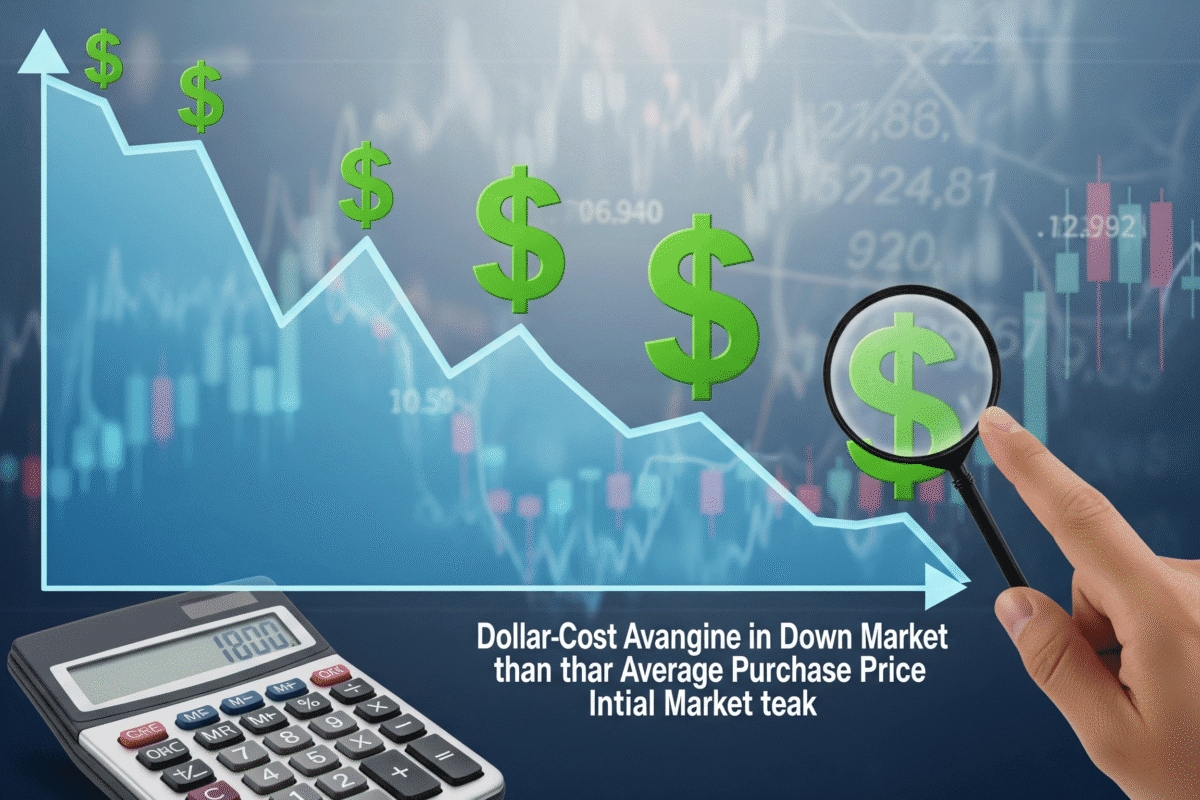
Dollar-Cost Averaging in Down Markets:
Dollar-Cost Averaging in Down Markets:
The instability of financial markets is nothing new. When markets turn red, investors everywhere frequently experience anxiety and uncertainty. Stock indexes may experience severe drops due to central bank policies, inflationary pressures, geopolitical unrest, or economic slowdowns. One issue dominates the minds of regular investors: how can I continue to invest while markets are declining?
Decades of financial study and real-world investor experience have shown that the answer frequently resides in a straightforward yet effective strategy: Dollar-Cost Averaging (DCA).
Cost in dollars Investing a certain sum of money at regular intervals, whether the market is rising or falling, is known as averaging. By using DCA, investors can reduce volatility and progressively build up assets over time, as opposed to attempting to time the market, which is a famously challenging undertaking even for seasoned professionals.
HSBC Cashback Credit Card 2025 – Benefits, Rewards & How to Apply?

What is Dollar-Cost Averaging (DCA)?
Dollar-Cost Averaging is fundamentally an investment discipline. You spread out your investments across weeks, months, or even years as opposed to making a large one-time commitment. For example, an investor might put $500 every month into an S&P 500 index fund, regardless of whether the index is soaring or crashing.
- When prices are high, the fixed investment buys fewer shares.
- When prices are low, the same amount buys more shares.
Over time, this averages out the cost per share, potentially lowering the investor’s risk of buying at market peaks.
Why Down Markets Are the Best for DCA
Investor psychology is put to the test in down markets. People frequently stop investing or sell at a loss out of fear of suffering more losses. However, history demonstrates that even though bear markets are unpleasant, recoveries always follow.
The reason Dollar-Cost Averaging does well during recessions is
Basis of Lower Average Costs
When prices are low, investors buy more shares, which lowers the average purchase price.
Relief of the Mind
Investors remain steady and steer clear of rash judgments rather than obsessing over the ideal time to enter the market.
Adding to Recovery
Cheaper equities bought during downturns yield disproportionate profits after markets recover.
Self-Control in the Face of Uncertainty
By enforcing consistency, DCA helps investors avoid the “sit on the sidelines” dilemma.
Historical Data: How DCA Has Performed
Numerous studies back DCA’s effectiveness, particularly for investors without large upfront sums.
- Morningstar Research: Showed that while lump-sum investing often yields higher returns in the long run (due to more time in the market), DCA significantly reduces downside risk and volatility.
- Vanguard Study (2020): Found that lump sum outperforms DCA about two-thirds of the time in a 10-year period, but DCA shines in bear markets, cushioning losses.
- Dalbar Behavioral Finance Reports: Suggest that DCA improves investor discipline, reducing the tendency to buy high and sell low.
DCA in 2025: Why It Still Matters
The year 2025 presents unique challenges:
- High interest rates still weigh on equity valuations.
- Global economic uncertainty from inflation, wars, and supply chain disruptions continues.
- AI-driven markets and rapid tech sector growth cause volatility spikes.
Against this backdrop, timing the market is harder than ever. DCA remains a low-stress, proven method to stay invested while avoiding emotional mistakes.
Dollar-cost averaging’s advantages
Mitigation of Risk
Prevents all money from being invested at market peaks.
Accessibility
It is suitable for frequent small-scale investors.
Emotional Discipline
Removes the temptation to “time the market.”
Long-Term Development
Profits from market recoveries, which have always happened in the past.
DCA’s disadvantages
Despite its strength, DCA is not flawless. Investors ought to think about:
Potentially Reduced Profits in Comparison to a Lump Sum
Because the money begins working sooner, lump sum investing can do better in steadily growing markets.
Needs Patience
Gains could not show up for months or even years.
Not a Protective Barrier to Losses
While DCA lowers danger, it does not completely remove it. Losses still happen if an asset performs poorly over the long run.
Is Lump Sum Better Than DCA?
The argument between lump-sum investing and dollar-cost averaging is still going strong:
- When markets are strongly trending upward, lump sum works well.
- DCA shines during periods of volatility, uncertainty, or decline.
In practice, many financial advisors recommend a hybrid approach: if you suddenly have a large sum (inheritance, bonus, sale proceeds), consider splitting it into installments over 6–12 months to balance risk and return.
DCA Across Asset Classes
Stocks
Works best with broad market indices like the S&P 500 or total market ETFs.
Cryptocurrency
Extremely volatile, making DCA a popular method for Bitcoin and Ethereum investors.
Bonds
Less common, but can smooth entry into bond markets when interest rates are fluctuating.
Real Estate REITs
Useful when property markets face downturns.
Dollar-Cost Averaging Is Timeless, in Conclusion
Consistency is preferable to perfection in the volatile world of investment. Although Dollar-Cost Averaging might not always optimize profits, it does provide something more worthwhile, such as long-term wealth accumulation, stress reduction, and discipline.
Investors who adhere to a DCA strategy will probably find themselves in a healthier financial position than those who attempted—and failed—to timing the market in 2025 as markets continue to fluctuate.
Dollar-Cost Averaging is still one of the best ways to gradually increase wealth for people looking for a dependable plan during unpredictable times, particularly during bear markets.
Is Cash Envelopes Better Than Digital Apps? A Complete 2025 Money Management Guide
Is Cash Envelopes Better Than Digital Apps? A Complete 2025 Money Management Guide