 A K
A K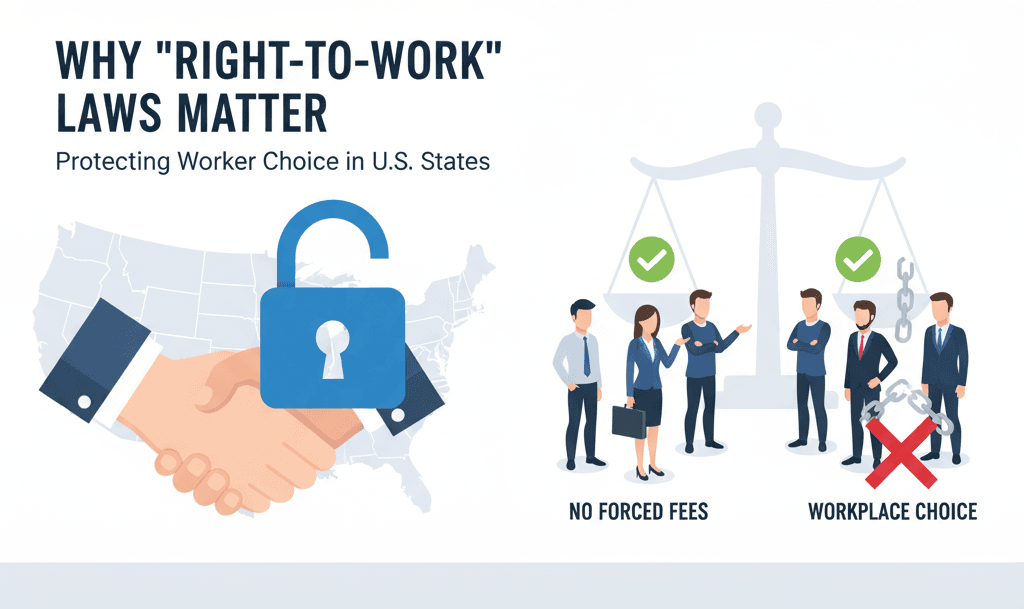
Why “Right-to-Work” Laws Matter in U.S. States?
Why “Right-to-Work” Laws Matter in U.S. States?
The phrase “right-to-work” has been crucial in discussions about labor laws, economic policies, and workers’ rights in the United States. Some contend that these laws diminish labor standards and the bargaining strength of unions, while others see them as crucial safeguards for employee freedom. Examining the history of right-to-work laws, their impact on businesses and employees, and their wider economic ramifications is necessary to comprehend why these laws are important in U.S. states.
HSBC Cashback Credit Card 2025 – Benefits, Rewards & How to Apply?

What Are Right-to-Work Laws?
Right-to-work laws are state-level statutes that prohibit mandatory union membership as a condition of employment. Simply put, employees in right-to-work states cannot be forced to join a labor union or pay union dues to secure or keep a job. These laws are legal under the Taft-Hartley Act of 1947, which allows states to pass legislation limiting union security agreements.
Currently, more than 27 states have enacted right-to-work laws, spanning across the South, Midwest, and parts of the West. The laws vary slightly by state but generally share the principle of protecting worker choice regarding union membership.
The Development of Right-to-Work Laws
The United States’ right-to-work movement began in the years following World War II. Unions grew significantly at this time, especially in industrial areas like Ohio and Michigan. But as labor union and business tensions increased, discussions about the fairness of required union membership emerged.
A watershed was reached in 1947 when the Taft-Hartley Act was passed, giving states the authority to limit mandatory union membership. In order to draw in employers and lessen the power of unions, Southern states in particular started enacting right-to-work legislation. Driven by claims that these rules safeguard individual worker freedoms and foster economic progress, the movement eventually spread to other areas.
The Importance of Right-to-Work Laws for Employees
Right-to-work advocates contend that these laws are essentially about the freedom and rights of employees. Important points consist of:
- Freedom of Choice: Employees cannot be forced to pay dues or join a union against their will. This guarantees that workers are not compelled to financially support groups they may not agree with and safeguards individual liberty.
- Workplace Flexibility: More flexible employment arrangements may result from right-to-work laws. Direct negotiations between employees and employers are possible without the need for union intervention.
- Opportunities for Employment: Advocates assert that right-to-work states frequently draw more companies, which could result in increased employment rates and more choices for job searchers.
Right-to-Work Laws’ Effects on the Economy
Right-to-work legislation’ effects on the economy are a hotly debated topic. Different viewpoints are frequently offered by economists, legislators, and corporate executives:
- Business Investment and Job Creation: Because labor expenses may be lower and union discussions are less mandatory, many firms find right-to-work states more appealing. Increased investment, the opening of factories, and the creation of jobs may result from this.
- Wage Growth Debate: According to critics, right-to-work states typically have lower wages than non-right-to-work states. According to studies, being a member of a union is frequently associated with better average salaries, and weakening unions may result in less collective bargaining power.
Political and Social Dimensions
Right-to-work laws are not just economic instruments—they are highly political and socially influential.
- Partisan Perspectives: Generally, Republican-led states are more likely to enact right-to-work laws, promoting free-market principles and individual worker choice. Democratic-leaning states often resist these laws, emphasizing collective bargaining rights and stronger labor protections.
- Union Strength: Right-to-work laws can weaken unions’ ability to organize and advocate for workers. This has social implications, including shifts in political representation, workplace policies, and access to benefits negotiated by unions.
- Cultural Considerations: In some regions, right-to-work laws reflect cultural attitudes toward unions, self-reliance, and economic independence. These laws resonate strongly in areas where union influence is traditionally low or where the economy relies heavily on attracting external investment.
In conclusion: Why “Right-to-Work” Laws Matter in U.S. States?
A major component of American labor policy, right-to-work laws affect how worker freedom, union power, and economic competitiveness are balanced. They are important because they influence a state’s overall economic climate, the locations of firms, and how workers interact with unions. These laws present issues with salaries, benefits, and collective bargaining even though they provide individual workers more options and may benefit states economically.
Understanding the ramifications of right-to-work laws is crucial for legislators, corporate executives, and employees alike as the US continues to negotiate complicated labor and economic challenges. These laws continue to be an essential component of the United States, whether they are seen as a tool for economic expansion or as a challenge to organized labor.
The Economics of Sports Stadium Financing: Public Costs, Private Gains, and Economic Impact
The Economics of Sports Stadium Financing: Public Costs, Private Gains, and Economic Impact