 A K
A K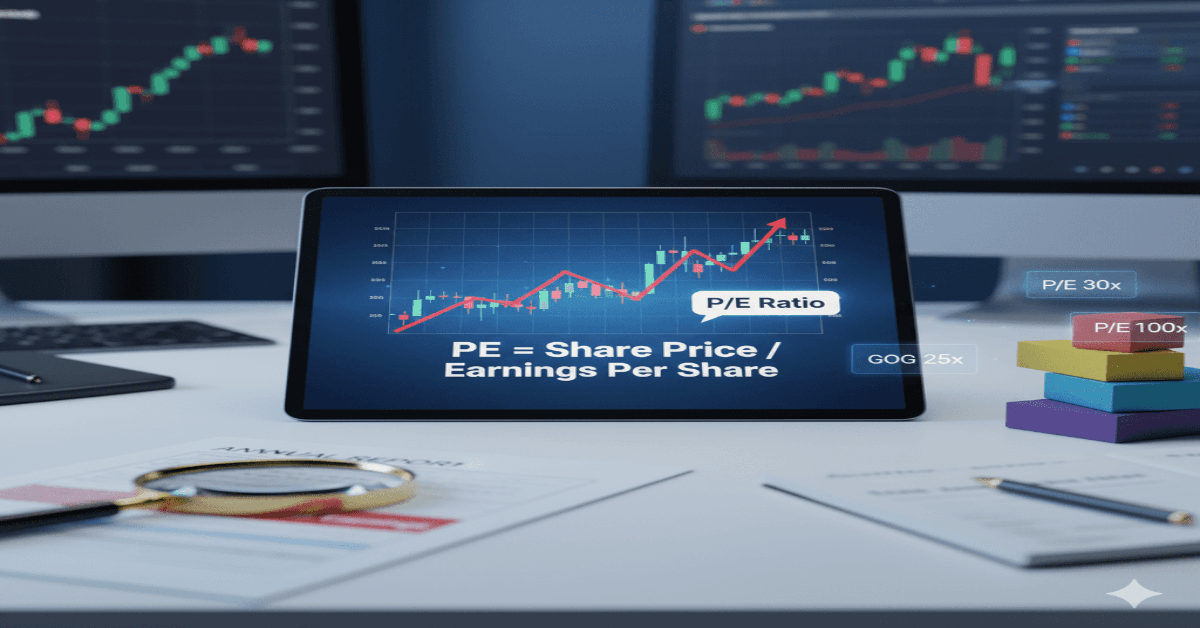
Why Investors Should Care About P/E Ratios in 2025?
Why Investors Should Care About P/E Ratios in 2025?
Although the stock market is a game of numbers, not all numbers are created equal. The Price-to-Earnings ratio (P/E ratio) is one of the most talked-about measures that investors use. It can be found on brokerage dashboards, firm earnings reports, and financial news tickers. Beyond the technicalities, however, the P/E ratio is among the most effective instruments for determining whether a company is cheap, expensive, or overvalued.
Understanding P/E ratios is more important than ever in 2025 as global markets deal with inflation, shifting interest rates, and unexpected corporate results. Knowing how to interpret this indicator gives investors a greater advantage in identifying opportunities and avoiding expensive errors.
HSBC Cashback Credit Card 2025 – Benefits, Rewards & How to Apply?

What is the P/E Ratio?
At its core, the P/E ratio is simple:
P/E Ratio = Stock Price / Earnings per Share (EPS)
If a company’s stock price is $100 and it earns $5 per share annually, its P/E ratio is 20.
That means investors are willing to pay $20 for every $1 of earnings.
On the surface, the calculation looks basic. But the interpretation is where the magic—and the risks—lie.
The Significance of Investors
An indicator of valuation
The P/E ratio helps investors gauge if a stock is trading at a fair value compared to its earnings power.
- A high P/E ratio indicates overvaluation, optimism, or growth expectations.
- Low P/E → may signal undervaluation or underlying risks.
Market Sentiment Barometer
The ratio reflects how much confidence investors collectively have in a company’s future. A soaring P/E often means investors are betting on future growth, while a depressed P/E signals caution.
Comparative Benchmark
Investors use P/E ratios to compare companies within the same industry. A tech stock with a P/E of 35 might look attractive if rivals trade at 50, but expensive if the sector average is 20.
Historical Background: Market Cycles and P/E Ratios
History provides the clearest explanation of the significance of P/E ratios:
- Dot-Com Bubble (Late 1990s): Tech firms, frequently without profits to support them, skyrocketed with P/E ratios exceeding 100. In 2000, the bubble popped.
- 2008 Financial Crisis: As investor confidence disappeared and earnings plummeted, P/E ratios fell precipitously.
- The post-pandemic rally (2020–2021) was driven by extremely low interest rates, which caused valuations to soar. Ten years ago, the P/E ratios of companies such as Tesla and Amazon would have sounded ridiculous.
Investors face a complex landscape as 2025 approaches, including uncertainties surrounding Federal Reserve rate policy, pressure from inflation in some industries, and earnings resiliency in others. P/E analysis is essential because of all these considerations.
Different P/E Ratio Types
P/E ratios are not all made equal. Investors ought to be aware of the differences:
P/E Trailing (TTM)
- Based on earnings during the last 12 months.
- Demonstrates the stock’s valuation in relation to its actual performance.
P/E forward
- Makes use of analyst projections for the upcoming year.
- It is more speculative since it reflects expectations.
P/E (CAPE Ratio) Shiller
- Adjusted price-to-earnings ratio on a cyclical basis.
- Averages earnings over a ten-year period adjusted for inflation.
- Well-liked for long-term market appraisal.
For an accurate analysis, it is essential to know which P/E is being mentioned.
How P/E Ratios Are Used by Investors to Make Decisions
Screening of Stocks
Frequently, investors set filters:
- Find possible value stocks by using the phrase “Show me companies with a P/E below 15” →.
- “Focus on P/E above 25” => to focus on increasing businesses.
Comparative Appraisal
Determining if a firm is cheap or expensive can be done by comparing its P/E to that of its peers in the industry.
Evaluation of Risk
Sometimes an extremely low P/E portends problems. For example, the market lowers a company’s stock price, lowering the P/E, if it is facing regulatory challenges, lawsuits, or dwindling revenues.
The Limitations of P/E Ratios
While powerful, the P/E ratio is not flawless:
Earnings Manipulation
Companies can use accounting tricks to boost earnings, distorting the denominator.
No Growth Consideration
A stock with a low P/E might look cheap, but without growth, it could be a value trap.
Sector Differences
Comparing a tech company’s P/E with a utility’s P/E is misleading because their business models differ drastically.
Macro Impact
Inflation, interest rates, and economic cycles affect P/E levels across the board.
Interest Rates and P/E Ratios: The Inverse Dance
The correlation between interest rates and P/E ratios is among the most significant.
- Higher P/E ratios result from investors being prepared to pay more for future earnings when interest rates are low.
- P/E ratios often decrease as interest rates rise because borrowing becomes more expensive and risk-free rewards become more alluring.
This dance will influence Wall Street valuations as the Fed manages monetary policy in 2025.
Global View: How P/E Is Seen in Other Markets
- U.S. Market: Historically higher P/Es due to innovation and strong corporate earnings.
- Europe: More conservative valuations, often reflecting slower growth.
- Emerging Markets: P/E ratios can be volatile, reflecting political risk, currency fluctuations, and growth potential.
Techniques for Investors
Value Investing with P/E
- Seek out businesses that are trading below industry or historical averages.
- Combine with other metrics like Price-to-Book (P/B) and Dividend Yield.
Growth Investing with P/E
- Accept higher P/Es for companies with robust future earnings potential.
- Focus on industries with secular growth like AI, renewable energy, and biotech.
Blended Approach
- Many investors use P/E ratios alongside tools like PEG ratio (Price/Earnings to Growth), which adjusts P/E for growth expectations.
Conclusion: The Significance of P/E Ratios
Despite being a straightforward formula, the P/E ratio encapsulates investor emotion, growth expectations, and valuation.
Investors cannot afford to ignore this indicator in 2025 as markets deal with shifting industries, shifting monetary policy, and geopolitical concerns. Knowing P/E ratios can make the difference between seeing an opportunity and getting caught in a trap, regardless of whether you are a short-term trader or a long-term value investor.
For both Wall Street and Main Street investors, the P/E ratio is more than simply a figure; it tells a story about the potential direction of a firm and the market.
How to Identify Your Financial Triggers: A Complete Guide to Smarter Money Habits
How to Identify Your Financial Triggers: A Complete Guide to Smarter Money Habits