 A K
A K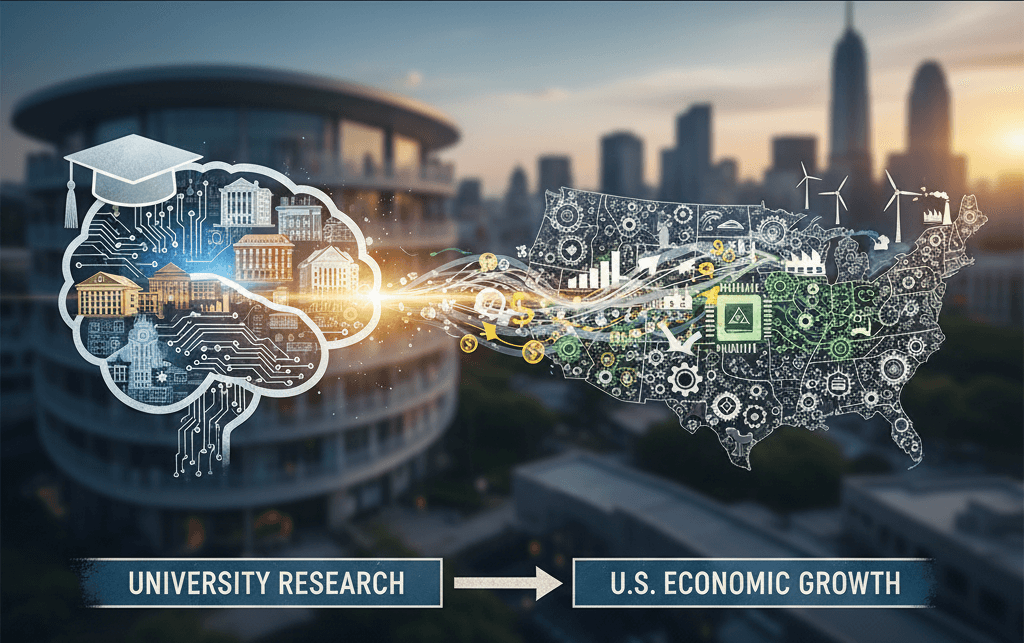
The Role of University Research in Driving U.S.
The Role of University Research in Driving U.S.
The United States has long been seen as a global leader in economic dynamism, creativity, and technical advancement. The substantial research carried out in American colleges is one of the main forces behind this leadership. University research is essential for promoting economic growth, generating jobs, and preserving national competitiveness, from ground-breaking scientific discoveries to innovative technology commercialization.
HSBC Cashback Credit Card 2025 – Benefits, Rewards & How to Apply?

The Historical Context of University Research in the U.S.
American history is deeply ingrained in university scholarship. For many years, universities like Harvard, MIT, Stanford, and the University of California system have been at the forefront of scientific advancement.
Universities played a major role in government-funded research during the 20th century, particularly during the Cold War when advancements in computing, aerospace, and military were crucial. Universities have been able to act as incubators for applied technology and knowledge production because to programs like the National Science Foundation (NSF) and funds from the Department of Defense (DoD).
Research at Universities as a Spark for Innovation
Universities are the main engines of innovation, which is the lifeblood of economic prosperity. Innovation is fueled by academic research in a number of ways:
- Basic Research: Fundamental research that advances human knowledge but has no direct commercial applicability is frequently the focus of universities. Even while this study might not make money right away, it lays the intellectual groundwork for upcoming inventions. For example, MIT’s early computer science research produced the hardware and techniques that support modern computers.
- Applied Research: University-based applied research focuses on particular business issues. Patents, prototypes, and commercially viable techniques are frequently the outcome of this study. By bridging the gap between lab discoveries and commercially viable products, applied research boosts economic activity.
Economic Impacts of University Research
University research significantly contributes to economic growth through multiple channels:
- Job Creation: Research activities at universities generate employment not only for academic staff but also for research assistants, technicians, and administrative personnel. Furthermore, startups emerging from university research create new jobs in the private sector. The biotech and IT sectors, in particular, owe much of their workforce growth to university research outputs.
- Attracting Investment: Cutting-edge research attracts private investment in the form of venture capital, partnerships, and industry-funded research projects. Cities with prominent research universities often see higher levels of economic activity and innovation clusters, such as Silicon Valley near Stanford University.
STEM Research: Driving the Knowledge Economy
Science, technology, engineering, and mathematics (STEM) research is a critical component of university-driven economic growth. Investments in STEM fields not only advance knowledge but also support high-paying jobs, industrial innovation, and global leadership.
For example, research in biotechnology has led to novel treatments, vaccines, and diagnostics, creating an entire industry that contributes billions to the U.S. economy. Similarly, advances in computer science and AI research at universities have propelled sectors ranging from cloud computing to autonomous vehicles. The continuous flow of knowledge from academic labs into industries underscores the interdependence between higher education and economic growth.
Government Funding and Policy Support
Government investment in university research is a cornerstone of the U.S. innovation ecosystem. Federal agencies such as the NSF, National Institutes of Health (NIH), Department of Energy (DoE), and the Department of Defense provide billions of dollars annually in grants. These funds support both basic and applied research, infrastructure development, and collaborative projects with industry partners.
Policies such as the Bayh-Dole Act of 1980 further incentivized universities to commercialize federally funded research. By allowing institutions to retain intellectual property rights, the law spurred a surge in university spin-offs, patents, and technology licensing deals, directly contributing to economic growth.
In conclusion: The Role of University Research in Driving U.S.
University research is far more than an academic pursuit—it is a vital engine of U.S. economic growth. Through innovation, job creation, technology commercialization, and industry collaboration, universities contribute directly to national prosperity. From pioneering breakthroughs in STEM fields to fostering entrepreneurial ecosystems, the impact of academic research resonates across industries and regions.
Sustained investment in university research, coupled with effective policy support and strong university-industry collaboration, is essential for maintaining U.S. competitiveness in the global knowledge economy. In essence, American universities are not just centers of learning—they are critical catalysts for innovation, economic growth, and the creation of a prosperous future.