 A K
A K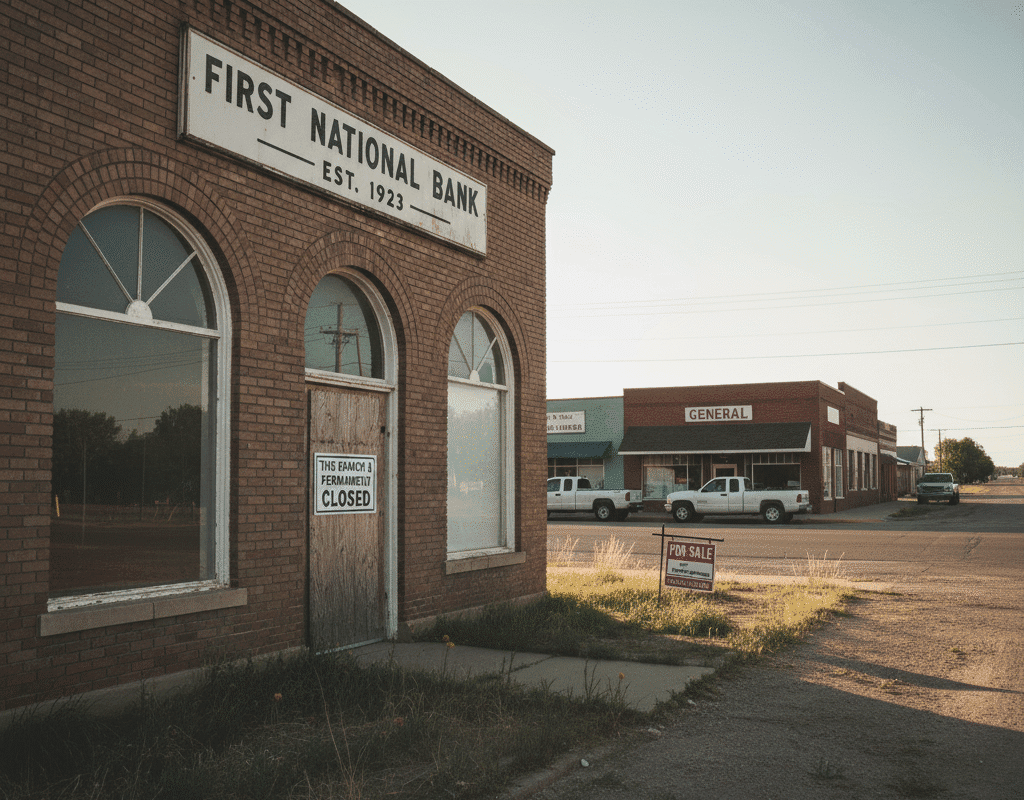
The Impact of Bank Branch Closures on Rural America:
The Impact of Bank Branch Closures on Rural America:
Bank branch closures have accelerated across the United States over the past decade, reshaping the financial landscape for millions of Americans. But nowhere are these changes felt more profoundly than in rural communities, where the presence of a local bank has traditionally been far more than just a place for deposits and withdrawals. In small towns across the country, banks have long served as a cornerstone of economic vitality—providing credit to farmers, supporting local businesses, sponsoring community events, and offering personalized customer service built on decades of trust.
HSBC Cashback Credit Card 2025 – Benefits, Rewards & How to Apply?

A Deeply Rooted and Growing Trend
The incidence of bank closures has increased dramatically in recent years, despite the fact that banks nationwide have been consolidating for decades. In favor of internet infrastructure and automated services, larger banks have combined, absorbed rivals, and simplified physical branch networks. The shift is frequently smooth for people who live in cities and suburbs and have high-speed internet. But for rural Americans—many of whom still lack reliable broadband or prefer in-person banking—the shift has created enormous challenges.
Industry analysts point to several key factors driving the closures:
Digital Banking Adoption
Online banking platforms have become the norm for many Americans. Mobile deposits, automated bill pay, and chat-based support have all reduced the need for physical branches.
Industry Consolidation
Mergers and acquisitions have resulted in fewer banks overall, and newly merged institutions often eliminate redundant locations. Rural branches, which generate lower revenue, are frequently the first to go.
Declining Rural Populations
Many rural communities have experienced population loss over the past several decades. Shrinking customer bases translate to fewer deposits and limited growth potential, making rural branches less attractive for banks seeking higher returns.
Rural Areas Turn Into “Banking Deserts”
The term “banking desert” refers to a region lacking bank branches within a reasonable distance, often forcing residents to travel long distances for basic services. As of recent years, hundreds of rural counties across the United States have become banking deserts or are at risk of becoming one.
For residents, closures are not simply an inconvenience. They represent a fundamental shift in the accessibility of key financial services that underpin daily life and broader economic stability.
Longer Travel Times
When a rural branch shuts down, customers often must drive 20, 40, or even 60 miles to find the next nearest location. For seniors, low-income families, and individuals without reliable transportation, this distance can be prohibitive.
Restricted Cash Access
In-person withdrawals, depositing cash, and obtaining certified checks or money orders become significantly more difficult. While ATMs can handle some tasks, they cannot replace the full range of services offered by a staffed branch.
Loss of Personal Relationships
For decades, rural banking has been built on relationships. Local bankers know their customers personally—understanding their history, creditworthiness, and community ties. The shift to distant and digital systems fractures these relationships.
Community Reactions: Regional Remedies with National Consequences
Across the United States, rural communities have begun developing creative solutions to the banking crisis.
Mobile Banking Units
Some banks and credit unions deploy mobile units—essentially “bank branches on wheels”—to bring services to underserved towns on weekly or monthly schedules.
Shared Banking Spaces
In areas where multiple banks have closed branches, local governments or nonprofits have considered establishing shared customer service centers staffed by rotating financial institutions.
Cooperative Lending Circles
Communities have revived local lending circles or cooperative loan programs to fill gaps in access to credit.
Final Thoughts: The Impact of Bank Branch Closures on Rural America
Closing bank branches is more than just a change in the financial sector. They reflect—and reinforce—a broader divergence between urban and rural America. As banks consolidate and digital banking becomes the norm, millions of rural residents face diminishing access to vital financial services that support household stability, business growth, and community resilience.
For rural America to thrive, policymakers, financial institutions, and local leaders must work together to ensure that every resident—regardless of geography—has access to safe, reliable, and affordable banking services.
The Fiscal Cost of U.S. Border Enforcement Policies: An In-Depth Analysis
The Fiscal Cost of U.S. Border Enforcement Policies: An In-Depth Analysis