 A K
A K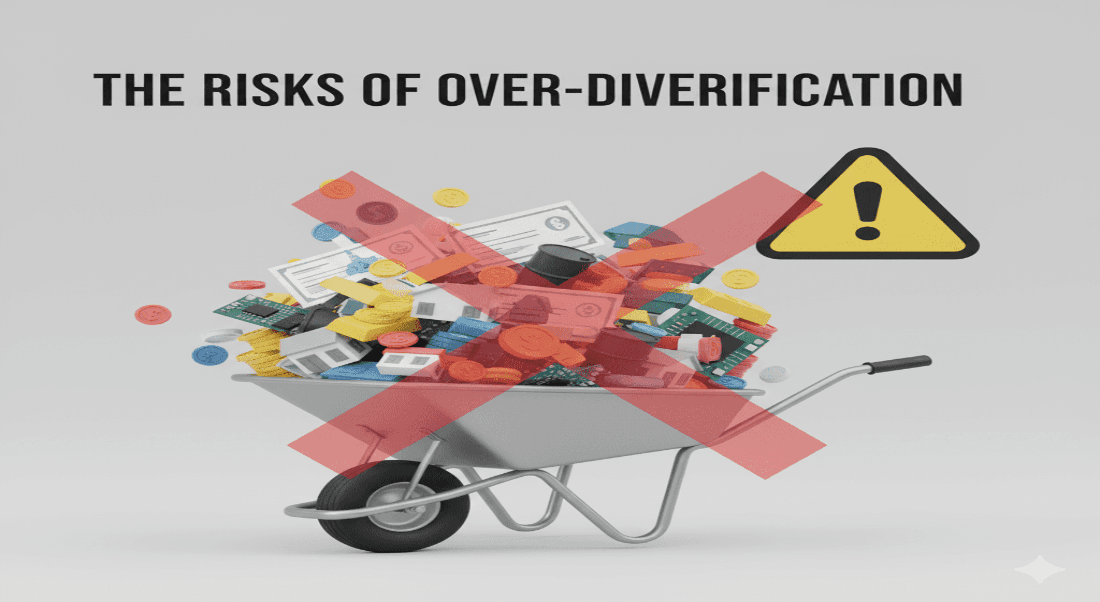
The Hidden Risks of Over-Diversification:
The Hidden Risks of Over-Diversification:
Diversification is frequently referred to as the “golden rule” of risk control in the investment industry. The concept is straightforward: you may lessen the effect of a single poor investment on your entire portfolio by distributing your investments throughout several assets, sectors, and geographical areas. Financial experts have advocated diversification as a hedge against market volatility for decades.
However, what occurs if diversification is overdone? Can too much diversification actually make an investor’s portfolio weaker? Many financial gurus strongly believe that the answer is yes.
When investors spread themselves so thin across too many investments that the potential benefits of diversification vanish, this is known as over-diversification, or “diworsification.” They wind up diluting earnings, raising expenses, and losing sight of their overarching strategy rather than safeguarding their riches.
HSBC Cashback Credit Card 2025 – Benefits, Rewards & How to Apply?

Over-Diversification: What Is It?
Fundamentally, diversification is about finding equilibrium. Avoiding allocating all of your funds to a single stock, bond, or asset class is the goal. U.S. stocks, foreign stocks, bonds, real estate, and even alternative assets like commodities could all be included in a well-diversified portfolio.
However, when investors overextend their holdings, over-diversification occurs. They wind up with hundreds of positions, many of which overlap or cancel each other out, rather than a carefully curated mix of 20 to 30 equities or a few mutual funds.
For instance:
- Ten distinct S&P 500 index funds are purchased by an investor who is unaware that they all follow the same companies.
- Dozens of mutual funds with comparable stock holdings and management costs make up a portfolio.
- An excessive number of minor stakes in businesses that have no discernible effect on total returns are held by retirement investors.
To put it briefly, excessive diversification reduces efficiency and makes it more difficult to beat the market.
Why Do Investors Diversify Too Much?
The tendency for investors to own “too much of everything” can be attributed to a number of factors.
FOMO, or the fear of missing out
Many investors get in when a new asset class, such as cryptocurrencies, stocks related to artificial intelligence, or global emerging markets, attracts interest. Portfolios get overloaded with overlapping yet trendy investments over time.
Excessive faith in “More is Better”
Many investors think that risk is immediately decreased by having more assets. This is somewhat accurate, however after a certain number of assets, the benefits of diversification in lowering risk plateau. Beyond that, the additional holdings just make things more complicated.
Guidance from Various Sources
Investors may amass dozens of overlapping funds and equities without recognizing how redundant they are if they follow financial media, change advisors, or follow stock advice.
Lack of Portfolio Oversight
Without regular rebalancing, portfolios become cluttered. Old positions remain while new ones are added, creating an inefficient mix that lacks clear direction.
The Dangers of Excessive Diversification
Let’s now look at the actual risks associated with dispersing investments too widely.
Diluted Profits
Diluted performance is the largest risk associated with over-diversification.
Gains from a few high-performing businesses can greatly increase the size of your portfolio. However, the impact of a single winner is insignificant when investments are dispersed across hundreds of stocks.
For instance, the advantage hardly makes a difference if Apple stock rises but only accounts for 0.5% of your portfolio.
Increased Prices and Charges
There are usually expense ratios, trading costs, or management fees associated with each extra mutual fund or exchange-traded fund (ETF). Fees increase with the number of funds you own, even if many of them own the same underlying assets.
Long-term wealth can be eroded by this fee drag, particularly in retirement funds.
Overlap of Portfolios
Having too many funds frequently results in holdings that are duplicated. For instance, three distinct index funds might all make significant investments in the same leading corporations, such as Amazon, Microsoft, and Apple.
Because of this overlap, the portfolio is not as broad as it seems, which lessens the intended benefit of diversification.
Difficulty in Managing and Tracking
A cluttered portfolio is harder to manage. Investors may lose sight of performance, risk exposure, or even forget why they purchased certain holdings in the first place.
Over time, this lack of clarity can result in poor decision-making, especially during market downturns.
Reduced Ability to Outperform the Market
Ironically, the more an investor diversifies, the more their returns mirror the market average. In extreme cases, portfolios perform no better than a basic index fund—yet cost more in fees and complexity.
Lower Conviction in Investments
With too many positions, investors struggle to maintain conviction in their choices. Instead of carefully monitoring a handful of high-quality stocks, they spread their attention thinly, often missing key market signals.
How Much Diversification Is Enough?
The million-dollar question: Where’s the sweet spot between diversification and over-diversification?
Research suggests:
- 20 to 30 stocks across different industries provide most of the diversification benefits an investor needs.
- A mix of asset classes (stocks, bonds, real estate, etc.) balances risk and return.
- For most investors, 3 to 5 ETFs or mutual funds are sufficient to cover global markets.
Anything beyond this usually results in diminishing returns.
Ways to Prevent Excessive Diversification
Investors should adhere to the following best practices to avoid diworsification:
- Establish a Clear Investment Strategy: Prior to adding new assets, determine your objectives, time horizon, and risk tolerance.
- Limit the Number of Holdings – Avoid owning more than 25–30 individual stocks or more than 5–7 funds.
- Check for Overlap: Make sure funds aren’t holding duplicate assets by using portfolio analysis tools.
- Prioritize Quality Over Quantity: Select assets with strong confidence that complement your plan.
- Rebalance Frequently: Evaluate your portfolio once a year to eliminate any investments that are superfluous or duplicate.
- Keep Costs in Mind – Always factor in fees and expenses before adding new investments.
The Role of Behavioral Finance
Behavioral finance research shows that many investors over-diversify due to psychological biases.
- Loss Aversion: Fear of losing money drives investors to own “a little bit of everything.”
- Overconfidence: Belief that they can spot every opportunity leads to portfolio clutter.
- Herd Mentality: Copying trends and advice from multiple sources results in overlapping investments.
Understanding these biases can help investors make more rational decisions and resist the urge to over-diversify.
The Bottom Line
One of the pillars of wise investment is still diversification. It helps investors withstand market volatility, balances rewards, and lowers risk. However, it can be overdone, just like any other tactic.
There is danger in over-diversification. It can lead to confusion, raise expenses, and deteriorate performance. Finding the sweet spot—enough diversification to lower risk without sacrificing possible gains—is crucial.
The answer is straightforward for the majority of investors: maintain discipline, eliminate duplication, and assemble a well-balanced portfolio of superior assets. Sometimes, when it comes to investing, less really is more.
The Psychology Behind Shopping Sprees: Why We Overspend and How to Stop
The Psychology Behind Shopping Sprees: Why We Overspend and How to Stop