 A K
A K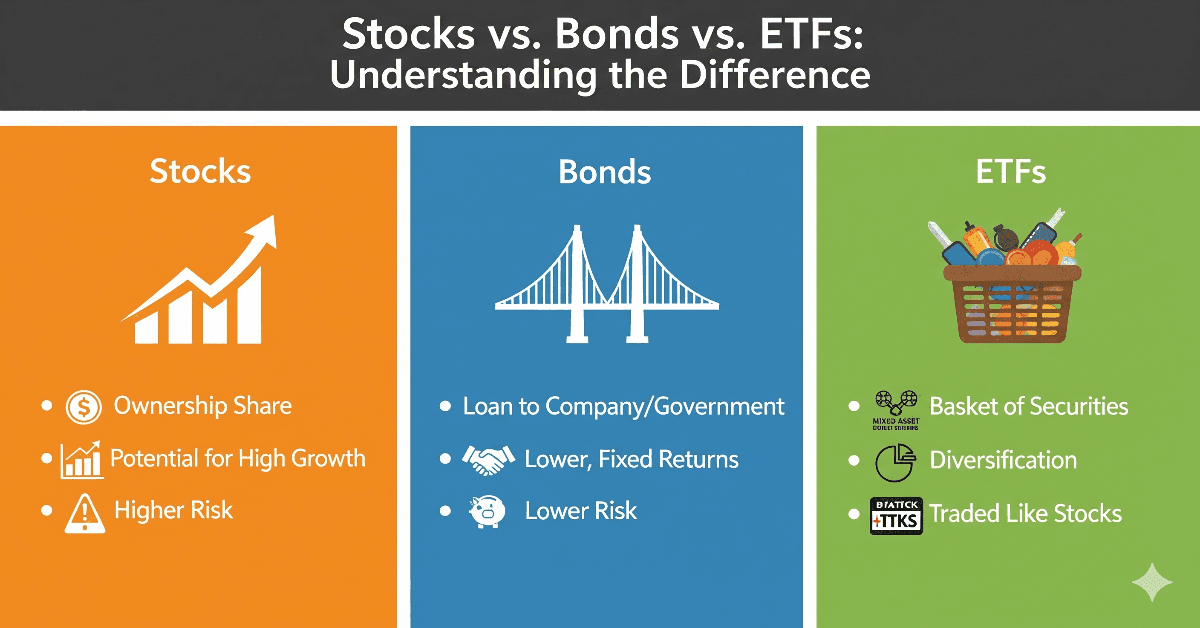
The Difference Between Stocks, Bonds, and ETFs:
The Difference Between Stocks, Bonds, and ETFs:
People are increasingly searching for strategies to increase their wealth, safeguard their retirement, and establish financial stability in the fast-paced financial markets of today. When it comes to investing, stocks, bonds, and exchange-traded funds (ETFs) are the three most popular options. These investment vehicles are appropriate for a variety of investor types because to their distinct features, risks, and advantages.
This article breaks down the differences between stocks, bonds, and ETFs in detail, providing insights into how they work, their advantages and disadvantages, and which option might align with your financial goals.
HSBC Cashback Credit Card 2025 – Benefits, Rewards & How to Apply?

Stocks: What Are They?
Ownership in a firm is represented by its stocks. In essence, you are buying a piece of that business when you buy stock. You could profit from the company’s expansion as a stakeholder through increased dividends and stock prices.
How Stocks Operate
- Ownership: Purchasing stock entitles you to a portion of the business.
- Profits: Investors make returns in two ways:
- A rise in the stock price is known as capital appreciation.
- Some businesses pay their shareholders dividends.
- Voting rights: Through voting, shareholders frequently have a role in business decisions.
Benefits of Stock Investing
- high potential for profit.
- liquidity, or the ease of buying and selling.
- ownership interest in a business.
Drawbacks of Stock Investing
- high risk and volatility.
- No returns are assured.
- susceptible to downturns in the economy and markets.
Bonds: What Are They?
Bonds are a type of debt instrument. By buying a bond, you are lending money to a corporation, government, or municipality in return for regular interest payments and principal payback when the bond matures.
The Function of Bonds
- Lender relationship: The bond issuer views investors as creditors.
- Interest payments: The coupon rate, or fixed interest, is paid to bondholders.
- Maturity date: The issuer pays back the principal amount of the bond at the conclusion of its tenure.
Bond Investing Benefits
- less hazardous than stocks.
- consistent revenue from interest payments.
- can serve as a buffer against fluctuations in the stock market.
Cons of Bond Investing
- less than stock returns.
- sensitive to shifts in interest rates.
- default risk (for municipal or corporate obligations).
ETFs: What Are They?
Like individual stocks, exchange-traded funds (ETFs) are investment vehicles that trade on stock exchanges. ETFs are a popular option for investors looking for wide market exposure because they usually hold a diverse portfolio of stocks, bonds, commodities, or other assets.
The Operation of ETFs
- Asset basket: ETFs follow sectors, asset classes, or indexes.
- Trading flexibility: Like stocks, ETFs can be bought and sold throughout the trading day.
- Diversification: A single ETF can give exposure to hundreds of securities.
Pros of Investing in ETFs
- Diversification with one purchase.
- Lower expense ratios than mutual funds.
- Flexibility to trade like stocks.
- Transparency in holdings.
Cons of Investing in ETFs
- Some ETFs have low liquidity.
- Returns depend on market performance.
- May involve trading fees.
Key Differences Between Stocks, Bonds, and ETFs
| Feature | Stocks | Bonds | ETFs |
| Type of Investment | Ownership in a company | Loan to issuer | Collection of assets |
| Risk Level | High | Low to medium | Moderate (depends on holdings) |
| Return Potential | High | Lower, stable | Moderate to high |
| Liquidity | High | Medium | High |
| Income Source | Dividends & price growth | Interest payments | Price appreciation & dividends |
| Diversification | Limited (single company) | Limited (issuer-specific) | High (multiple assets) |
Which Is Better for You: Stocks, Bonds, or ETFs?
- Your time horizon, investing objectives, and risk tolerance all play a role in your decision between stocks, bonds, and exchange-traded funds (ETFs).
- Stocks can be the best option if you can tolerate risk and are looking for rapid development.
- Bonds are a better option if you value stability and consistent income.
- If you’re looking for flexibility and diversity, ETFs offer a balance between equities and bonds.
Stock, bond, and ETF examples
Stocks: Tesla (TSLA), Microsoft (MSFT), and Apple (AAPL).
Bonds: corporate, municipal, and U.S. Treasury bonds.
ETFs include Vanguard Total Stock Market ETF (VTI), iShares Core U.S. Aggregate Bond ETF (AGG), and SPDR S&P 500 ETF (SPY).
Comparison of Risk and Reward
Stocks: The greatest return, the greatest risk. Perfect for sustained expansion.
Bonds: Consistent, lower risk, but lower returns. good for stability and income.
ETFs: Integrated diversification with a balanced risk-return profile.
How to Create a Portfolio That Is Balanced
A diversified portfolio including a range of stocks, bonds, and exchange-traded funds (ETFs) is advised by the majority of financial advisors. Your age, financial objectives, and risk tolerance all influence the allocation.
Allocation Strategies in Example
10% of bonds, 20% of ETFs, and 70% of stocks are held by young investors with high risk tolerance.
Investors in their middle years (moderate risk tolerance): 20% bonds, 30% ETFs, and 50% stocks.
50% bonds, 30% ETFs, and 20% equities are appropriate for retirees with low risk tolerance.
Tax-Related Issues
Stocks: Dividend taxes and capital gains tax on profits.
Bonds: Interest income is frequently subject to taxes, with the possible exception of municipal bonds.
Although ETFs have a tax-efficient structure, profits are still subject to taxes upon sale.
Typical Myths Regarding ETFs, Bonds, and Stocks
“Investing in stocks is always preferable to bonds.”
– Not true. Bonds can outperform stocks during recessions.
“ETFs are risk-free.”
– False. ETFs carry market risk since they track indexes or sectors.
“Bonds are always safe.”
– Corporate and junk bonds can default. Only U.S. Treasuries are considered virtually risk-free.
United States Current Trends (2025 Outlook)
Stocks: Despite significant market volatility, American tech businesses remain dominant.
Bonds: As interest rates level off, risk-averse investors are drawn to Treasury yields.
ETFs: With trillions of assets managed, passive investment is becoming more and more popular.
In conclusion
Anyone interested in investing must comprehend the distinctions between stocks, bonds, and exchange-traded funds (ETFs). Bonds offer stability, ETFs offer diversity, and stocks offer rapid growth. A balanced portfolio often includes a mix of all three, tailored to your individual goals and risk tolerance.
By making informed decisions, investors can maximize returns, minimize risks, and achieve long-term financial success.
How to Rebuild Credit After Bankruptcy in 2025: Expert Guide for Financial Recovery
How to Rebuild Credit After Bankruptcy in 2025: Expert Guide for Financial Recovery