 A K
A K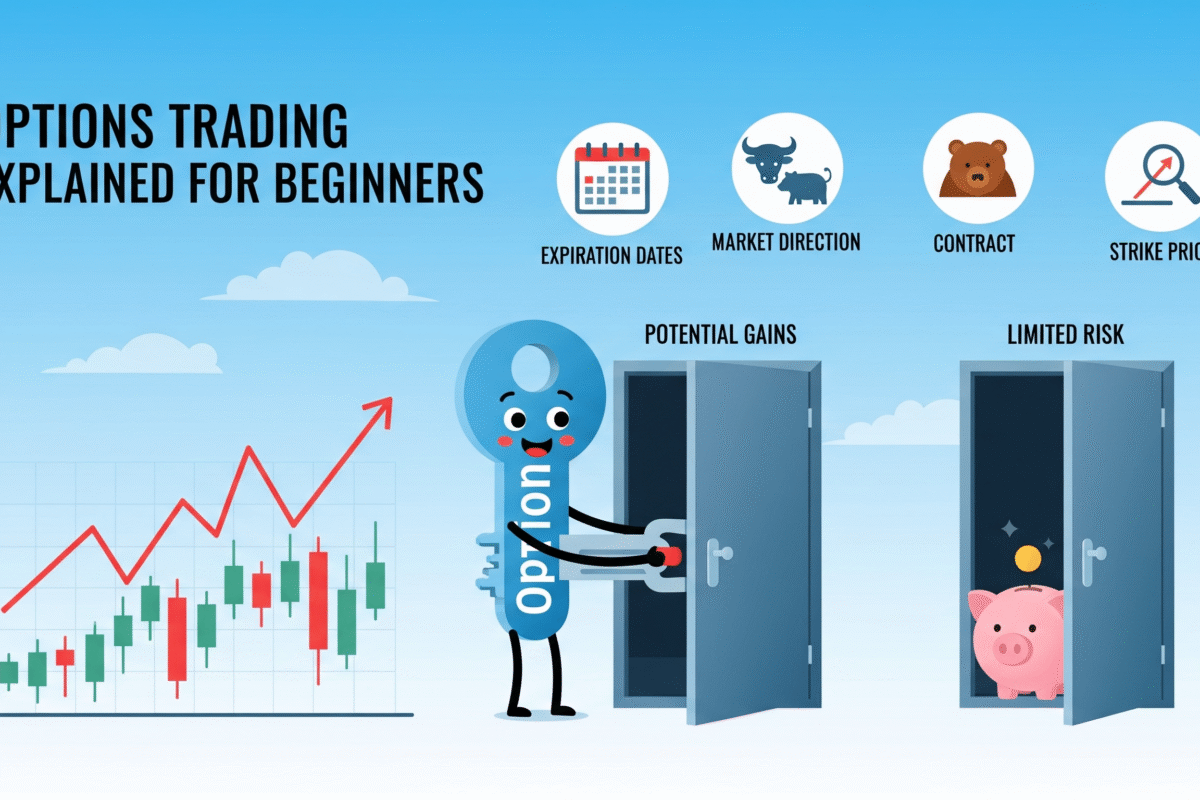
Options Trading Explained for Beginners:
Options Trading Explained for Beginners:
The investment industry is changing quickly, and more American ordinary investors than ever before are getting involved in options trading. The options market is one of the stock market’s fastest-growing divisions because platforms like Robinhood, E*TRADE, and TD Ameritrade make trading accessible to the general public.
In reality, millions of new traders entered the market in 2024, and the volume of options contracts traded in the United States hit all-time highs, according to the Options Clearing Corporation (OCC). However, options can be difficult for novices to grasp because they are full of technical terms like “calls,” “puts,” “strike price,” and “expiration date.”
This beginner’s guide breaks down options trading in simple terms, covering the basics, benefits, risks, and strategies to help you navigate this exciting yet complex world in 2025.
HSBC Cashback Credit Card 2025 – Benefits, Rewards & How to Apply?

What is Options Trading?
One kind of financial derivative is an option, whose value is determined by an underlying asset, typically a stock. Instead of owning the stock itself, options give you the right (but not the obligation) to buy or sell a stock at a predetermined price before a specific date.
Two primary categories of alternatives exist:
- Call Option → The right to buy a stock at a fixed price.
- Put Option → The right to sell a stock at a fixed price.
Options are flexible tools that traders use for speculation, hedging, and income generation.
Why Do People Trade Options?
Options attract investors for several reasons:
- Leverage – You can control 100 shares of stock with just one option contract at a fraction of the cost.
- Hedging – Protect existing investments against losses.
- Income – Selling options can generate consistent income.
- Flexibility – Options allow for strategies in rising, falling, or sideways markets.
However, with high reward potential comes high risk. Beginners must understand the risks before diving in.
Important Words Every Novice Should Understand
Learn the following terms before making your first options trade:
- The price at which you can purchase or sell the shares is known as the strike price.
- The date on which the option contract expires is known as the expiration date.
- Premium: The cost of purchasing an option.
- When it would be profitable to exercise the option, it is said to be in the money (ITM).
- When exercising would not be profitable, it is referred to as “out of the money” (OTM).
- An option’s intrinsic value is its true worth.
- Time Value: The percentage of the premium that is determined by the amount of time until it expires.
How Options Operate: Detailed Illustration
Consider The current price of Tesla shares is $250.
- For a premium of $5 per share ($500 total, as one contract = 100 shares), you purchase a call option with a strike price of $260 that expires in one month.
- If Tesla rises to $280 before expiration, your call is worth $20 per share. Profit = ($20 – $5) × 100 = $1,500.
- If Tesla stays below $260, your option expires worthless, and you lose the $500 premium.
This example highlights the asymmetry of options: limited loss (premium) but potentially unlimited profit.
Options Strategy Types for Novices
It’s not necessary for novices to jump right into sophisticated tactics. Here are some easy ones:
Purchasing Calls
a bullish approach in which you make money if the stock rises.
Purchasing Puts
A bearish strategy where you profit if the stock goes down.
Covered Call
Own 100 shares of a stock and sell a call option on it. Generates income but caps upside.
Protective Put
Own a stock and buy a put option to protect against downside losses.
Cash-Secured Put
Sell a put option while holding enough cash to buy the stock if assigned. A conservative income strategy.
Benefits of Options Trading
- Leverage: Control more shares with less capital.
- Risk Management: Hedge against stock losses.
- Flexibility: Profit in up, down, or sideways markets.
- Income: Generate premium income from selling options.
Risks of Options Trading
While options are powerful, they are not without risks:
- Time Decay – Options lose value as expiration approaches.
- Volatility Risk – Unexpected changes in volatility affect pricing.
- Leverage Risk – While leverage increases profits, it can magnify losses.
- Complexity – Options are harder to understand than stocks.
Options Trading vs. Stock Trading
| Feature | Stock Trading | Options Trading |
| Ownership | Own company shares | Right to buy/sell shares |
| Risk | Limited to investment | Can lose 100% of premium |
| Capital Requirement | Higher (must buy shares) | Lower (leverage available) |
| Profit Potential | Unlimited (if stock rises) | Unlimited (calls), limited (puts) |
| Use Cases | Investing | Speculation, hedging, income |
How to Begin Trading Options in 2025 as a Novice
- Select a Brokerage: TD Ameritrade, Fidelity, E*TRADE, and Robinhood are well-known options brokers.
- Brokers need your experience and risk tolerance to determine whether to approve your application for options approval.
- Learn the fundamentals by practicing with paper trading, which uses virtual currency.
- Start Easy: At first, limit your trading to calls, puts, and covered calls.
- Management of Risk: Never take on more debt than you can afford to lose.
The Tax Consequences of Trading Options
Depending on their use, options are taxed differently in the United States:
- Gains on short-term capital if kept for less than a year.
- financial profits that last for longer than a year.
- Special guidelines: For intricate index possibilities and methods.
- Seek advice from an expert in taxes.
Current Events: 2025 Options Market Trends
- Growing Retail Participation: More Gen Z and millennial traders are using mobile apps to research their alternatives.
- AI-Powered Trading Tools: AI-based options analysis is currently available from a number of firms.
- Increasing Volatility: Options are widely used for portfolio hedging due to the unpredictability of the world economy.
- Regulatory Review: To shield novices from dangerous trading, the SEC is thinking about enforcing stricter regulations.
Professional Advice for Novices
Don’t invest all of your money in one trade; start small.
- Follow the Greeks: Vega, Theta, Gamma, and Delta describe how options move.
- Don’t short naked options; it’s too dangerous for novices.
- Put Learning First: Read books, enroll in classes, and keep up with market developments.
- Control Your Emotions: Greed and fear might cause you to make bad choices.
In summary, should novices trade options?
Options trading is a powerful financial tool that can help you profit in any market condition. For beginners, the key is to start simple, manage risk, and keep learning.
In 2025, with advanced trading apps, AI-driven insights, and growing educational resources, options trading is more accessible than ever. But remember: with great opportunity comes great responsibility. Always trade cautiously and never risk money you can’t afford to lose.
If you’re ready to dive in, start with paper trading, build confidence, and gradually explore more strategies. Options trading isn’t just for Wall Street anymore—it’s for anyone willing to learn.
How to File Taxes Online in the U.S. (2025 Guide) – Step-by-Step Filing Process
How to File Taxes Online in the U.S. (2025 Guide) – Step-by-Step Filing Process