 A K
A K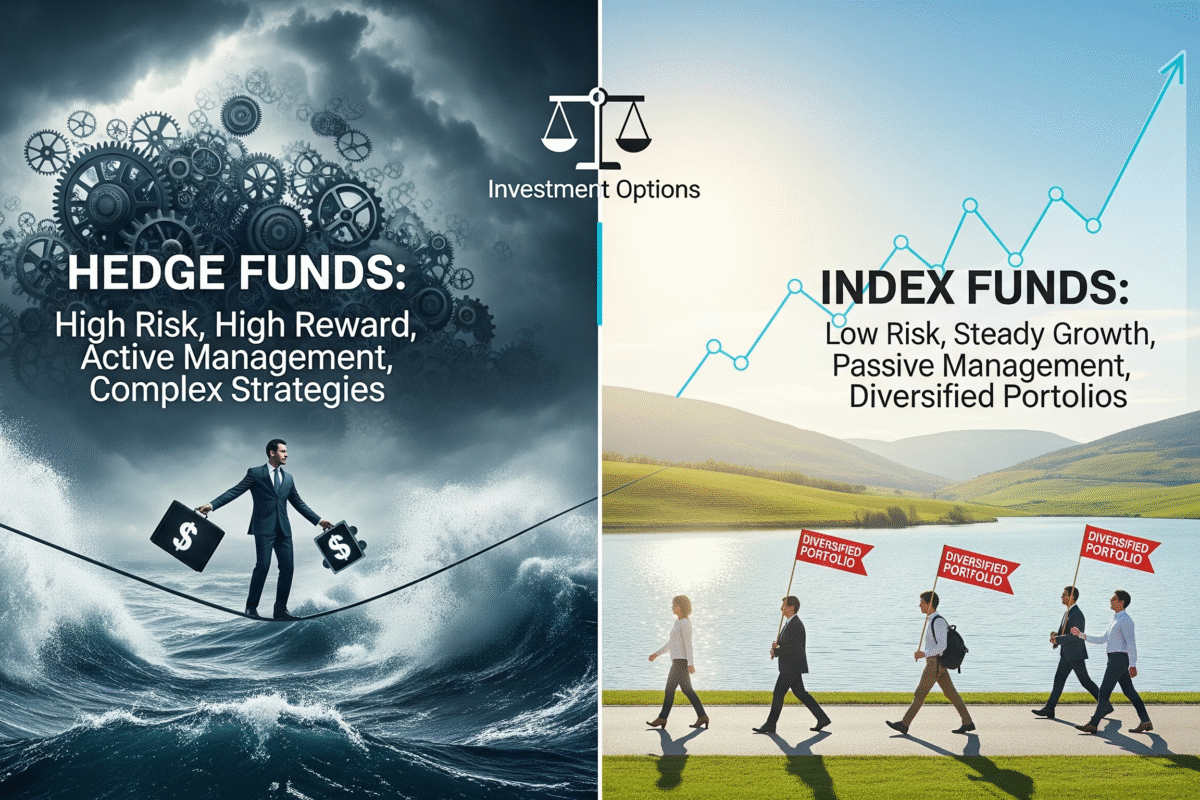
Hedge Funds vs Index Funds:
Hedge Funds vs Index Funds:
In 2025, discussions about hedge funds versus index funds are rife in the U.S. financial system. Retail and institutional investors are still balancing the advantages of actively managed, high-risk hedge funds against the consistent, inexpensive growth of index funds. The emergence of index funds has changed the financial scene, drawing billions of dollars from pension funds and regular investors, whereas hedge funds were traditionally thought to as the “elite” of Wall Street.
The main distinctions between hedge funds and index funds, as well as their past performance, dangers, fees, regulations, and prospects, will be dissected in this essay. You’ll know by the end which investment plan makes the most sense for 2025.
HSBC Cashback Credit Card 2025 – Benefits, Rewards & How to Apply?

Describe Hedge Funds.
Private investment partnerships known as hedge funds combine capital from institutional or affluent investors. In contrast to mutual funds or exchange-traded funds (ETFs), hedge funds frequently use sophisticated tactics, such as:
- Selling stocks short
- Leveraging borrowed capital
- Derivatives trading
- Events-driven investments (such as mergers and acquisitions) and global macroeconomic wagers
Hedge funds aim to deliver absolute returns regardless of market direction. This means they try to profit in both rising and falling markets. However, hedge funds are only open to accredited investors (individuals with a net worth over $1 million or annual income above $200,000).
What Do Index Funds Mean?
Index funds are passive investment funds that track a specific market index, such as the S&P 500, Nasdaq 100, or Dow Jones Industrial Average. They don’t try to outperform the market; instead, they aim to mirror the market’s performance.
An index fund may hold shares of all 500 companies in the S&P 500, providing broad diversification at a low cost. Index funds are widely available through mutual funds or ETFs and are ideal for long-term, hands-off investors.
Key Characteristics of Index Funds:
- Low expense ratios (as low as 0.03%).
- Long-term buy-and-hold strategy.
- Accessible to all investors (no accreditation required).
- Backed by giants like Vanguard, BlackRock (iShares), Fidelity.
Hedge Funds vs Index Funds: Core Differences
| Feature | Hedge Funds | Index Funds |
| Management Style | Active, complex strategies | Passive, market-tracking |
| Accessibility | Accredited investors only | Available to all investors |
| Fees | 2% + 20% performance fee | Expense ratios as low as 0.03% |
| Risk | High (use of leverage & shorting) | Low to moderate (market risk only) |
| Liquidity | Limited (lock-in periods) | High (can buy/sell anytime) |
| Transparency | Low (limited disclosures) | High (fully transparent) |
| Returns (long-term) | Mixed, often underperform | Consistently match market growth |
Performance: Hedge Funds vs Index Funds
One of the strongest criticisms against hedge funds is underperformance compared to index funds.
Index Funds Performance:
Over the last 20 years, the S&P 500 index fund has returned an average of 9–10% annually. Even after market crashes, index funds tend to recover and deliver solid long-term growth.
Hedge Funds Performance:
A study by HFR (Hedge Fund Research) shows that hedge funds returned just 6–7% annually on average over the past decade. A few superstar hedge funds outperform, but the majority fail to beat the S&P 500 after fees.
Fees: The Quiet Killer of Wealth
Hedge funds charge a performance fee of 20% plus a management fee of 2%.
The expense ratio for index funds is as low as 0.03%.
For instance:
- You might lose $22,000 in fees if you put $1,000,000 into a hedge fund that makes 10% ($100,000).
- An index fund might only cost $300 annually for the same amount.
For long-term investors, index funds are the obvious winner because of this enormous gap that compounds over decades.
Risks: Which Is Safer?
Hedge Funds Risks:
- Use leverage (borrowed money) → magnifies losses.
- Strategy risk (if the manager bets wrong, returns crash).
- Liquidity risk (lock-in periods).
- Market downturns can wipe out years of gains.
Index Funds Risks:
- Market risk (if the S&P 500 falls, so does your fund).
- No protection in crashes, but history shows recovery.
In short: Hedge funds are high-risk, high-reward, while index funds are steady, predictable, and resilient.
Disparities in Regulation
- Hedge funds are only available to wealthy investors and are subject to lax SEC regulation.
- Index funds are subject to strict regulation under the Investment Company Act of 1940, which guarantees investor protection and transparency.
Prospects for 2025 and Beyond
2025 Hedge Funds:
- facing pressure from quant funds powered by AI.
- battling with poor performance and exorbitant rates.
- Certain segments remain appealing, such as distressed debt funds and crypto hedge funds.
2025 Index Funds:
- Keep controlling inflows.
- By 2030, it is anticipated to control more than 60% of the US equities market.
- Investors continue to select ETFs like iShares Core S&P 500 and Vanguard S&P 500.
Professional Views
- Warren Buffett: “Most investors are better off in a low-cost index fund.”
- Ray Dalio (Hedge Fund Titan): Advocates diversification but admits most funds underperform.
- Jack Bogle (Vanguard Founder): “Don’t look for the needle in the haystack. Just buy the haystack.”
Conclusion
The hedge funds vs index funds debate highlights two very different investing philosophies:
Hedge funds promise exclusive, high-risk opportunities but often disappoint due to high fees and inconsistent returns.
Index funds offer low-cost, steady, market-matching returns, making them the best choice for most investors.
In 2025, the evidence is clear: Index funds are the winning strategy for long-term wealth building, while hedge funds remain a niche option for the ultra-rich seeking diversification.
How Capital Gains Tax Works in the U.S. – Complete 2025 Guide
How Capital Gains Tax Works in the U.S. – Complete 2025 Guide