 A K
A K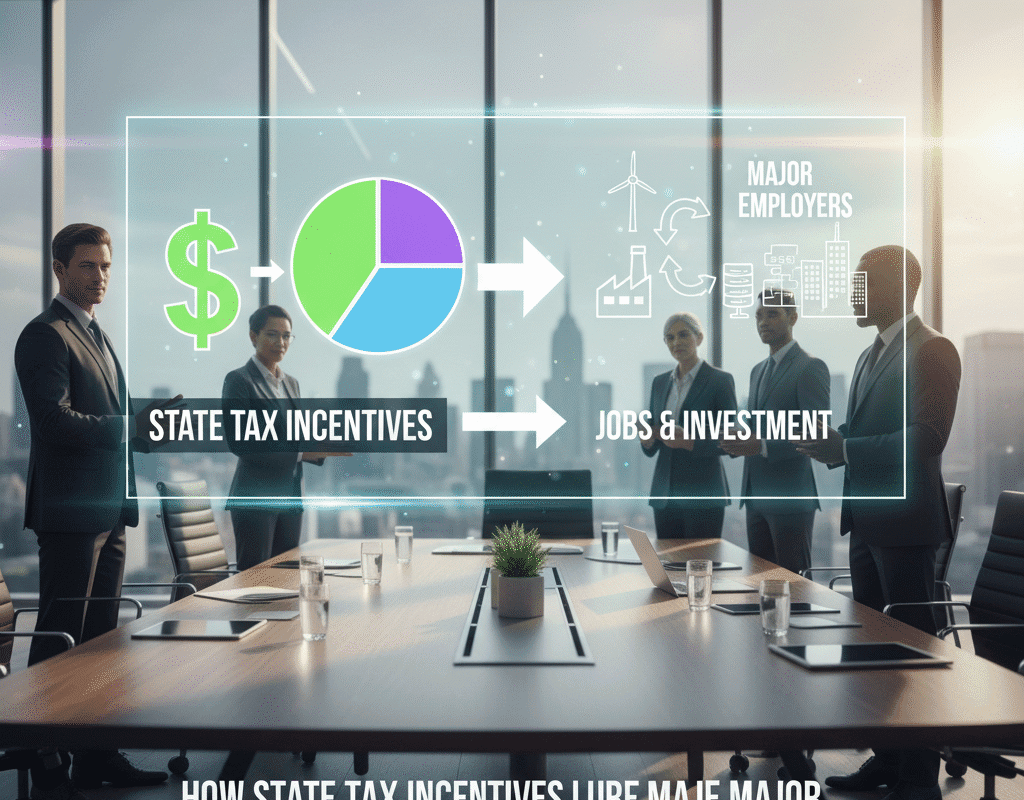
How State Tax Incentives Lure Major Employers?
How State Tax Incentives Lure Major Employers?
Across the United States, states are locked in a competitive race to attract major employers—technology companies, manufacturers, distribution giants, and advanced research labs. The weapon of choice in this race? State tax incentives, a broad category that includes corporate tax breaks, payroll incentives, land grants, and infrastructure subsidies.
As the American economy continues to reorient around new industries—from electric vehicle manufacturing to semiconductor production—states are deploying increasingly aggressive incentive packages to lure employers. These packages can be worth hundreds of millions, sometimes even billions, of dollars, sparking renewed debate about the true costs and benefits of subsidizing corporations.
HSBC Cashback Credit Card 2025 – Benefits, Rewards & How to Apply?

Why States Compete for Employers
Job Creation
Major employers often create thousands of direct jobs and tens of thousands of indirect jobs in construction, supply chains, and service industries.
Long-Term Economic Growth
A single high-profile employer can reshape a regional economy, attracting suppliers, start-ups, and new residents.
Political Gains
Governors often campaign on the promise of attracting companies. Landing a corporate headquarters or large factory is a political victory.
Industry Diversification
States reliant on declining industries—like coal, steel, or agriculture—seek modern, tech-driven companies to diversify their economies.
Global Competitiveness
Many U.S. states argue that without incentives, companies might instead choose other countries that offer inexpensive labor or favorable trade terms.
The Rise of Multi-Billion Dollar Incentive Packages
Over the past decade, incentive packages have grown dramatically in value. States now frequently offer nine-figure or ten-figure deals to secure large manufacturing or technology projects.
Several factors drive this escalation:
High Cost of Advanced Manufacturing
New semiconductor, electric vehicle, and battery factories can cost anywhere from $1 billion to $25 billion, making incentives a critical bargaining tool.
Competition Between States
When one state offers a massive subsidy, others often follow with even larger packages.
The “Arms Race” Dynamic
Economic analysts refer to this as an incentive arms race—each state increases its offer to avoid losing projects.
Failures and Controversies: When Incentives Backfire
Officials often highlight success stories, but incentive programs can also fail—sometimes spectacularly.
Overestimated Job Creation
Some companies fail to meet job creation targets, yet still enjoy tax benefits.
Public Services Lose Revenue
Because incentives reduce taxes, states sometimes face budget shortfalls for schools, infrastructure, and emergency services.
Expensive Projects With Limited Long-Term Benefits
Critics cite examples where states spent hundreds of millions only for companies to automate jobs or shut down operations prematurely.
Unclear Accountability
Many incentive agreements lack strong enforcement mechanisms.
Local Community Pushback
Residents sometimes oppose incentives if they believe the funds could be better used for housing, healthcare, or education.
The Effect on Employees
Incentives for employees might vary widely.
Positive Results
- greater pay for innovative manufacturing.
- more complex occupations that call for training.
- less out-migration due to more local opportunities.
Adverse Results
- Housing markets may be strained by rapid population increase.
- Long-term sustained employment is not necessarily the result of short-term construction booms.
- Certain jobs may have a shorter duration due to automation.
- The effectiveness with which states enforce pay and job quality criteria will determine the final benefit to workers.
Conclusion: How State Tax Incentives Lure Major Employers?
One of the most contentious instruments in American economic policy is still state tax incentives. They can spark new industries, attract global companies, and transform regional economies. Yet they also carry risks—fiscal, political, and social.
As states continue competing for the employers of the future, one thing is clear: tax incentives will remain a defining feature of America’s economic landscape. The challenge ahead lies in balancing growth with accountability, ensuring that public investments truly serve the public good.
The Effect of Inflation Indexing on U.S. Tax Brackets: What Americans Need to Know in 2025
The Effect of Inflation Indexing on U.S. Tax Brackets: What Americans Need to Know in 2025
1 Comment