 A K
A K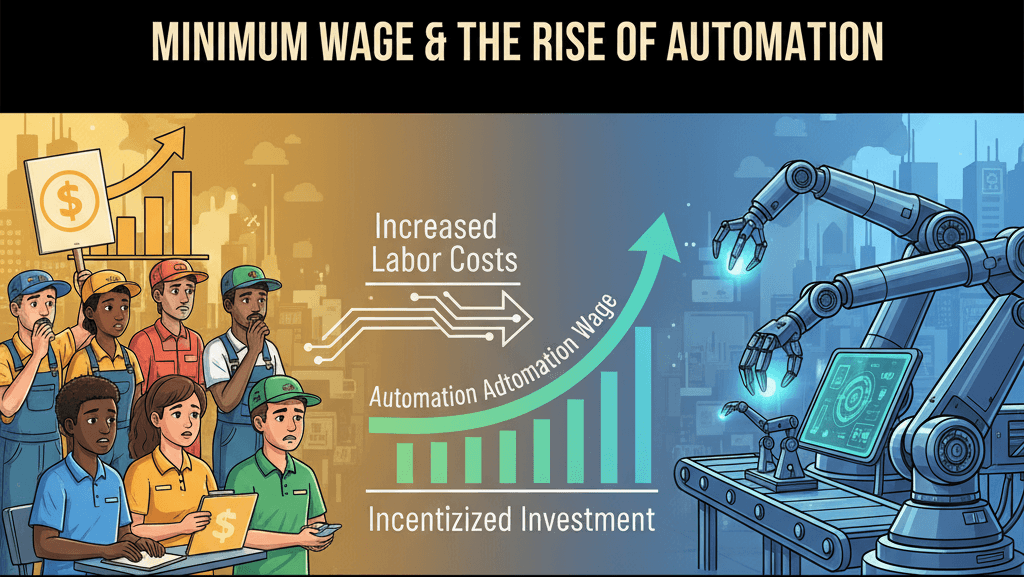
How Minimum Wage Hikes Influence Automation Investment?
How Minimum Wage Hikes Influence Automation Investment?
Economic and political discourse in the US has traditionally revolved around minimum wage laws. However, there has been a significant change in recent years: wages, employment, and household income are no longer the primary topics of discussion. Instead, businesses, economists, and legislators are paying more attention to how growing minimum wages affect investments in automation, from touch-screen kiosks in fast-food restaurants to sophisticated robotics in manufacturing.
Businesses are adjusting their labor tactics as states and municipalities around the nation keep boosting the minimum wage, some of which already exceed $15 per hour. Automation, once considered a long-term transformation, is now becoming a near-term necessity for many industries facing persistent labor shortages, rising labor costs, and competitive pressure.
HSBC Cashback Credit Card 2025 – Benefits, Rewards & How to Apply?

Increases in the Minimum Wage: The New National Scene
The federal government of the United States has long fixed the minimum wage at $7.25 per hour. However, more than half of states have raised wage floors, and many large cities have passed even more stringent wage standards, making the federal figure increasingly meaningless.
The deployment of automation around the country is being impacted in different and uneven ways by this patchwork of pay laws. Automation technologies are being adopted more quickly in locations with higher wage regulations, especially in metropolitan areas and on the West Coast.
The arithmetic is simple for companies in these sectors: the return on investment for automation increases as labor expenses grow.
Financial justification used to take years, but today it might just take months.
Why Rising Wages Make Automation Appealing
It’s useful to examine the fundamental economics of employer decision-making in order to comprehend how salary rises affect automation.
Growing Labor Costs Promote Capital Substitution
Labor and capital—humans and machines—are economic inputs that can often substitute for each other. When the cost of labor rises, capital investment becomes relatively cheaper.
Automation Reduces Long-Term Operational Risk
Firms often view wages not just as a current expense but as a source of future uncertainty. Potential future legislation, labor shortages, unionization, and economic cycles all contribute to risk. Automation stabilizes costs, offering predictability that human labor cannot.
Increases in Productivity Increase the Competitiveness of Your Company
Automation offers consistent output, fewer errors, and 24/7 operation. For many industries—manufacturing, logistics, retail—productivity gains can be substantial enough to offset upfront equipment costs, especially when labor becomes more expensive.
Industries Most Affected by Automation Driven by Minimum Wages
The manner that different industries react to pay increases varies. Some rely more on repetitive, routine chores that are easily completed by machines. Others necessitate intricate, human-driven decision-making that is currently unreplicable by automation.
Grocery and retail
Inventory management software, shelf-scanning robots, and self-checkout systems are becoming ubiquitous. Retailers who formerly relied on a high number of hourly workers are encouraged to automate front-of-house and back-of-house processes by raising the minimum wage.
Logistics and Storage
Conveyor automation, autonomous forklifts, and robotic picking systems are gradually taking the place of manual labor. Logistics companies are making significant investments to stay cost competitive in jurisdictions with increasing minimum salaries.
Manufacturing
Many manufacturing facilities were early adopters of automation, but rising labor costs continue to push companies toward even more advanced robotics and AI-powered production lines.
The Role of AI: A New Factor Accelerating Automation
Artificial intelligence is not just supplementing automation—it’s redefining what tasks machines can do.
AI allows automation of:
- Customer interaction
- Inventory prediction
- Scheduling and workforce management
- Fraud detection
- Customer support
- Order processing
AI systems are cheaper than robotics and have lower barriers to entry, making them particularly attractive to mid-sized firms.
Minimum wage hikes further accelerate AI adoption because AI reduces the need for human decision-making in routine areas.
Conclusion: How Minimum Wage Hikes Influence Automation Investment?
Minimum wage hikes are reshaping the U.S. labor market—and accelerating the adoption of automation across multiple industries. While rising wages improve living standards for millions of workers, they also shift business incentives, driving investment in technologies that replace or augment human labor.
The key challenge for policymakers, employers, and workers will be managing this transition. Automation is not inherently harmful—in fact, it has the potential to increase productivity, reduce workplace injuries, and create new, higher-paying roles. But without careful planning, the transition may deepen inequality and leave some workers behind.
How U.S. Climate Policy is Shaping the Future of Heavy Industries
How U.S. Climate Policy is Shaping the Future of Heavy Industries