 A K
A K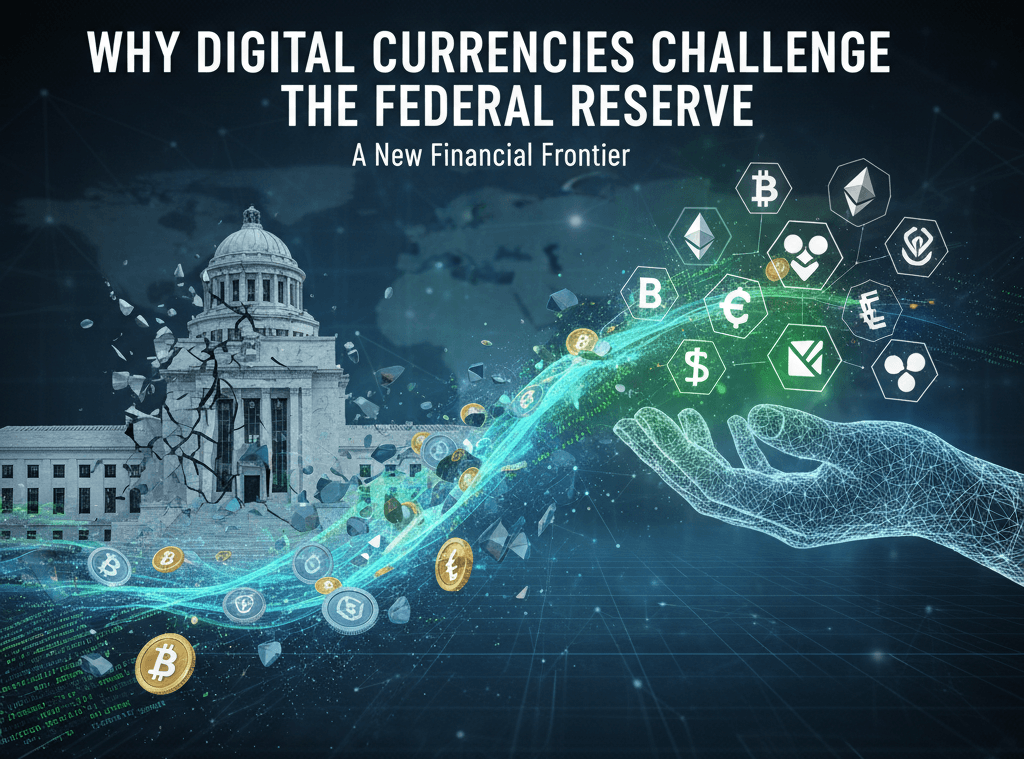
Why Digital Currencies Are Challenging the Federal Reserve?
Why Digital Currencies Are Challenging the Federal Reserve?
The Federal Reserve has spent more than a century shaping the American financial system, stabilizing markets, influencing employment, and maintaining the strength of the U.S. dollar. But in the last decade—especially the last few years—a new contender has emerged to challenge that dominance: digital currencies.
These currencies, which range from decentralized cryptocurrencies like Bitcoin to privately issued stablecoins and prospective government-backed digital dollars, are redefining how people store, transfer, and interpret the value of money. They operate faster than traditional payment networks, often cheaper, and sometimes outside government oversight entirely.
HSBC Cashback Credit Card 2025 – Benefits, Rewards & How to Apply?

The Federal Reserve’s Traditional Role in Money Creation
To understand the challenge, it’s essential to recognize how the Federal Reserve maintains monetary control.
The Fed influences the economy by:
- Issuing the U.S. dollar – the world’s dominant reserve currency
- Managing interest rates to influence borrowing and spending
- Controlling the money supply through open-market operations
- Overseeing commercial banks, payment systems, and liquidity
- Responding to financial crises through lending and asset purchases
This framework relies on one core assumption: U.S. dollars and the banking system are the central pillars for all large-scale economic activity.
Digital currencies disrupt that assumption in several ways—technologically, structurally, and politically.
The Rise of Digital Currencies: A Quick Overview
Digital currencies fall into several categories:
Cryptocurrencies
- Examples: Bitcoin, Ethereum
- These are decentralized, permissionless, and borderless. No government controls them.
Stablecoins
- Examples: USDC, Tether
- These are digital tokens backed—at least in theory—by assets such as dollars, bonds, or cash equivalents. They allow instant global transactions without banks.
Central Bank Digital Currencies (CBDCs)
- A digital dollar, issued and controlled by the government.
- The U.S. does not have a CBDC yet, but the Federal Reserve is researching one.
Private Digital Payment Networks
- Examples: Apple Pay, PayPal’s digital dollar-like instruments
- These are centralized systems replacing traditional bank-mediated payments.
Why the Federal Reserve Cannot Ignore Digital Currencies
Despite skepticism, digital currencies are too influential to dismiss.
Adoption is accelerating
- Major corporations hold crypto.
- Wall Street trades crypto-backed financial instruments.
- Millions of Americans own digital assets.
- Stablecoins process billions in daily transaction volume.
Technological momentum is irreversible
Once faster, cheaper alternatives exist, consumers rarely return to slower systems.
Global competition is fierce
China’s digital yuan shows how digital currency can be used to expand international influence.
The U.S. risks falling behind if innovation stalls.
Younger generations prefer digital money
Digital natives view traditional banking as outdated, pushing the monetary system toward technological change.
Potential Futures: What Comes Next?
Several scenarios could unfold:
Scenario 1: The Digital Dollar Dominates
A successful CBDC cements the Fed’s control over digital payments while modernizing the system.
Scenario 2: Private Stablecoins Become Mainstream
Corporations issue widely used stablecoins, shifting monetary power away from the Fed.
Scenario 3: Hybrid System
The U.S. financial ecosystem blends traditional banking, stablecoins, crypto, and a potential CBDC.
Scenario 4: The Dollar Loses Global Dominance
If foreign CBDCs and private digital currencies gain traction, the dollar’s international role could weaken.
Conclusion: Why Digital Currencies Are Challenging the Federal Reserve?
Digital currencies are not merely technological novelties—they are structural threats to how the Federal Reserve has operated for over a century.
They challenge:
- The Fed’s control of the money supply
- The speed and cost of payment networks
- Global dominance of the dollar
As digital currencies reshape global finance, the next decade will determine whether the United States maintains its monetary leadership—or watches it shift elsewhere.
The Impact of Inflation on Fixed-Income Retirees: Challenges, Trends, and Long-Term Financial Risks
The Impact of Inflation on Fixed-Income Retirees: Challenges, Trends, and Long-Term Financial Risks