 A K
A K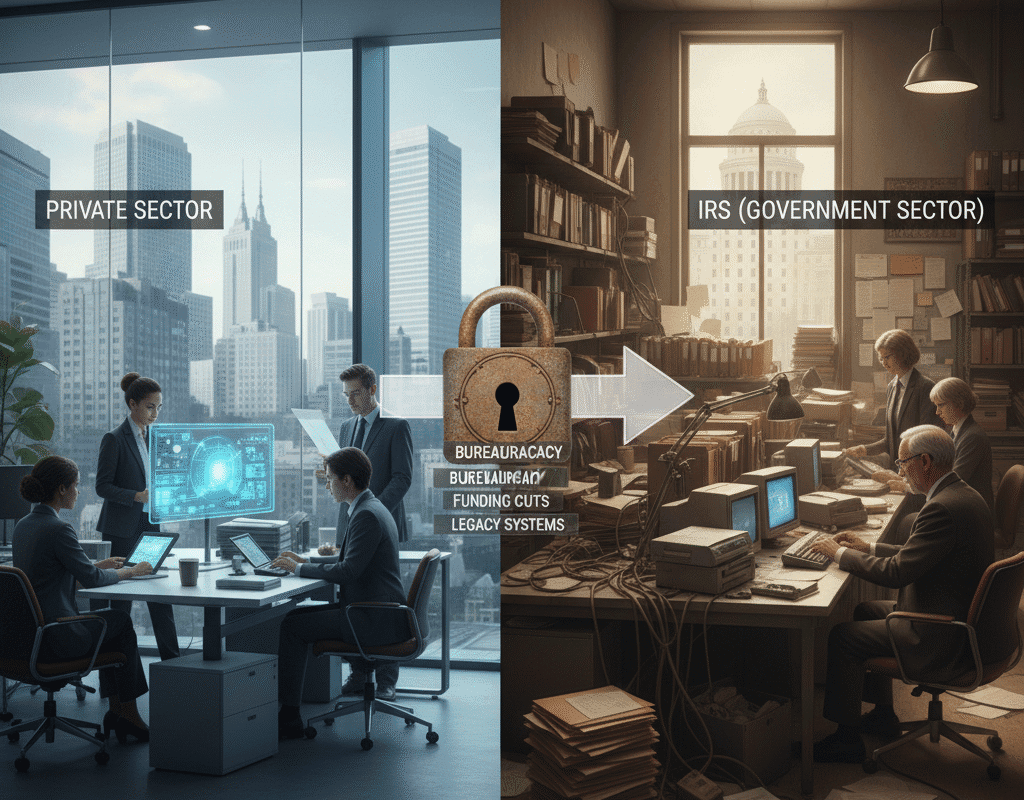
Why the IRS Modernizes Slower Than Private Firms?
Why the IRS Modernizes Slower Than Private Firms?
The Internal Revenue Service (IRS) is the backbone of the United States tax system, processing trillions of dollars in revenue every year, supporting federal programs, and ensuring that America’s financial infrastructure remains functional. Yet despite its central role, the IRS is widely known for operating with outdated software, slow digital adoption, and decades-old core systems still in active use. Compared with private companies—especially financial, fintech, and technology firms—the IRS appears to modernize at a significantly slower pace.
Why does this happen? Why can private companies overhaul their technology stacks rapidly, while the nation’s tax agency often takes years or decades to complete even modest upgrades?
HSBC Cashback Credit Card 2025 – Benefits, Rewards & How to Apply?

The IRS Uses Legacy Systems That Are Decades Old
The existence of outdated computer systems from the 1960s and 1970s is one of the most frequently mentioned causes of the IRS’s sluggish modernization. The Individual Master File (IMF), the main database containing taxpayer data, is vital to the agency’s activities. This system is written in COBOL and assembly language, two languages that are rarely used by modern programmers.
Why modernization is slowed down by old systems
- They require specialized talent that is in increasingly short supply.
- Updating them is risky; breaking a core system could halt tax collection nationwide.
- Rebuilding them from scratch requires massive funding and multi-year investment.
- Integrating modern tools with outdated platforms leads to compatibility issues.
Strict Limit on Federal Budget Cycles Long-Term Investment in Technology
When necessary, private companies can make aggressive investments and distribute resources in accordance with company needs. To pursue modernization projects, they can generate money, take out loans, or rearrange the budget.
Conversely, the IRS is constrained by:
- Federal appropriations cycles each year
- oversight by Congress
- Political inspection of expenditures
- Restricted long-term financial commitments
Usually, multi-year financial guarantees are needed for large-scale IT upgrades. However, the agency frequently receives inadequate or inconsistent support due to shifting political environments, budgetary limitations, and altering congressional objectives.
Project execution is slowed by delays, limitations, and supervision requirements even when Congress increases funds, as has been the case in recent years.
Political Oversight Makes Every Change More Complicated
Unlike private companies that answer to boards or shareholders, the IRS answers to Congress, the Treasury Department, watchdog organizations, and the general public. Every modernization decision is subject to scrutiny, hearings, accountability reports, and compliance reviews.
Political challenges include:
- Shifting political priorities depending on which party controls Congress.
- Resistance to expanding IRS capabilities due to ideological perspectives.
- Public scrutiny over data privacy and surveillance concerns.
- Legislative restrictions on how IRS funds may be used.
While oversight exists for good reason—taxation is sensitive and tied to national governance—it significantly slows the pace of innovation. Even well-intentioned proposals often stall due to political disagreements or concerns about public perception.
The IRS needs to put stability ahead of innovation.
Even if new systems are flawed, private businesses are still able to implement them and make necessary adjustments. The IRS does not have this luxury.
The IRS must ensure:
- Every taxpayer can file returns successfully.
- Every refund and payment is processed accurately.
- Every record is preserved and stored securely.
- Systems operate 24/7 during filing season without fail.
This enormous responsibility means the agency cannot easily experiment with innovative platforms or accept disruptive transitions. A technical failure isn’t just inconvenient—it could disrupt the entire U.S. economy.
In conclusion: Why the IRS Modernizes Slower Than Private Firms?
Although it’s simple to compare the IRS to big private companies, doing so ignores significant distinctions in funding, risk tolerance, governance, responsibility, and public accountability.
The IRS is modernizing more slowly because
- Its systems are older and bigger.
- Its dangers are widespread.
- It receives uneven funding.
- Its monitoring is complex and political.
Private firms may innovate faster, but they operate under entirely different conditions. Modernizing the U.S. tax system requires balancing reliability, security, legislative mandates, and universal accessibility—tasks that inherently slow rapid innovation.
How U.S. IPO Trends Signal Economic Health: Insights and Analysis
How U.S. IPO Trends Signal Economic Health: Insights and Analysis