 A K
A K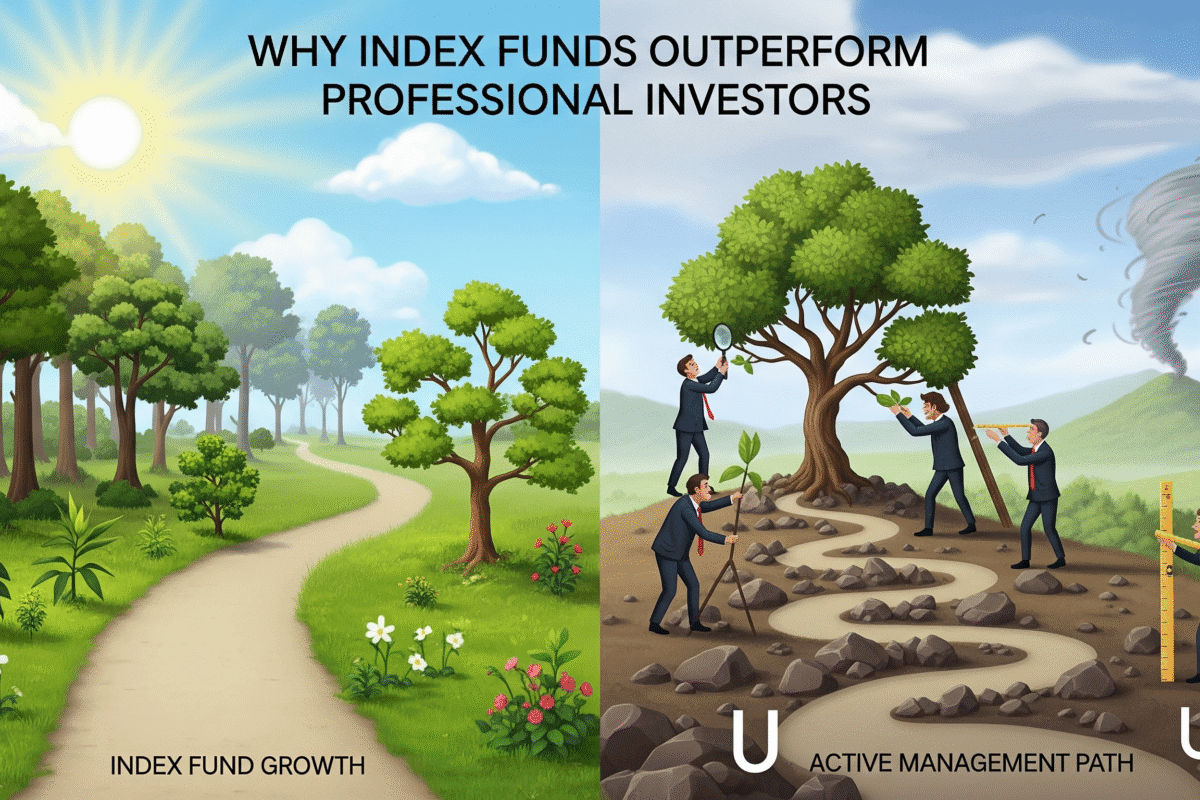
Why Index Funds Often Outperform Professionals?
Why Index Funds Often Outperform Professionals?
For decades, investors have debated whether active or passive strategies deliver better long-term returns. The rise of index funds — low-cost investment vehicles that track the performance of a market index like the S&P 500 — has reshaped this debate. Surprisingly, research consistently shows that index funds often outperform professional fund managers who actively pick stocks, despite their expertise, research teams, and advanced tools.
HSBC Cashback Credit Card 2025 – Benefits, Rewards & How to Apply?

Knowledge of Index Funds
Index funds: What Are They?
An index fund is a kind of exchange-traded fund (ETF) or mutual fund that mimics the performance of a certain index, like:
- The top 500 American firms, or S&P 500
- The Dow Jones Industrial Average
- Russell 2000 NASDAQ 100
Index funds seek to mirror the market rather than beat it. They hold a diversified basket of stocks that make up the index, providing broad exposure at low cost.
The Reasons Experts Fight to Outperform the Market
2.1 Exorbitant Erode Return Fees
Annual management costs for actively managed funds are usually at least 1%. One percent may not seem like much at first. However, this expense increases significantly over decades.
For instance, if you invest $100,000 for 30 years at an annual growth rate of 8%, you will eventually have more than $1,000,000. That drops to about $750,000 with a 1% charge. That’s a difference of $250,000!
In contrast, index funds typically charge 0.05% or less. They perform better than the majority of experts just because of the financial advantage.
2.2 Human Bias and Mistakes
Professional managers are still human. They are vulnerable to:
- Herd mentality: chasing hot stocks during bubbles.
- Loss aversion: holding onto losing investments too long.
- Overconfidence: believing they can consistently outsmart the market.
Index funds, being rules-based, avoid these emotional mistakes.
2.3 Market Efficiency
The stock market is highly competitive. Every stock trade involves a buyer and a seller, both believing they’re making a smart move. This means that most information is already reflected in stock prices — a concept known as the Efficient Market Hypothesis (EMH).
Because the market is so efficient, it’s nearly impossible to consistently identify undervalued or overvalued stocks. Professionals may get lucky in the short term, but over the long run, very few beat the market.
The Evidence: Index Funds vs Professionals
S&P SPIVA Report
Every year, S&P Dow Jones Indices releases the SPIVA (S&P Indices Versus Active) Scorecard, which compares active managers against benchmarks.
The results are clear:
- Over 80% of U.S. large-cap active managers underperform the S&P 500 over 10 years.
- In some categories, more than 90% fail to beat their benchmark.
This shows that the odds are stacked against professional stock pickers.
Warren Buffett’s Famous Bet
In 2008, Warren Buffett made a bold bet: he challenged hedge funds to outperform a simple S&P 500 index fund over a decade. The results?
- The index fund returned 125%.
- The hedge funds averaged 36% after fees.
Buffett’s message was clear: most investors are better off in low-cost index funds.
Why Index Funds Work So Well
4.1 The Process of Diversification
Index funds spread your money across hundreds or even thousands of companies. This diversification reduces risk — if one company fails, it has little impact on your portfolio.
4.2 Lower Turnover, Lower Taxes
Active managers frequently buy and sell stocks, which triggers capital gains taxes. Index funds trade less often, which helps investors keep more of their returns.
4.3 Compounding Advantage
Over long horizons, small advantages compound into massive differences. Low costs, fewer taxes, and consistent market-matching returns add up to big wealth-building power.
Active vs Passive: Is There a Place for Both?
Some argue that active management still has a role, particularly in:
- Emerging markets (where inefficiencies exist).
- Small-cap stocks (less analyst coverage).
- Specialized sectors (like biotech).
However, for the average investor saving for retirement, index funds provide a safer, more reliable option.
Frequently Held Myths Regarding Index Funds
Myth 1: There Is No Risk With Index Funds
Not true. Index funds carry market risk — if the entire stock market falls, so will the index fund.
Myth 2: Professionals Can Protect You in Downturns
Data shows that most active managers fail to outperform even during bear markets. Timing the market is nearly impossible, even for experts.
Myth 3: Index Funds Limit Growth
Some investors believe that only active funds can deliver big gains. But history shows that the stock market itself is one of the best long-term wealth creators, and index funds capture that growth.
Useful Advice for Investing
If you’re considering index funds, here are key strategies:
- Choose Broad Market Funds – S&P 500, Total Stock Market Index, or international index funds.
- Keep Costs Low – Look for funds with expense ratios under 0.1%.
- Stay Consistent – Invest regularly through market ups and downs.
- Reinvest Dividends – Compounding accelerates growth.
- Think Long-Term – Index funds shine over decades, not months.
The Future of Investing
With the rise of robo-advisors, 401(k) index fund options, and increasing investor awareness, passive investing continues to dominate. In fact, U.S. index funds now manage more assets than active funds, a historic milestone reached in 2019.
The trend is clear: investors are embracing simplicity, transparency, and reliability.
In Conclusion
Index funds are frequently a better option than professional money managers, in addition to being a convenient substitute. Their combination of low costs, broad diversification, and market-matching performance makes them tough to beat.
For everyday investors aiming to grow wealth steadily and prepare for retirement, index funds provide a proven, evidence-backed path to financial success. While professionals may shine in certain niches, the majority of evidence shows that the market itself remains the ultimate winner — and index funds let you ride its success with ease.
How to Create a Financial Vision Board in 2025: A Step-by-Step Guide to Achieve Money Goals
How to Create a Financial Vision Board in 2025: A Step-by-Step Guide to Achieve Money Goals