 A K
A K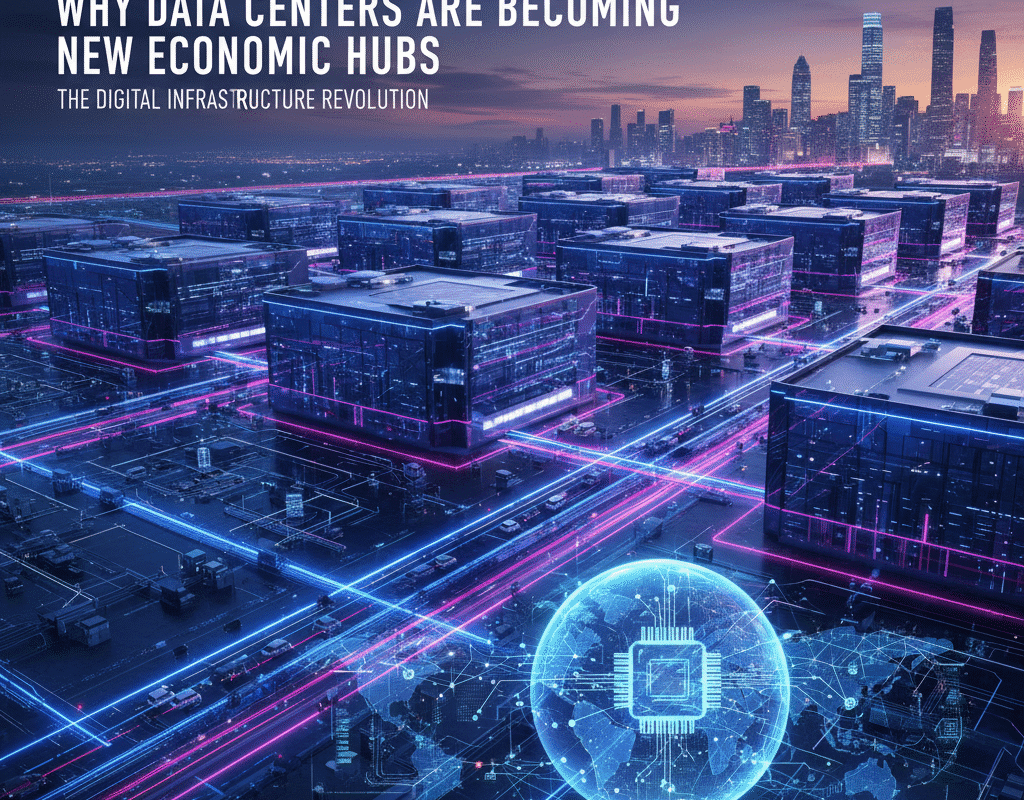
Why Data Centers Are Emerging as New Economic Hubs?
Why Data Centers Are Emerging as New Economic Hubs?
In an era dominated by digital transformation, the United States is witnessing an unprecedented surge in the establishment of data centers. Once considered merely the backend infrastructure for internet services and cloud computing, data centers are now emerging as critical economic engines, reshaping local economies and driving technological advancement.
HSBC Cashback Credit Card 2025 – Benefits, Rewards & How to Apply?

Data Centers’ Ascent as Economic Motivators
Economic centers in the United States have historically been linked to trade, manufacturing, and finance. However, the emphasis has shifted to cloud-based services and information technology in the digital age. In this transition, data centers—which handle, store, and process enormous volumes of digital data—have become essential.
Industry analysts predict that the increased demand for cloud services, artificial intelligence, and big data analytics will propel the U.S. data center market to over $100 billion by 2030. These facilities produce significant local economic advantages in addition to supporting enterprises’ digital infrastructure.
Workforce Development and Job Creation
One of the most visible impacts of data centers is job creation. While the construction phase demands a temporary surge of labor, including engineers, electricians, and construction workers, the operational phase requires a highly skilled workforce for ongoing maintenance, cybersecurity, and network management.
For example, a single large-scale data center can employ hundreds of full-time professionals, ranging from IT specialists to facilities management teams. In rural areas, where economic opportunities may be limited, a new data center can significantly reduce unemployment and spur skill development.
Infrastructure Investment and Regional Growth
Data centers are high-energy, high-tech facilities requiring robust infrastructure. Their establishment often leads to significant investment in power supply, fiber optic networks, water systems for cooling, and transportation infrastructure.
For example, regions that host multiple data centers often experience upgrades in electricity grids and broadband networks, which benefit not only the data centers themselves but also local businesses and residents. This kind of infrastructure investment creates a multiplier effect, stimulating local construction, utilities, and technology sectors.
Economic Incentives and Government Support
Recognizing the potential economic benefits, federal and state governments across the U.S. are offering a range of incentives to attract data center investment. These include tax breaks, low-cost land, expedited permitting, and energy subsidies.
States like Virginia, Texas, and Utah have become leading data center hubs due to favorable business climates, abundant energy resources, and strategic geographic positioning. Virginia, often called the “Data Center Capital of the World,” hosts more than 50% of the world’s cloud traffic, generating billions in local revenue and thousands of jobs.
Sustainability and Green Technology
As the environmental impact of high-energy data centers becomes more visible, many operators are turning to renewable energy sources and innovative cooling solutions to reduce their carbon footprint.
For instance, some centers now rely on solar, wind, or hydroelectric power, while others implement advanced cooling technologies, including liquid immersion and free-air cooling. Not only does this approach minimize environmental impact, but it also positions data centers as sustainable economic engines, aligning with corporate and governmental sustainability goals.
Cloud Computing and Digital Transformation
The surge in cloud computing and digital services has accelerated the demand for data centers. Companies across sectors—finance, healthcare, entertainment, e-commerce, and government—require robust, secure, and scalable storage solutions.
Data centers serve as the backbone of cloud platforms, supporting services such as AI-driven analytics, real-time data processing, video streaming, and large-scale e-commerce operations. This dependence on cloud infrastructure has turned data centers into critical economic assets, attracting investments from multinational corporations and venture capitalists alike.
In conclusion: Why Data Centers Are Emerging as New Economic Hubs?
Data centers are no longer just behind-the-scenes players in the tech ecosystem—they are rapidly evolving into economic powerhouses. By fostering job creation, infrastructure development, and regional investment, these facilities are transforming cities and rural communities alike.
As the digital economy continues to expand, the strategic development of data centers will be crucial for U.S. economic growth, positioning them as central hubs in a tech-driven future. Policymakers, business leaders, and communities that embrace this shift will likely enjoy substantial economic and technological dividends in the years to come.
How Remote Work is Reshaping U.S. Real Estate Markets: Trends, Challenges, and Opportunities
How Remote Work is Reshaping U.S. Real Estate Markets: Trends, Challenges, and Opportunities