 A K
A K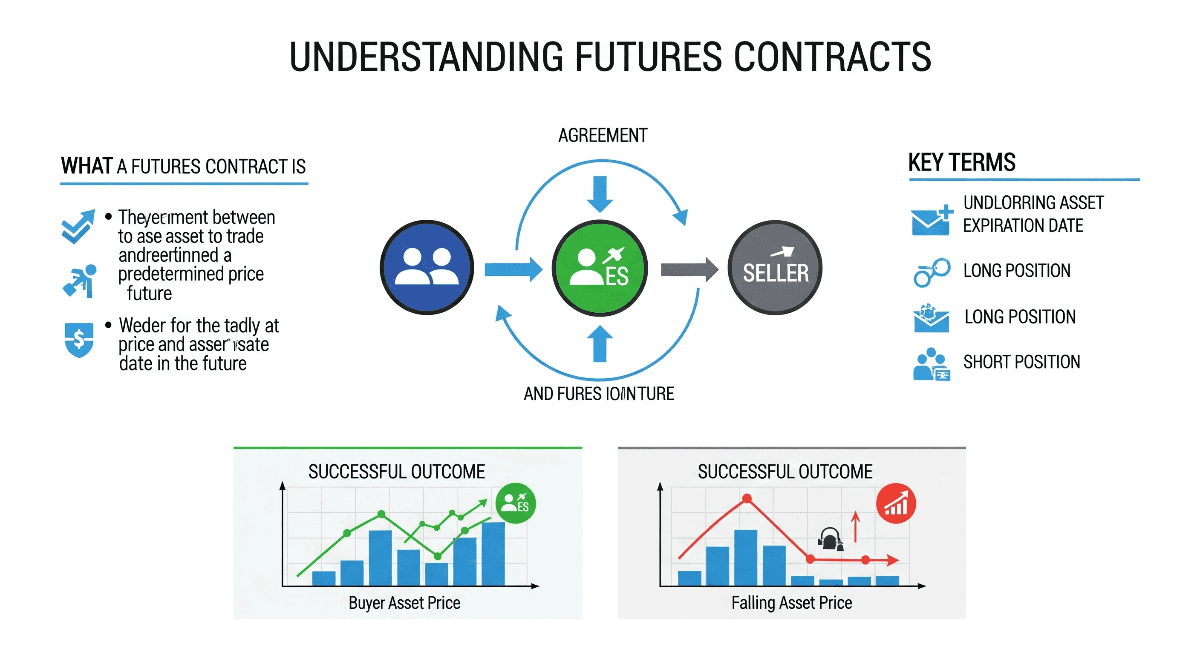
Understanding Futures Contracts:
Understanding Futures Contracts: The Significance of Futures Contracts
Agreements that enable governments, corporations, and investors to manage uncertainty are the foundation of the global financial system. Futures contracts are one of the most important of these. They are crucial tools for risk hedging, commodity price stabilization, and maintaining liquidity in financial markets, in addition to being tools for traders looking to make money.
Futures contracts support the pricing of assets that have an impact on our daily lives, such as wheat, crude oil, stock indices, and currencies. Anyone interested in investing, financial markets, or even the global economy has to understand how they operate.
This article delves further into the definition of futures contracts, their history, methods, risks, and effects on the global and American financial systems.
HSBC Cashback Credit Card 2025 – Benefits, Rewards & How to Apply?
A Futures Contract: What Is It?
A common agreement between two parties to purchase or sell an asset at a fixed price on a given future date is known as a futures contract.
- The buyer’s role is to consent to buy the item later.
- The seller agrees to provide the asset at a later date.
- The underlying asset may be a financial instrument (stock indexes, interest rates, currencies) or a commodity (oil, wheat, gold).
Futures are traded on regulated exchanges, which guarantees openness, security, and uniformity in contrast to a traditional purchase.
For instance, an airline can utilize futures contracts to protect itself from future price hikes if it want to fix jet fuel prices for the upcoming year. An oil producer, on the other hand, can guarantee a selling price.
A Synopsis of Futures Contract History
- Ancient Times: The idea originated with the usage of forward contracts in agriculture in Mesopotamia around 1750 BC.
- 17th Century Japan: The Dōjima Rice Exchange standardized rice futures, becoming the first organized futures market.
- 19th Century Chicago: The Chicago Board of Trade (CBOT), founded in 1848, formalized grain futures contracts to stabilize agricultural trade.
- Modern Era: Today, futures cover stocks, currencies, commodities, and interest rates, with trading volume in trillions of dollars annually.
How Do Futures Contracts Work?
To understand futures, let’s break down the process:
- Standardization: Each contract specifies asset type, quantity, and delivery date.
- Margin Requirement: Traders deposit a percentage of the contract value as collateral (called initial margin).
- Mark-to-Market: Daily settlement adjusts accounts based on price changes.
- Expiration & Delivery: Contracts can be settled by physical delivery or cash settlement.
Example in Action:
- A corn futures contract might represent 5,000 bushels of corn.
- If the price of corn rises, the buyer profits, while the seller loses (and vice versa).
- Most traders close their positions before expiration to avoid physical delivery
Futures Contract Types
Futures on Commodities
- Agricultural: cotton, soybeans, corn, wheat, and coffee.
- Energy: gasoline, natural gas, and crude oil.
- Metals: copper, silver, and gold.
Future Financial Situations
- Stock Index Futures: NASDAQ, S&P 500.
- USD/JPY and EUR/USD are currency futures.
- Interest rate futures include LIBOR rates and US Treasury bonds.
Particularized Prospects
- Futures on volatility (VIX index).
- Weather derivatives (protecting against changes in temperature and precipitation).
- Futures for carbon credits.
Futures vs. Options: Key Differences
While both are derivatives, they function differently:
- Futures: Obligation to buy/sell at contract expiry.
- Options: Right (not obligation) to buy/sell.
- Risk: Futures carry unlimited risk; options limit risk to the premium paid.
- Liquidity: Futures markets often have higher liquidity for major assets.
Why Do Traders and Businesses Use Futures?
Hedging:
- Farmers hedge against falling crop prices.
- Airlines hedge against rising fuel costs.
Speculation:
Traders bet on price movements to earn profits.
Arbitrage:
Taking advantage of price differences between futures and spot markets.
Portfolio Diversification:
Futures provide exposure to different asset classes.
Essential Components of a Futures Agreement
- Contract Size: The asset’s quantity (e.g., 100 barrels, 5,000 bushels).
- Tick Size: The least amount of change in pricing.
- Settlement Date: When the agreement expires.
- Leverage: Greater exposure with less capital is possible with small margin requirements.
Hazards Associated with Trading Futures
- Leverage Risk: Even minor price fluctuations can result in significant profits or losses.
- Market Volatility: Unexpected price movements are possible.
- Liquidity Risk: There is little trading activity in some futures markets.
Margin Calls: Traders must add money if losses outweigh margin deposits.
Global Futures Markets
Some of the largest futures exchanges include:
- CME Group (Chicago): World’s largest derivatives marketplace.
- Eurex (Europe): Major for financial futures.
- Tokyo Commodity Exchange (TOCOM).
- Intercontinental Exchange (ICE).
The U.S. leads in futures trading volume, but Asia and Europe are rapidly expanding.
Futures Contracts in the U.S. Economy
Futures trading impacts everyday life:
- Gasoline prices are linked to crude oil futures.
- Food prices rely on agricultural futures.
- Mortgage rates tie to interest rate futures.
- Stock market performance reflects index futures.
- Even if you don’t trade futures, you feel their effects in inflation, prices, and investment markets.
Conclusion
Futures contracts are more than speculative tools—they are essential instruments of risk management and market efficiency. They:
- Help businesses secure stable prices.
- Allow traders to profit from volatility.
- Provide governments and corporations with hedging mechanisms.
Whether you are a farmer in Kansas, a Wall Street trader, or a policy maker, futures contracts shape the financial decisions that impact the economy.
As the U.S. financial markets evolve, futures contracts will continue to grow in importance, serving as a vital link between real-world assets and financial markets.
How to File Taxes Online in the U.S. (2025 Guide) – Step-by-Step Filing Process
How to File Taxes Online in the U.S. (2025 Guide) – Step-by-Step Filing Process