 A K
A K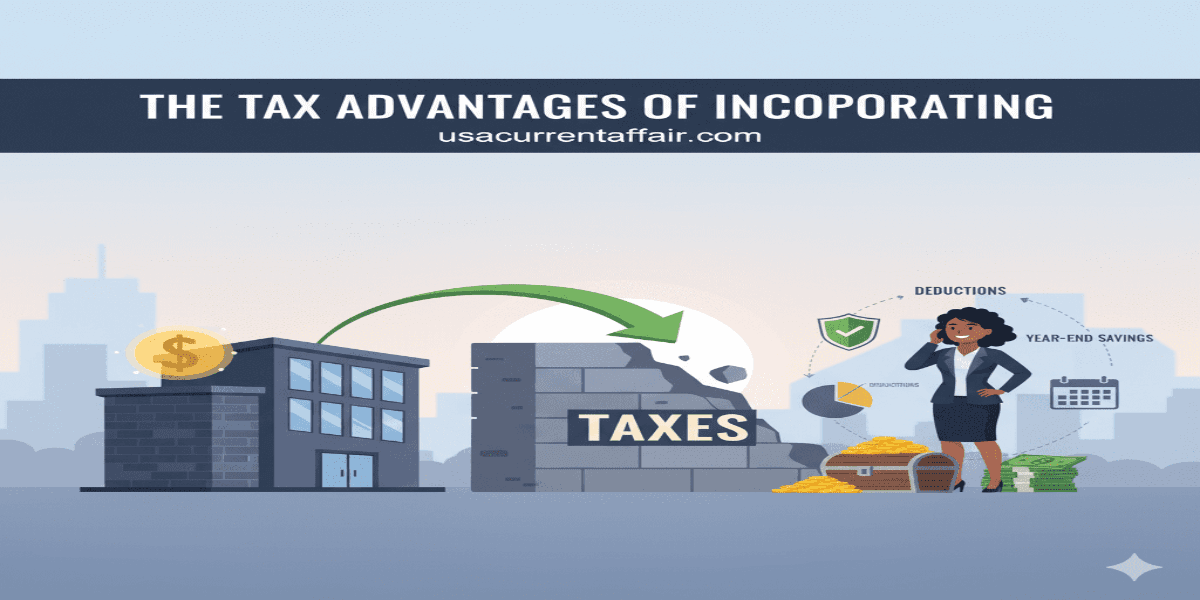
The Tax Advantages of Incorporating:
The Tax Advantages of Incorporating:
Every dollar matters in the cutthroat American economy of today, for both new and established companies. Whether to continue as a sole proprietorship, function as a partnership, or formally incorporate is one of the most important choices a business owner can make. Being incorporated gives substantial tax benefits that can have a direct influence on the bottom line, so it’s not just about legitimacy or status.
For many years, businesses have used the U.S. tax system to legitimately lower their liabilities, reinvest their profits, and safeguard their assets. The tax benefits of incorporating are significant, regardless of whether you decide on a C-Corporation, S-Corporation, or even a combination of tactics with an LLC.
HSBC Cashback Credit Card 2025 – Benefits, Rewards & How to Apply?

What Makes an Incorporation? The Basis of Corporate Tax Planning
When a business incorporates, it becomes a distinct legal entity. By clearly separating personal and corporate finances, this gives sole proprietors access to opportunities and security.
In terms of taxes, incorporation enables companies to:
- Get access to more credits and deductions.
- In some cases, take advantage of reduced tax rates.
- Establish a pay plan that includes dividends and salaries.
- Use retained earnings to strategically postpone taxes.
- Gain the trust of lenders and investors.
Although there are paperwork, compliance, and annual reporting requirements associated with incorporation, they are frequently outweighed by the long-term tax advantages.
The Principal Tax Benefits of Incorporation
Reduced Rates of Corporation Tax
The federal corporate tax rate has stayed at a consistent 21% since the Tax Cuts and Jobs Act (TCJA), which is much lower than the highest individual tax brackets, which can reach 37%.
By transferring income from personal to corporate tax status, incorporation can result in thousands of dollars in annual savings for successful enterprises.
Business Expenses That Are Deductible
Compared to single owners, corporations are eligible for more deductions, such as:
- Supplies, equipment, and office space.
- Travel and entertainment costs.
- rates for owners’ and workers’ health insurance.
- contributions to a retirement plan.
- Expert services (legal, accounting, and consulting).
By lowering taxable income, these deductions enable companies to reinvest in expansion rather than incur tax losses.
Planning for Compensation and Income Splitting
Owners can split income between salary (taxed as ordinary income) and dividends (often taxed at a lower rate). Compared to declaring all profits as personal income, this flexibility offers greater control over tax outcomes.
Benefits for Retirement and Health
Corporations can establish 401(k) plans, pension funds, and health reimbursement arrangements (HRAs). Contributions are typically deductible, reducing the corporation’s taxable income while also providing long-term benefits for owners and employees.
Carrying Losses Forward
Businesses don’t always turn a profit immediately. Corporations can carry forward operating losses to offset future profits, creating tax relief in growth years.
Deferral of Taxes Through Retained Earnings
Unlike sole proprietors, corporations can retain earnings within the company without distributing them to owners. This allows businesses to reinvest profits tax-efficiently without triggering personal tax obligations.
Incorporation Structures and Their Tax Implications
Corporations are not all made equal. The U.S. tax system distinguishes between C-Corporations, S-Corporations, and LLCs, each with unique tax advantages.
C-Corporation (C-Corp)
- Tax Rate: Flat 21% federal rate.
- Advantages:
- Unlimited growth potential with shareholders.
- Retained earnings taxed at corporate rates.
- Wide range of deductions and fringe benefits.
- Drawback: Double taxation (profits taxed at corporate level and dividends taxed again at personal level).
S-Corporation (S-Corp)
- Tax Treatment: Pass-through entity (no corporate-level tax).
- Advantages:
- Avoids double taxation.
- Owners can pay themselves “reasonable salaries” and take additional income as dividends, often taxed at lower rates.
- Eligibility for the Qualified Business Income (QBI) deduction of up to 20%.
- Drawback: Strict ownership and shareholder limitations.
Corporate Tax Election for Limited Liability Companies (LLCs)
- Flexibility: May be taxed as a corporation, partnership, or sole proprietorship.
- Benefits:
- Restricted protection against responsibility.
- Flexibility to save money by using the S-Corp tax treatment.
- Compliance is easier than with businesses.
Ownership arrangements, growth strategies, and income levels all influence the best structure.
Examining Incorporation in Relation to Other Business Forms
A corporation vs a sole proprietorship
- All income is reported as personal income by sole proprietors, who frequently pay higher tax rates.
- Restricted deductions in contrast to businesses.
- No defense against liability.
Corporation vs. Partnership
- Although partnerships have certain tax advantages, they are unable to strategically divide or retain earnings.
- Businesses offer greater investment prospects and scalability.
Case Studies: Real-World Tax Savings
Case 1: The Owner of a Small Business
Maria is the only proprietor of a profitable design firm that brings in $200,000 a year. She pays more than 30% in combined taxes at her personal tax rate.
Maria pays herself a fair $90,000 income, receives the remaining amount as dividends, and is eligible for the QBI deduction by incorporating as an S-Corp. She saves more than $20,000 a year when her effective tax rate falls by almost 10%.
Case 2: The Tech Startup
A software business that makes $1 million decides to form as a C-Corp. The corporation pays $210,000 in taxes at a 21% tax rate, which is significantly less than what would be paid if profits were taxed at the highest personal income rate. $790,000 is kept by the business to be reinvested in expansion.
Case 3: The Family-Owned Business
An LLC elects S-Corp taxation, allowing family members to split income strategically. This reduces overall household tax liability while maintaining liability protection.
Tax Considerations at the State Level
State-level regulations differ, despite the substantial benefits of federal taxes. While Wyoming, Nevada, and South Dakota are renowned for being business-friendly states with no corporate income tax, other states charge additional corporate taxes.
When choosing where to incorporate, businesses must consider the tax loads at the federal and state levels.
Beyond Taxes: Extra Advantages of Including
Although tax benefits are frequently the primary incentive, incorporation also offers:
- Protecting personal assets from lawsuits is known as liability protection.
- Credibility: Drawing in customers, lenders, and investors.
- Continuity: Businesses endure after their founders pass away.
- Capital Access: Raising funds through shares is simpler.
Over time, these indirect financial benefits increase the tax benefits.
Possible Consequences and Needs for Compliance
There are expenses associated with incorporation. Companies need to think about:
- Reporting requirements and yearly filing fees.
- Board meetings and minutes are examples of corporate formalities.
- C-Corps may be subject to double taxation.
These expenses, however, pale in comparison to the tax savings and legal safeguards enjoyed by companies with high revenue.
Prospects for the Future: Integration in 2025 and Later
Business owners should keep an eye out for any changes as Congress continues to debate corporate tax reform. Nonetheless, tax experts concur that incorporation will continue to be a potent tactic for lowering taxes and safeguarding earnings.
A growing number of entrepreneurs are using incorporation as a safeguard and a cost-cutting measure in a digital-first economy that supports startups, freelancers, and small enterprises.
In Conclusion: The Tax Advantages of Incorporating
The benefits of incorporation go well beyond lower tax rates. Incorporation provides businesses with the resources they need to succeed financially, from revenue splitting and deductions to retirement benefits and reinvestment options.
In 2025, incorporating is not only a legal requirement for American business owners, but also a calculated step toward ensuring sustained financial success.
Is It Smart to Take a Loan for Investments? Risks, Rewards, and Expert Insights
Is It Smart to Take a Loan for Investments? Risks, Rewards, and Expert Insights