 A K
A K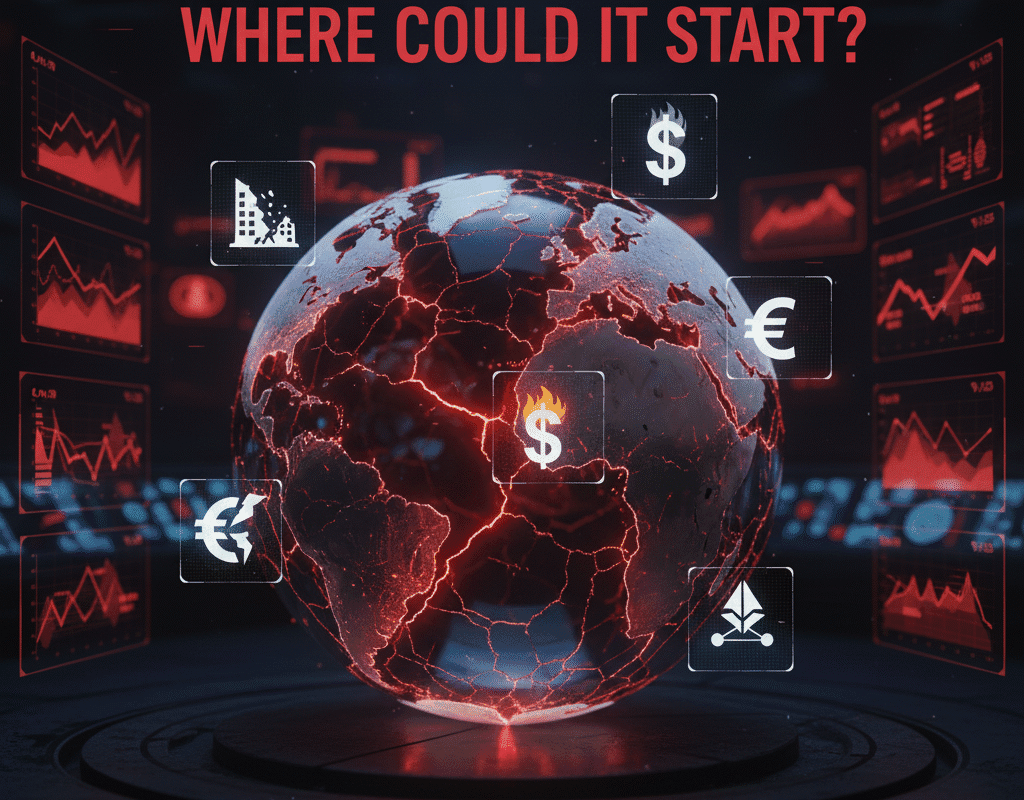
The Next Financial Crisis:
The Next Financial Crisis:
The global economy has always been shaped by cycles of growth, stagnation, and crisis. From the Great Depression of 1929 to the global financial crisis of 2008 to the pandemic-driven downturn in 2020, every financial disaster in the last century has altered economic policies and left behind long-lasting effects. Now, as the world navigates unprecedented levels of debt, inflation, and geopolitical uncertainty, economists and policymakers are asking the same pressing question:
Where could the next financial crisis begin, and how might it unfold?
This article explores the potential triggers, regions, and sectors most vulnerable to collapse, as well as the systemic risks that could turn local problems into a global financial disaster.
HSBC Cashback Credit Card 2025 – Benefits, Rewards & How to Apply?

1. Learning from History: How Crises Usually Begin
Financial crises rarely appear suddenly—they build up over time, fueled by excessive speculation, debt accumulation, or policy missteps. Historically, crises tend to start in one of these areas:
- Banking system failures: When bad loans pile up and banks lose liquidity (2008 subprime mortgage crash).
- Asset bubbles bursting: Rapid rises in housing, stock, or crypto markets followed by sharp collapses.
- Currency and debt crises: Emerging markets unable to pay back foreign-denominated debt.
- Policy mistakes: Central banks keeping interest rates too high or too low for too long.
Today, all these ingredients are present in different parts of the global economy.
2. The American Economy as a Possible Epicenter
The United States frequently takes the lead in international crises because it has the biggest economy in the world and issues the world’s reserve currency. A number of indicators point to weaknesses in the US financial system:
2.1.The Federal Reserve’s Tightrope
The Federal Reserve has aggressively raised interest rates since 2022 to combat inflation. While inflation has cooled, higher borrowing costs have exposed weak spots in the economy:
- Regional banks under stress due to commercial real estate loan defaults.
- Corporate debt refinancing risks as companies face higher interest payments.
- Household debt at record highs, driven by credit cards, auto loans, and mortgages.
2.2.Stock Market Fragility
U.S. equity markets have been fueled by tech-sector dominance and speculative investment in artificial intelligence. Valuations are historically high, leading many analysts to warn of a stock market correction that could erase trillions in household wealth.
3. Europe’s Debt Dilemma
Europe is still grappling with the aftershocks of the energy crisis, Russia’s war in Ukraine, and years of ultra-low interest rates.
- Southern European countries like Italy and Greece face mounting debt burdens.
- The European Central Bank (ECB) has hiked rates to tame inflation, increasing the risk of sovereign debt defaults.
- Germany’s slowing economy, once Europe’s engine, threatens to drag down the eurozone.
A bond market crisis in Europe could spread quickly, undermining confidence in the euro and creating global ripple effects.
4. The Debt and Real Estate Bomb in China
The second-largest economy in the world, China, has historically relied on infrastructure spending and real estate development to spur growth. But cracks in the system are becoming more visible:
- Evergrande and Country Garden, two of the largest property developers, face insolvency.
- A large portion of the hidden debt that local governments are drowning in is not on the books.
- The youth unemployment rate has surged, weakening consumer demand.
If China’s property bubble bursts completely, it could cause a deflationary shock worldwide, disrupting supply chains and commodity markets.
5. Emerging Markets: The Weakest Links
Emerging economies are often the first victims when global conditions tighten. Rising interest rates in the U.S. and Europe make it harder for developing countries to service their debts.
- Turkey, Argentina, and Pakistan are already struggling with inflation and currency crises.
- Sub-Saharan Africa faces food insecurity, high borrowing costs, and political instability.
- A stronger U.S. dollar makes dollar-denominated debt even harder to repay.
The risk of a wave of sovereign defaults could create instability in global banking and investment markets.
6. The Global Debt Bubble
One of the most alarming statistics today is the sheer size of global debt. According to the Institute of International Finance, total global debt surpassed $315 trillion in 2023 and continues to grow.
- Government debt levels are at post–World War II highs.
- Corporate borrowing exploded during the era of ultra-low interest rates.
- Households face rising mortgage and consumer loan burdens.
If interest rates remain elevated, the cost of servicing this debt could overwhelm both governments and private borrowers, sparking defaults and financial instability.
7. Banking System Risks
Though banks are more regulated than before 2008, vulnerabilities remain:
- Shadow banking (hedge funds, private equity, non-bank lenders) has grown significantly, outside traditional regulation.
- Regional and mid-sized banks are more exposed to commercial real estate downturns.
- Cybersecurity threats and digital fraud increase systemic risks.
A failure of one or more major institutions could trigger panic similar to the Lehman Brothers collapse in 2008.
8. Possible Causes of the Upcoming Crisis
Although the exact beginning of the next financial catastrophe cannot be predicted, there are a number of plausible triggers that could do so:
- U.S. stock market crash from overvalued tech companies.
- European sovereign debt default, particularly in Italy or Greece.
- Chinese property sector collapse, leading to banking failures.
- Emerging market debt crisis fueled by a strong dollar.
- Energy price shock due to geopolitical conflict.
- Bond market rout as investors flee government debt.
9. Economic Fragility Enhanced by Geopolitical Risks
Global financial stability is not only about markets—it’s also tied to geopolitics:
- Food and energy supplies are still being disrupted by the conflict between Russia and Ukraine.
- U.S.-China tensions over Taiwan and technology could escalate into trade wars.
- Middle East instability could trigger oil supply shocks.
Any of these flashpoints could be the spark that ignites an already fragile financial system.
10.How Policymakers Might Respond
If a crisis begins, governments and central banks will likely turn to familiar tools:
- Liquidity injections to stabilize markets.
- Interest rate cuts to stimulate growth.
- Bailouts and guarantees to protect banks and depositors.
- Debt restructuring programs for struggling countries.
But with debt already at record highs, policymakers may have fewer tools at their disposal than during past crises.
11.What Investors and Households Can Do
While individuals cannot prevent a global financial crisis, they can take steps to mitigate risks:
- Diversify investments across asset classes and regions.
- Limit leverage and avoid excessive debt.
- Hold emergency savings in liquid, safe assets.
- Stay informed about economic indicators and policy changes.
Preparation and prudence can reduce vulnerability to shocks.
Conclusion: Where Could the Next Crisis Begin?
The next financial crisis could start in many places: a U.S. recession, a European debt meltdown, a Chinese property collapse, or an emerging market default. What makes the current era especially dangerous is the interconnectedness of global markets. A crisis in one region is unlikely to remain contained—it could spread rapidly, just as the 2008 crisis went from Wall Street to the entire world.
While no one knows the precise trigger, the warning signs are flashing: high debt, fragile banks, overvalued markets, and geopolitical instability. The question is no longer if another financial crisis will occur, bu
How Big Data Shapes Lending Decisions: Transforming the Future of Borrowing in the U.S.
How Big Data Shapes Lending Decisions: Transforming the Future of Borrowing in the U.S.