 A K
A K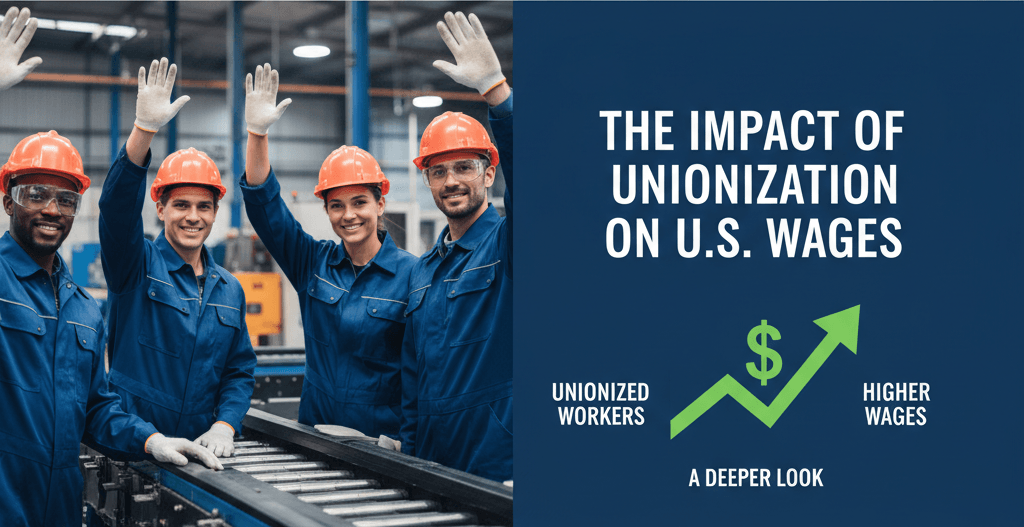
The Impact of Unionization on U.S. Wages:
The Impact of Unionization on U.S. Wages:
In the United States, labor unions have long played a pivotal role in shaping work life, wages, and broader economic trends. As union density has declined over recent decades, questions have emerged about how this shift affects workers’ pay, wage dispersion, and the strength of the middle class.
This article examines the impact of unionization on U.S. wages — the mechanisms by which unions influence pay, how that effect has changed over time, and what it means for non-union workers, wage inequality, benefits, and state-by-state variations.
HSBC Cashback Credit Card 2025 – Benefits, Rewards & How to Apply?

What is the “Union Wage Premium”?
At its core, a key reason unions affect wages is the so-called “union wage premium” — the difference between what a unionised worker earns and what a comparable non-union worker might earn. For instance:
- According to the U.S. Department of the Treasury, simple comparisons show that union workers in the U.S. typically earn about 20 % more than nonunion workers.
- The AFL‑CIO cites that on average union workers earn 11.2 % more than nonunion workers.
- A recent long-term study found that, by 2023, the unadjusted weekly wage differential between union and nonunion workers was about 31 %.
Why is there a premium?
Usually, unions bargain for improved pay, benefits, job security, and working conditions on behalf of their members. Consequently:
- They wield collective bargaining power which can push employers to raise wages.
- They may set standards in an industry or region that raise the baseline pay for both union and non-union workers.
- They may help reduce labor market slack (under-employment) and increase hours for union workers, further raising weekly pay.
How Unionization Impacts Wages: Mechanisms and Evidence
Bargaining and wage setting
When workers are organized into a union, they negotiate as a group rather than individually. This gives them leverage to set wage floors, raise the average pay in a firm or industry, and influence benefits. The presence of a union can push employers to raise pay to avoid organizing or to keep workers satisfied.
Spillover effects to non-union workers
An interesting and important feature is that unions don’t only benefit union members — they can raise the wage floor and norms in a region or industry, thus improving pay for non-union workers as well. For instance:
The Economic Policy Institute notes that unionization helps reduce wage inequality, close gender and race gaps, and improve pay.
Reduced wage dispersion and inequality
Numerous studies find that higher union density is associated with lower wage dispersion (smaller gaps between high and low earners). For instance:
- Research by Bruce Western and Jake Rosenfeld (2011) found that from 1973 to 2007, the decline of unions helped explain a significant portion of the growth in hourly wage inequality.
- A broad review summarised: “Unions continue to affect wage rises and reduce wage inequality despite reductions in their bargaining power.”
In short: stronger unions are tied to not only higher average wages, but more equitable pay distributions.
Historical Trends: Union Membership and Wage Impact in the U.S.
The number of union members has decreased.
The United States’ union density has drastically decreased from its peak in the middle of the 20th century. Although precise numbers differ by industry, one important element is:
- About 10.1% of wage-and-salary workers belonged to a union in 2022.
- In the past, union membership peaked in the middle of the 20th century (about one-third of workers in 1945, for example).
The salary structure and bargaining strength of all workers are affected by the reduction, in addition to union members.
Over time, the wage premium
As previously stated, union members continue to make greater money, but the difference has decreased:
- In the early 1970s, the hourly pay premium (unadjusted) was over 40%; by 2023, it was about 20%.
- In more recent decades, adjusted premiums (which account for worker, occupation, and industry differences) have generally been between 10% and 20%.
This decline can be attributed to a combination of factors: reduced union density, shifts in the economy away from heavily-unionised industries (manufacturing) to service, increased global competition, automation and so on.
What Does This Mean for Employees Who Are Not in a Union?
Unionization may have an indirect impact even if an employee is not a member:
- Particularly in places with high unionization rates, higher salaries in unionized businesses set a standard or “floor” that non-union employers could feel compelled to match.
- Better minimum wages and more robust protections for non-union workers are common outcomes of state policies and labor market norms that encourage collective bargaining.
- On the other hand, wage growth and worker bargaining strength are typically weaker in areas with low union density, which can lower compensation even for non-union employees.
As a result, the state of unions in a given area frequently indicates the strength of the labor market overall, making it important for all workers.
In conclusion: The Impact of Unionization on U.S. Wages
The impact of unionization on U.S. wages remains significant, even if the magnitude has fallen from its mid-20th-century highs. Unionised workers continue to earn more, benefit from stronger protections, and enjoy more stable work.
Equally important, unions influence wage norms, compress wage inequality, protect middle-class wages and benefit non-union workers indirectly as well.
However, the decline in union density, shifts in the economy, and changes in labour law have weakened these effects.
For policymakers, workers and employers alike, understanding the role of unions is critical: unions are not just a relic of the past, but a present-day factor shaping how much workers earn, how fairly they are paid, and how resilient middle-class wages will be in the years ahead.
How Home Equity Lines of Credit (HELOCs) Work in the U.S. — A Complete Guide for Homeowners
How Home Equity Lines of Credit (HELOCs) Work in the U.S. — A Complete Guide for Homeowners