 A K
A K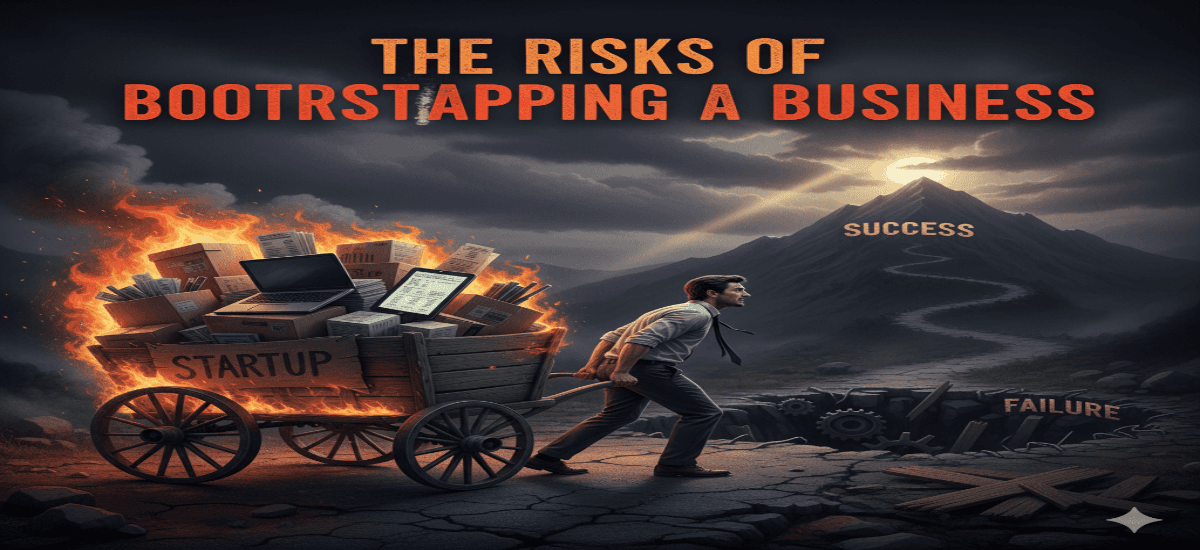
The Hidden Risks of Bootstrapping a Business:
The Hidden Risks of Bootstrapping a Business:
Bootstrapping has long been celebrated as the “purest” form of entrepreneurship. It embodies resilience, independence, and determination. By relying on personal savings, reinvesting revenue, and avoiding outside investors, entrepreneurs maintain complete control of their companies. But in 2025, with rising inflation, competitive markets, and increased business costs, the risks of bootstrapping are sharper than ever.
While stories of garage-to-global empires built without venture capital inspire millions, the harsh reality is that many self-funded businesses struggle under financial, operational, and psychological pressures. This article examines the hidden risks of bootstrapping a business, why they are particularly relevant now, and what every entrepreneur must weigh before choosing this path.
HSBC Cashback Credit Card 2025 – Benefits, Rewards & How to Apply?

What Is the True Meaning of Bootstrapping?
The term “bootstrapping” describes launching and expanding a company without outside funding. Entrepreneurs typically rely on:
- Personal savings or credit cards
- Revenue reinvestment
- Friends and family contributions
- Small bank loans (sometimes)
The philosophy is simple: build lean, spend wisely, and keep control. While this model minimizes dilution of ownership, it comes with heavy risks that venture-backed startups may avoid.
Financial Strain: The Biggest Risk of All
Cash Flow Crunch
Cash is the lifeblood of any business, and bootstrapped startups often operate on razor-thin margins. Without investor capital, entrepreneurs may delay salaries, cut marketing budgets, or even struggle to pay suppliers. A single late client payment can jeopardize operations.
Personal Debt Risks
Many founders use personal credit cards or loans to fund their ventures. According to U.S. small business statistics, over 40% of bootstrapped founders rely on personal credit. If the business fails, personal bankruptcy becomes a very real possibility.
Limited Growth Potential
Bootstrapped businesses must grow organically, which often means slower scaling. Competitors with external funding may outspend them in advertising, technology, and talent acquisition.
Difficulties with Emotion and Mental Health
The stress of being an entrepreneur is increased when one bootstraps.
- Isolation: Founders may feel isolated in their difficulties if they have no partners or investors to share the load.
- Burnout: Exhaustion can result from long hours, uncertainty, and financial strain.
- Emotional Attachment: Failure is terrible when personal finances are linked to corporate success.
2025 Competitive Disadvantages
Marketing and technology are essential in today’s economy. Bootstrapped companies have a number of drawbacks.
- Costs of Digital Marketing: Due to the explosive growth of Google, Meta, and TikTok advertising, exposure has become costly.
- Talent Acquisition: It becomes challenging to draw in top talent without investor funding.
- Innovation Lag: Wealthier rivals are able to experiment, change course, and develop more quickly.
Bootstrapping’s Opportunity Costs
Entrepreneurs who turn down outside financing run the risk of losing out on opportunities:
- Delayed Market Entry: If you move slowly, your competitors may gain an advantage.
- Missed Partnerships: Startups with strong financial support are preferred by many corporate partnerships.
- Slow Expansion: External funding is frequently needed to scale across states or nations.
Success and Struggle in Real-World Stories
- Success Story: Mailchimp, founded in 2001, grew to become a $12 billion company without outside investors. Its story is legendary in startup circles.
- Struggle Story: Thousands of small retail and e-commerce businesses launched during the pandemic have since closed, largely due to lack of funding to survive inflation and supply chain disruptions.
These contrasting examples highlight that while bootstrapping can succeed, the risks are real and widespread.
The Stress on Families’ Minds
Bootstrapping has an impact on families as well as founders. Financial sacrifices, such as lowered lifestyles or delayed life milestones like home ownership, are frequently shared by spouses and kids.
Relationship pressure may result from the ongoing uncertainty. According to surveys, 46% of business owners say that their unstable finances cause relationship stress.
Innovation Sacrifices: The Hidden Cost
Innovation is frequently neglected when funds are limited. Bootstrapped companies might stay away from:
- Investigation and advancement
- Enhancements to the customer experience
- Strategic long-term investments
This leads to a paradox: being lean discourages innovation while preventing overspending.
Risks to Legality and Compliance
Bootstrapped companies could take shortcuts in:
- Legal defense (contracts, patents)
- Policies for insurance
- Adherence to regulations
This can put business owners at risk for legal action or fines that could have been prevented with stronger funding.
The Best Times to Use Bootstrapping
Bootstrapping isn’t necessarily bad, despite the hazards. It functions effectively when:
- Low initial investment is needed for the business (e.g., consulting, digital products).
- The founders already have a sizable customer base or network.
- Revenue from the product can be generated rapidly.
- Rapid scaling and total ownership are important to entrepreneurs.
Non-Pure Bootstrapping Options
Entrepreneurs don’t need to choose between full bootstrapping and heavy venture capital. Alternatives include:
- Angel investors with flexible terms
- Crowdfunding campaigns
- Government grants and small business loans
- Revenue-based financing
Hybrid approaches often reduce risks while preserving independence.
Risk Mitigation Strategies for Bootstrapped Entrepreneurs
To reduce risks, founders should:
- Maintain strict financial discipline – track every dollar.
- Build multiple revenue streams early.
- Invest in low-cost digital marketing strategies like SEO.
- Network strategically to access mentorship and partnerships.
- Set mental health safeguards like peer support groups and scheduled downtime.
The Business Environment of 2025: The Reasons for Increasing Risks
The business environment in the United States in 2025 increases the risk of bootstrapping:
- The cost of services and raw materials rises due to inflationary pressures.
- Personal loans are more costly when interest rates are high.
- Markets become saturated more quickly when there is fierce global rivalry.
- AI-driven disruptions benefit well-funded companies that can swiftly implement state-of-the-art technologies.
For many small businesses, the decision to bootstrap is now riskier than it was just five years ago.
Professional Views
Business analysts warn that while bootstrapping builds resilient founders, it should not be romanticized.
“Bootstrapping is not always bravery—it can sometimes be unnecessary risk-taking,” says a small business advisor from New York. “Entrepreneurs need to evaluate the opportunity cost of staying self-funded.”
Concluding Remark: Is Bootstrap Necessary in 2025?
Although it provides autonomy and ownership, bootstrapping is not a universally applicable approach. Particularly in the current market, the risks—financial, emotional, and strategic—may exceed the rewards.
Entrepreneurs need to consider:
- Speed versus control
- Risk-sharing versus ownership
- Individual sacrifice against long-term development
Conclusion
The entrepreneurial aspiration of starting a company from the ground up without outside assistance never goes out of style. However, numerous others suffer from the unspoken dangers of bootstrapping behind every success story. Entrepreneurs must be open-minded about the realities of 2025, which include increased expenses, fiercer competition, and greater pressures.
Bootstrapping involves more than simply financial risk; it also involves a company’s long-term viability and mental and emotional health. Each founder should carefully consider whether this course fits with their resources and vision.