 A K
A K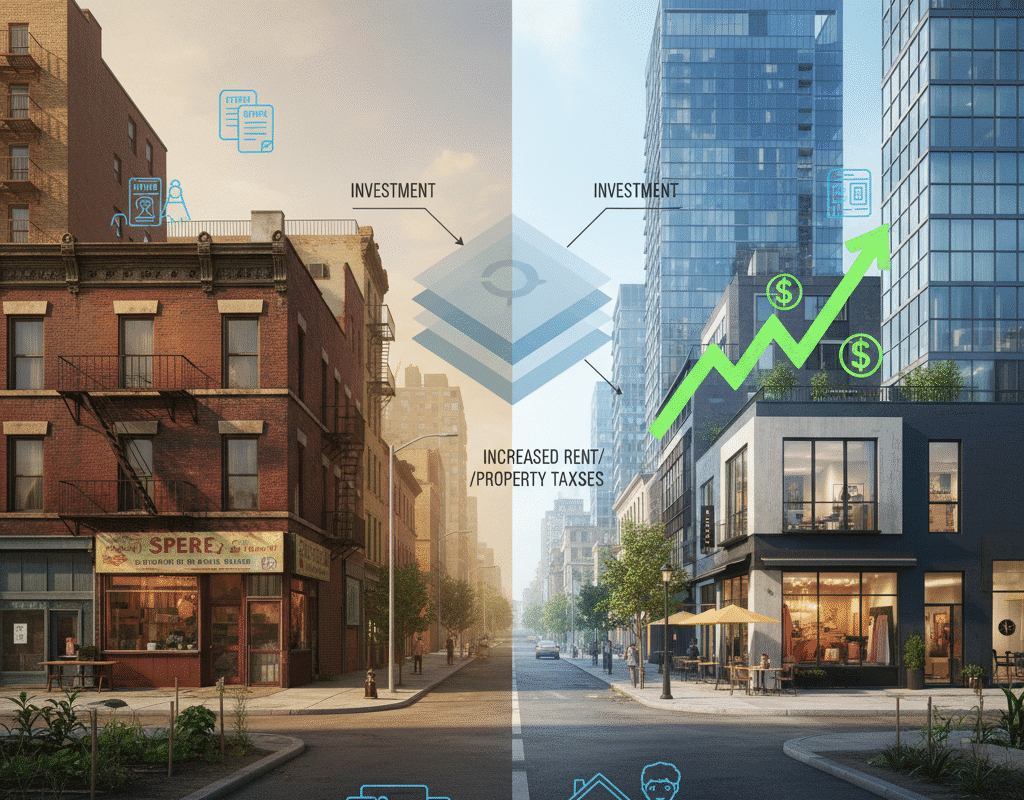
The Economics of Urban Gentrification in U.S. Cities
The Economics of Urban Gentrification in U.S. Cities
One of the most significant—and contentious—economic developments influencing American cities in the twenty-first century is urban gentrification. Rent increases, new building, and an inflow of wealthier residents are all occurring in once-dismissed communities.
Long-standing communities also have to deal with growing inequality, cultural deterioration, and displacement. Gentrification’s underlying economic mechanics reveal a complicated system of incentives, market forces, and governmental decisions that have developed over decades, despite the fact that the political disputes around it are well-known.
HSBC Cashback Credit Card 2025 – Benefits, Rewards & How to Apply?

A Market-Driven Transition: The Reasons Behind Gentrification
At its core, gentrification is an economic process. It happens when wealthy residents or investors suddenly show interest in neighborhoods that were previously undervalued by the market. This change is driven by several factors:
The Movement for Urban Revival
Young professionals’ interest in American cities increased starting in the late 1990s and picking up speed in the 2010s. Demand was driven back into urban cores by a desire for walkable communities, convenient access to public transportation, and closeness to employment areas.
This reversed decades of suburban flight from an economic standpoint. As tech and service industries grew, cities like New York, Washington, Austin, Seattle, Nashville, and Denver attracted younger, better-paying workers.
Lack of Housing
New home development has not kept up with population increase in many metropolitan regions. Buyers and renters are driven to previously neglected neighborhoods—often those with historically lower house prices—by the combination of limited supply and rising demand.
Price increases are accelerated when early adopters are followed by developers and speculative investors.
Investing in Real Estate
Institutional investors have grown to be significant participants in the urban real estate market, buying numerous older houses or apartment complexes, remodeling them, and increasing rents. Finding undervalued sectors with room to grow is the foundation of their business strategy.
Neighborhoods change quickly as a result, frequently more quickly than locals can adjust.
Policy’s Function: Fuel or Fix?
Economic factors are not isolated entities. The results of gentrification are greatly influenced by public policy.
Land Use and Zoning Regulations
Zoning restrictions, particularly those pertaining to multi-family housing, restrict supply and raise prices. Gentrification is more aggressive in cities with stringent zoning.
Developer Tax Incentives
To encourage development, several communities provide tax breaks. They can hasten displacement by increasing land values or promoting luxury development over cheap housing, even while they are beneficial for rehabilitation.
Tenant Protections and Rent Control
Although they may also restrict new construction, cities like New York and San Francisco that have robust tenant rights lessen displacement. Maintaining affordability while promoting supply is still a hotly debated policy issue.
Case Studies: Lessons from U.S. Cities
While no city has solved gentrification entirely, several offer insight into different approaches.
New York City
New York’s story illustrates how massive demand and limited housing supply can drive extreme price escalation. Despite strong tenant protections, displacement in outer boroughs remains a growing problem.
Washington, D.C.
Washington transformed dramatically between 2000 and 2020, with neighborhoods like Shaw and H Street changing demographically and commercially. The city now grapples with one of the highest displacement rates in the nation.
Austin
Austin’s rapid tech-driven growth pushed gentrification eastward, displacing long-established communities. Policy responses—like affordable housing bonds—aim to slow the trend but struggle to match demand.
Conclusion: The Economics of Urban Gentrification in U.S. Cities
The economics of urban gentrification show that market pressures, governmental choices, changes in the population, and international investment trends all influence this phenomena. Gentrification can result in economic opportunity, better infrastructure, and regeneration, but it often costs vulnerable residents a lot and changes the character of historic neighborhoods.
The task for politicians is to manage gentrification so that affluence is distributed fairly and widely rather than to completely halt it. The argument over striking a balance between affordability and development will continue to be at the forefront of economic and social policy as American cities expand and change.