 A K
A K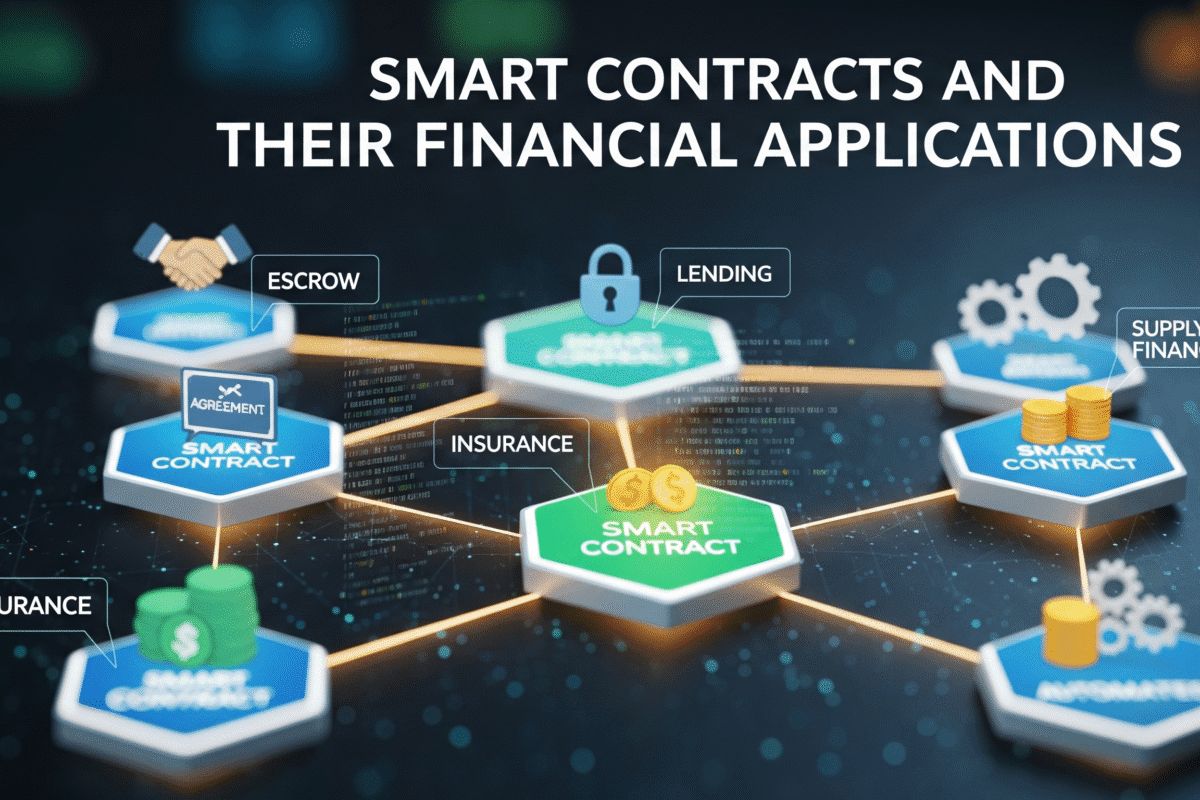
Smart Contracts and Their Financial Applications:
Smart Contracts and Their Financial Applications:
A key invention in the rapidly changing field of financial technology is smart contracts. These digital agreements, which are based on blockchain technology, have the potential to completely change how investors, financial institutions, and regular consumers do business. Smart contracts are already changing the face of international finance, from banking and insurance to investments and decentralized finance (DeFi).
Smart contracts are becoming useful tools with a wide range of uses rather than future ideas as the US and other economies adopt blockchain-driven solutions. Along with forecasts, case studies, and expert perspectives, this article examines smart contracts’ definition, operation, benefits, drawbacks, and financial applications.
HSBC Cashback Credit Card 2025 – Benefits, Rewards & How to Apply?

Smart Contracts: What Are They?
A self-executing contract with terms and conditions encoded directly into code is called a smart contract. Smart contracts run automatically when certain criteria are satisfied, as contrast to traditional contracts that need legal supervision, middlemen, or manual enforcement.
For instance, the interest rate, penalties, and repayment date are encoded if Alice uses a smart contract to give Bob $1,000. The contract automatically takes effect when the repayment is due, incurring penalties if it is missed or taking money out of Bob’s pocket if it is met.
Nick Szabo first put out the idea in the 1990s, but it really took off in 2015 when Ethereum emerged and developers were able to use programmable contracts to create decentralized applications (dApps).
Key Features of Smart Contracts
- Automation: No manual intervention is needed once conditions are coded.
- Transparency: Contract terms are visible on a public or private blockchain.
- Security: Encrypted and stored on blockchain, making them difficult to alter.
- Efficiency: Faster execution compared to traditional paperwork.
- Trustless Transactions: Parties don’t need to trust each other — they trust the code.
Financial Applications of Smart Contracts
Banking and Payments
Smart contracts eliminate intermediaries such as clearinghouses and payment processors. They enable instant cross-border transactions, real-time settlements, and reduced costs.
- Use Case: JPMorgan Chase developed a blockchain-based platform, Onyx, using smart contracts to settle interbank transactions within seconds instead of days.
- Impact: This could save banks billions annually by reducing fraud and operational inefficiencies.
Insurance
Traditional insurance often suffers from delays, disputes, and fraudulent claims. Smart contracts can automate claims processing by linking policies with real-time data sources.
- Example: Flight delay insurance — if a flight is delayed beyond a set time, the smart contract triggers instant compensation to the traveler without requiring a claim.
- Impact: Reduces administrative costs and builds consumer trust.
Borrowing and Lending
Decentralized Finance (DeFi) platforms, which allow people to lend or borrow money without the use of institutions, rely heavily on smart contracts.
- How It Works: Lenders deposit funds into a liquidity pool; borrowers access loans by locking collateral. Smart contracts enforce repayments automatically.
- Example: Platforms like Aave and Compound run entirely on smart contracts, handling billions in assets.
Investment and Asset Management
Tokenized assets and smart contracts allow fractional ownership of stocks, bonds, or real estate. This opens up investment opportunities to a wider audience.
- Example: Real estate companies use blockchain platforms where smart contracts enable small investors to purchase fractions of high-value properties.
- Impact: Democratizes investment and enhances liquidity in traditionally illiquid markets.
Trade Finance
Global trade involves multiple intermediaries, making it slow and costly. Smart contracts can automate letters of credit, shipment tracking, and customs clearance.
- Case Study: IBM and Maersk’s TradeLens platform leverages blockchain to streamline shipping documentation with smart contracts.
- Impact: Reduces fraud, cuts paperwork, and ensures real-time updates.
Decentralized Finance (DeFi)
The most significant financial impact of smart contracts is in DeFi, where users engage in borrowing, lending, staking, yield farming, and derivatives trading without intermediaries.
- Growth: As of 2025, DeFi markets manage over $70 billion in locked assets, much of which runs on Ethereum smart contracts.
- Impact: Challenges traditional banking while promoting financial inclusion.
The Financial Advantages of Smart Contracts
- Cost reduction: Transaction costs are decreased when middlemen are eliminated.
- Speed: Financial agreements are carried out in real time.
- Security: Blockchain records that cannot be altered lower the possibility of fraud.
- Accessibility: Makes it possible to participate in finance globally without regard to location.
- Transparency: Open-source code ensures accountability.
Risks and Limitations
Despite the advantages, smart contracts face challenges:
- Coding Errors: Bugs in the code can be exploited. Example: The infamous DAO hack in 2016 led to $50 million in losses.
- Regulatory Uncertainty: Governments, including the U.S., are still debating how to regulate blockchain-based agreements.
- Irreversibility: Once executed, contracts cannot be undone, even if there was a mistake.
- Complexity: Non-technical users may struggle to understand the underlying code.
- Scalability: Ethereum and other blockchains face congestion issues, leading to high fees.
Regulatory Outlook in the USA
The U.S. government recognizes the importance of blockchain innovation but seeks to balance growth with consumer protection.
- SEC & CFTC Oversight: The Securities and Exchange Commission (SEC) monitors tokenized securities, while the Commodity Futures Trading Commission (CFTC) oversees derivatives.
- State-Level Initiatives: Arizona and Tennessee have passed laws recognizing smart contracts as legally binding.
- Future Trends: A push for federal-level legislation to standardize smart contract use in finance is expected by 2026.
Conclusion
Smart contracts are no longer just a buzzword — they are a transformative force in finance. By automating trust, reducing costs, and opening global access, they are paving the way for a new era of decentralized and transparent financial systems.
While challenges like regulation, scalability, and coding risks remain, the financial applications of smart contracts in banking, insurance, investments, and DeFi demonstrate their disruptive potential.
For the United States and the world, smart contracts mark a paradigm shift from traditional financial structures to a blockchain-powered future.
REITs: Investing in Real Estate Without Owning Property (2025 Guide)
REITs: Investing in Real Estate Without Owning Property (2025 Guide)