 A K
A K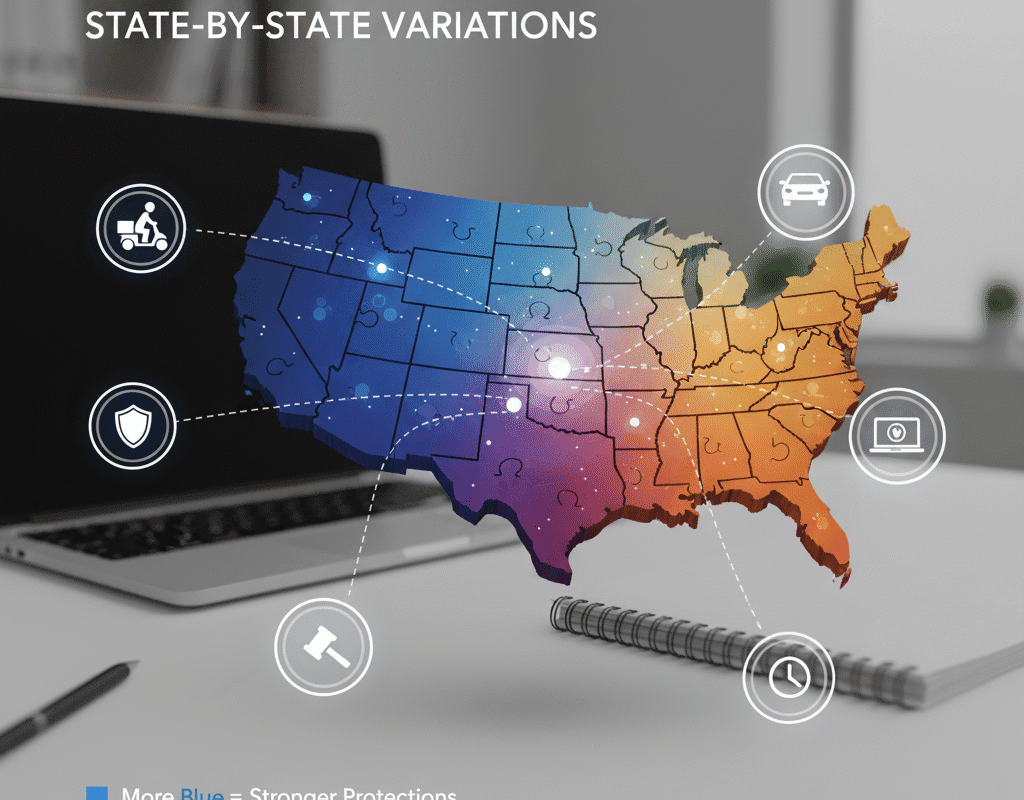
How U.S. Gig Worker Protections Differ Strongly Across States?
How U.S. Gig Worker Protections Differ Strongly Across States?
In the United States, protections for gig workers — such as ride-hail drivers, delivery couriers, and other app-based laborers — vary dramatically depending on the state. Unlike traditional employees, gig workers are often classified as independent contractors, a status that excludes them from many labor protections such as minimum wage, unemployment benefits, and full workers’ compensation.
But across the country, states are charting very different courses: some are strengthening rights through tougher classification tests and pay minimums, while others preserve flexibility for platforms.
HSBC Cashback Credit Card 2025 – Benefits, Rewards & How to Apply?

Why State Laws Matter: The Classification Conundrum
Under U.S. federal law, many gig workers are treated as independent contractors, meaning they are not eligible for many of the benefits that traditional employees receive.
A key tool used by some states to combat misclassification is the ABC test — a legal standard that presumes a worker is an employee unless certain conditions are met. According to the Economic Policy Institute, as of 2022, 18 states plus the District of Columbia have adopted ABC tests for some employment-related laws.
Washington State: A Model of Compromise
One notable state that maintained independent contractor status while establishing a customized set of safeguards under a 2022 statute is Washington (ESHB 2076). Important characteristics consist of:
- Minimum trip payments: As of December 31, 2022, ride-hail drivers are guaranteed at least $0.34 per passenger platform minute, $1.17 per passenger platform mile, or $3.00 per trip — whichever is greater.
- Workers’ Compensation: From January 1, 2023, premiums are assessed for rideshare drivers.
- Paid Sick Leave: Drivers accrue one hour of sick leave per 40 hours worked.
- Resource Center: The law also creates a driver resource center funded by a small passenger fee (about 15 cents), giving drivers support and a route to dispute deactivations.
Workers’ Risks and Trade-Offs
Advantages vs. Flexibility
One of the main conflicts in gig worker legislation is striking a balance between safeguards and flexibility, which is the allure of the independent contractor model. The freedom to choose their own hours is a big draw for a lot of gig workers. Hard classification into employment may result in trade-offs, such as greater benefits but possibly more oversight or less flexibility.
Gaps in Enforcement
Enforcement can be slow, even in jurisdictions with protective legislation. California’s experience with Prop 22 is instructive: underfunded regulatory agencies cause many wage or benefit claims to remain unresolved despite legal promises.
Algorithmic Risk and Deactivation
Beyond compensation, gig workers run the risk of having their income unexpectedly cut off by being deactivated, or removed from the app. A resource center and appeals procedure are mandated by Washington law to handle this.
Wider Consequences: The Significance of This Patchwork
Racial Justice and Inequality
Low-income and minority populations are disproportionately represented in gig work. Labor advocates claim that gig work is more common among Black and Hispanic Americans than among White Americans. As a result, inadequate safeguards may make already-existing disparities worse.
State-by-State Contest
Platform firms frequently claim that excessive state regulation could force them away or inhibit growth. States may be reluctant to enact robust gig protections for fear of pushing platforms to greener pastures or losing revenue as a result, creating a race to the bottom risk.
The Road Ahead: What to Watch For
- Expansion of ABC Tests: Several states still lack strong ABC tests. Labor advocates are pushing for more states to adopt this test, arguing it’s the most reliable legal way to challenge misclassification.
- Growth of Portable Benefits Programs: As more states explore portable benefit systems, there is potential for more uniform protections that don’t depend on employer classification.
- Enforcement Resourcing: Even in states with strong gig-worker laws, underfunded labor departments weaken implementation. Future advocacy may focus on increasing budgets or creating dedicated enforcement units.
- Algorithmic and Deactivation Protections: Deactivation remains a major risk in gig work. More states may push for appeal mechanisms, transparency in algorithmic decisions, and financial remedies.
Conclusion: How U.S. Gig Worker Protections Differ Strongly Across States?
The U.S. gig economy is not a monolithic entity: protections for gig workers differ sharply across states. California offers a cautionary tale of limited gains under Prop 22, while Washington provides a model of compromise with guaranteed minimum trip pay, sick leave, and resource support. Elsewhere, ABC tests and portable benefit initiatives are pushing the labor landscape forward — but enforcement gaps, classification risks, and algorithmic opacity remain major obstacles.
For gig workers, understanding their state’s legal framework is essential. For policymakers, the challenge is designing rules that preserve flexibility without sacrificing fairness. And for platform companies, navigating this patchwork means balancing labor costs, regulatory compliance, and business growth.
The Economics of State Estate Taxes: How They Impact Wealth and State Revenue in the U.S.
The Economics of State Estate Taxes: How They Impact Wealth and State Revenue in the U.S.