 A K
A K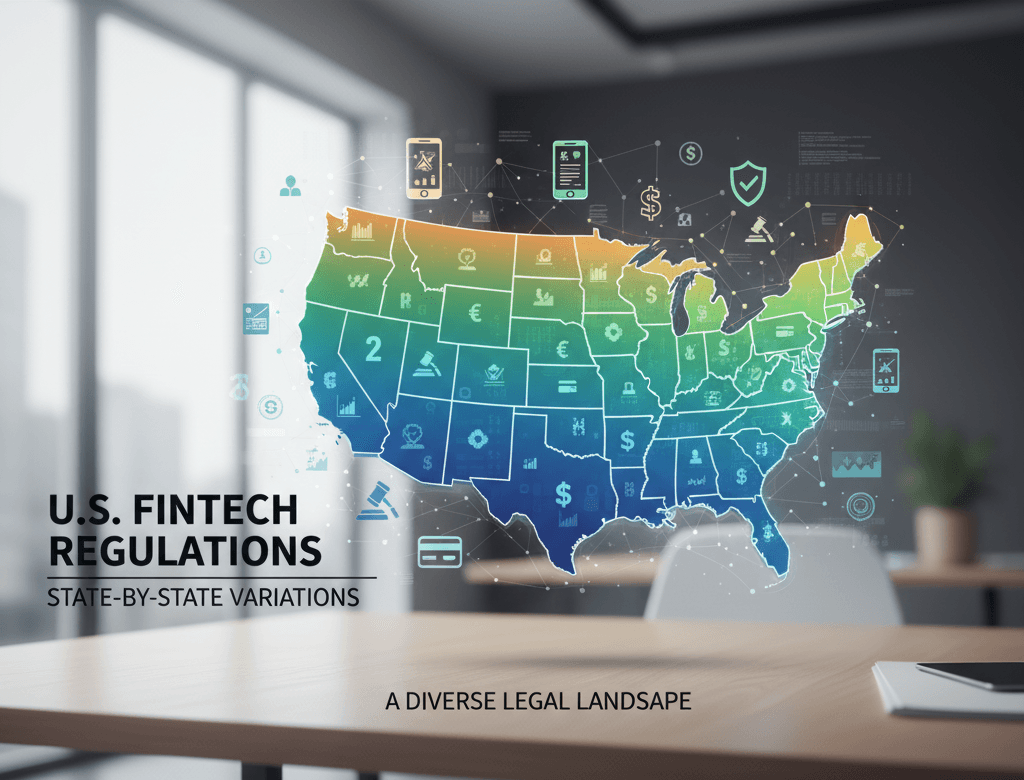
How U.S. Fintech Regulations Differ Across States?
How U.S. Fintech Regulations Differ Across States?
In the United States, the regulatory landscape for financial-technology (fintech) firms is far from uniform. While there is federal supervision, much of the licensing, operating permission, and compliance burden falls to individual states. This creates a patchwork of rules that fintech companies must navigate if they wish to operate across state lines.
In this article we examine how the U.S. regulatory system is structured, why there is so much variation among states, key examples of state-by-state differences (especially in money‐transmitter licensing, cryptocurrency, consumer protection and data privacy), and what the implications are for fintech firms.
HSBC Cashback Credit Card 2025 – Benefits, Rewards & How to Apply?

Federal vs State: The Dual System
At the federal level, agencies such as the Consumer Financial Protection Bureau (CFPB), the Securities and Exchange Commission (SEC), the Commodity Futures Trading Commission (CFTC), the Financial Crimes Enforcement Network (FinCEN) and the Office of the Comptroller of the Currency (OCC) all have important roles in supervising aspects of fintech, payments, lending, and securities.
However, federal regulation often sets minimum standards or addresses broad themes (e.g., anti-money-laundering, securities offerings) while the licensure, supervision and enforcement of non-bank financial services is often handled by each state. For example, the term “money transmitter” is typically defined in state law, and many states require a separate license for such activity.
Implications for Fintech Firms
The state-by‐state variation has significant practical implications for fintech vendors, investors and startups:
- Cost and time to scale nationally – Because each state has its own licensing regime, a fintech firm wishing to operate in the U.S. broadly may need dozens of licenses, pay multiple application and renewal fees, secure surety bonds in each state, and maintain ongoing state-specific compliance. This slows expansion and raises barriers to growth.
- Regulatory arbitrage & market strategy – Some firms may choose to launch first in states with lighter licensing burdens or more permissive regulation, then expand into states with heavier requirements. However, this must be balanced against enforcement risk and consumer-protection scrutiny.
- Operational complexity and compliance burden – Firms must maintain systems to track state-specific rules: e.g., lending rules in one state, money-transmitter bond amounts in another, crypto licensing in yet another. This demands stronger compliance, legal and regulatory infrastructure.
- Risk of enforcement if non-compliant – Operating without a license or in a state in which you are not authorized can lead to enforcement actions, fines or forced withdrawal from that market. For example, a recent settlement with a U.S. crypto firm for operating without required state licenses underscores the risk.
- Consumer-protection and reputational risk – Because consumers expect fintech services to be seamless and safe, any regulatory misstep slows trust and may invite state regulators to step in aggressively.
Recent Trends in U.S. Fintech Regulation
Several recent developments highlight how the regulatory landscape is evolving:
- According to “Fintech Laws and Regulations 2025 – USA” (Global Legal Insights), the fintech sector in 2025 is seeing major growth in AI, blockchain and big-data usage, which in turn is prompting regulators to refine AML, cyber-security, data-protection and licensing frameworks.
- State privacy laws continue to proliferate – more states are adopting comprehensive privacy statutes (e.g., data minimization, private right of action) which fintechs must address.
- State regulators are increasingly coordinating via multistate licensing systems (e.g., the Conference of State Bank Supervisors and the Money Transmitters Regulators Association) to provide more consistency.
Recommendations for Fintech Startups & Investors
Given the complex state-by-state fintech regulatory environment, here are some actionable recommendations:
- Conduct early mapping of state regulatory regimes – Before launching services across many states, assess which states impose burdensome licensing (higher bond/capital/fee), which are more permissive, and where your business model fits best.
- Consider phased state roll-out – Launch in a subset of states with favourable regimes, refine your compliance and operations, then expand gradually into heavier regimes.
- Design compliance infrastructure with flexibility – Build modular systems that can adapt to state-specific rules (e.g., bonding calculations, renewal schedules, consumer-disclosure language, geo-fencing by state).
Conclusion: How U.S. Fintech Regulations Differ Across States?
In the U.S., fintech firms cannot rely solely on a unified national regulatory regime. Instead, they face a dual-layer landscape: federal oversight plus state-by-state licensing and regulatory regimes.
The variation among states — in terms of money-transmitter licensing, crypto-asset regulation, consumer-credit requirements and data-privacy laws — means that firms seeking national scale must navigate a complex tapestry of rules.
For fintech companies, this means planning for regulatory complexity from the outset, designing flexible compliance architectures, and budgeting for the cost of multi-state licensing and supervision.
Investors and management teams must recognise that this regulatory fragmentation is not a temporary anomaly but a structural feature of the U.S. market. Success depends on regulatory strategy as much as on product innovation.
Why Remote Work Is Reshaping the Office Leasing Market in 2025 | Economic Trends & Analysis
Why Remote Work Is Reshaping the Office Leasing Market in 2025 | Economic Trends & Analysis