 A K
A K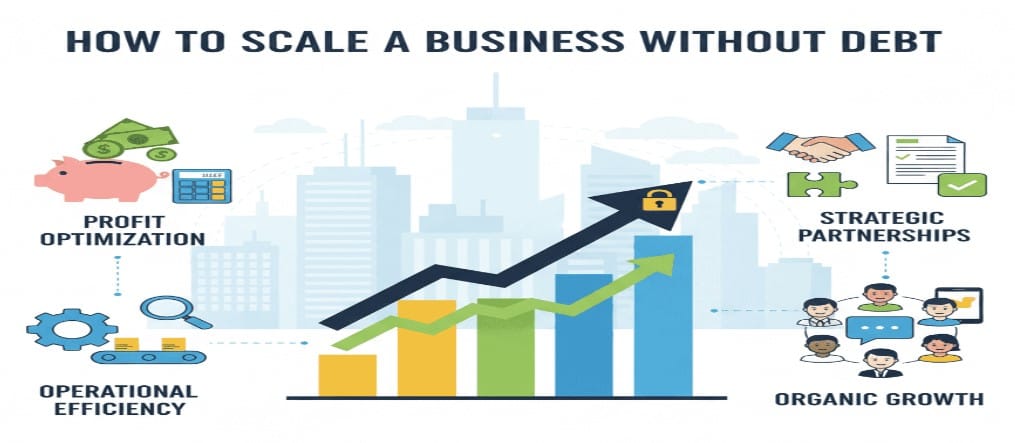
How to Scale a Business Without Debt?
How to Scale a Business Without Debt?
Entrepreneurs all throughout the world have long aspired to scale their businesses. Nevertheless, the conventional approach to quick growth frequently depends largely on debt funding, making companies susceptible to interest payments, cash flow problems, and unstable finances. More business owners are searching for debt-free strategies to grow their companies in the current uncertain economic environment, with an emphasis on organic, sustainable, and debt-free expansion.
This article examines tried-and-true methods for successfully expanding a business while avoiding the financial pitfalls that can result from taking on too much debt. These guidelines can help you achieve long-term, debt-free success whether you are an established entrepreneur, small business owner, or startup founder.
HSBC Cashback Credit Card 2025 – Benefits, Rewards & How to Apply?

The Dangers of Growing Debt-Free
Prior to using debt-free development solutions, it’s critical to comprehend the risks associated with excessive debt use during scaling:
- High Interest Burden: Unpredictable interest rates associated with loans frequently reduce profitability.
- Cash Flow Pressure: Repayments every month cut down on liquidity, which restricts investments in company activities.
- Economic Uncertainty – Recessions or market downturns can leave debt-heavy businesses vulnerable to collapse.
- Equity Dilution Risks – Sometimes, debt is paired with giving up equity, reducing the founder’s control.
While borrowing can accelerate growth, it can also compromise a company’s resilience. This is why debt-free scaling strategies are gaining traction, especially in 2025 where economic volatility and rising interest rates pose new challenges.
Why Scale Without Debt?
Financial Independence: Owners of businesses maintain complete control free from influence from creditors.
- Long-Term Stability: Scaling slowly and strategically builds resilience.
- Better Investor Appeal: Companies with low liabilities attract higher valuations.
- Reduced Stress: Entrepreneurs focus on growth, not repayment schedules.
In short, scaling without debt allows companies to grow organically, sustainably, and profitably.
Put Profits Back Into Development
Reinvesting profits back into the company is one of the best strategies to grow without taking on debt. Rather than taking large payouts or needless costs, set aside a percentage of profits for:
- Marketing initiatives to broaden the audience.
- Improvements in technology to increase efficiency.
- Employee education to increase output.
- Innovation through product development.
Pay Attention to Natural Development
Scaling without debt mostly depends on organic growth tactics, such as:
- Using podcasts, videos, and blogs to establish brand authority is known as content marketing.
- Social Media Engagement: Expanding a following without spending a lot of money on advertising.
- Increasing a website’s steady traffic is known as search engine optimization, or SEO.
- Referral programs: Encouraging happy clients to recommend others.
Cost effectiveness and lean operations
Businesses must use a lean operations approach in order to grow debt-free. This include eliminating wasteful spending, automating monotonous jobs, and optimizing processes. Important strategies consist of:
- Assigning non-essential work to agencies or independent contractors.
- Marketing, accounting, and customer service automation tools.
- Negotiating better margins on supplier contracts.
- Models of remote work to cut expenses.
Strategic Alliances and Cooperation
Growing alone is not the only way to scale without debt. Without requiring significant financial outlays, strategic alliances offer access to new markets, resources, and clients. Among the examples are:
- Partnerships with complementary industries.
- Cross-promotions with companies that aim to reach the same demographic.
- Affiliate programs in which partners market goods in exchange for a cut.
Growth Focused on the Customer
Leveraging client loyalty to scale is one of the most underutilized debt-free tactics. Instead of chasing new leads with expensive advertising, organizations may expand by leveraging existing customer value.
Tactics include:
- Cross-selling and upselling related goods.
- Subscription or membership models for steady recurring income.
- Long-term customer retention through exclusive loyalty rewards.
- Customized marketing to improve connections.
Innovative Bootstrap
From Basecamp to Mailchimp, many of the most prosperous businesses in the world were founded entirely on their own without the use of venture capital or outside loans. Discipline, perseverance, and resourcefulness are necessary for bootstrapping.
Among the bootstrap tactics are:
- Beginning Small: Introducing a minimal viable product (MVP) at launch.
- Using Low-Cost or Free Tools: As an alternative to pricey software.
- Leveraging Sweat Equity: Making a personal investment rather than hiring someone early.
- Growing Gradually: Increasing only when financial gains permit.
Debt-Free Alternative Funding
Despite the dangers of debt, there are other funding options that spare companies from having to make repayments:
- Crowdfunding: Platforms like Kickstarter and Indiegogo allow businesses to raise funds from customers directly.
- Grants: Government or private grants provide capital without repayment.
- Angel Investors: Individuals who invest in exchange for equity, not loans.
- Revenue-Based Financing: Repayment linked to revenue performance instead of fixed interest.
Expand Through Technology
Technology enables businesses to scale rapidly at minimal cost. Key areas to focus on include:
- E-commerce Platforms: Expanding reach beyond local markets.
- AI-Powered Tools: Automating customer support and analytics.
- Cloud Solutions: Reducing IT infrastructure expenses.
- Digital Payment Solutions: Streamlining transactions.
Establish a Culture of Effective Leadership and Teamwork
Scaling involves more than simply money; it also involves team development and leadership. Debt-fueled expansion is not necessary to accomplish outstanding results when a team is committed and aligned.
Some strategies are:
- Hiring wisely as opposed to hastily.
- Encouraging the team to adopt a growth mindset.
- Putting money into staff development to improve performance over time.
- Promoting intrapreneurship to get creative ideas from staff members.
Assess, Modify, and Enhance
Scaling without debt necessitates a continuous cycle of optimization and measurement. Companies need to keep an eye on:
- Rates of Revenue Growth
- Costs of Acquiring Customers (CAC)
- Profit margins for customer lifetime value (CLV)
Examples of Debt-Free Scaling Case Studies
The Mailchimp
From a side project to a billion-dollar business, Mailchimp relied only on customer income to grow without venture capital or debt.
Patagonia
The massive outdoor apparel company prioritized customer-driven, sustainable growth above aggressive borrowing.
Basecamp, which has 37signals today
Scaled purely through bootstrapping, emphasizing lean operations and product excellence.
These examples prove that debt-free scaling is not only possible but can lead to long-term dominance in competitive industries.
Debt-Free Scaling’s Future in 2025 and Beyond
In 2025, economic trends show that more businesses are adopting sustainable and debt-free growth models. Rising interest rates, global economic uncertainty, and consumer demand for authenticity push businesses to grow responsibly.
The future of scaling lies in:
- Sustainability First: Eco-friendly, socially responsible growth.
- Digital Transformation: Using technology to reduce costs.
- Customer Empowerment: Engaging customers as brand partners.
- Resilient Business Models: Built on adaptability, not debt.
Conclusion: How to Scale a Business Without Debt?
Scaling a business without debt is not only possible but increasingly necessary in today’s unpredictable economy. By reinvesting profits, leveraging organic growth, adopting lean operations, and exploring alternative funding sources, entrepreneurs can achieve long-term success without financial burdens.
Debt-free scaling requires patience, creativity, and resilience — but the reward is a sustainable, profitable, and independent business.
Why People Stay in Debt for Decades: The Hidden Traps of Modern Finance
Why People Stay in Debt for Decades: The Hidden Traps of Modern Finance