 A K
A K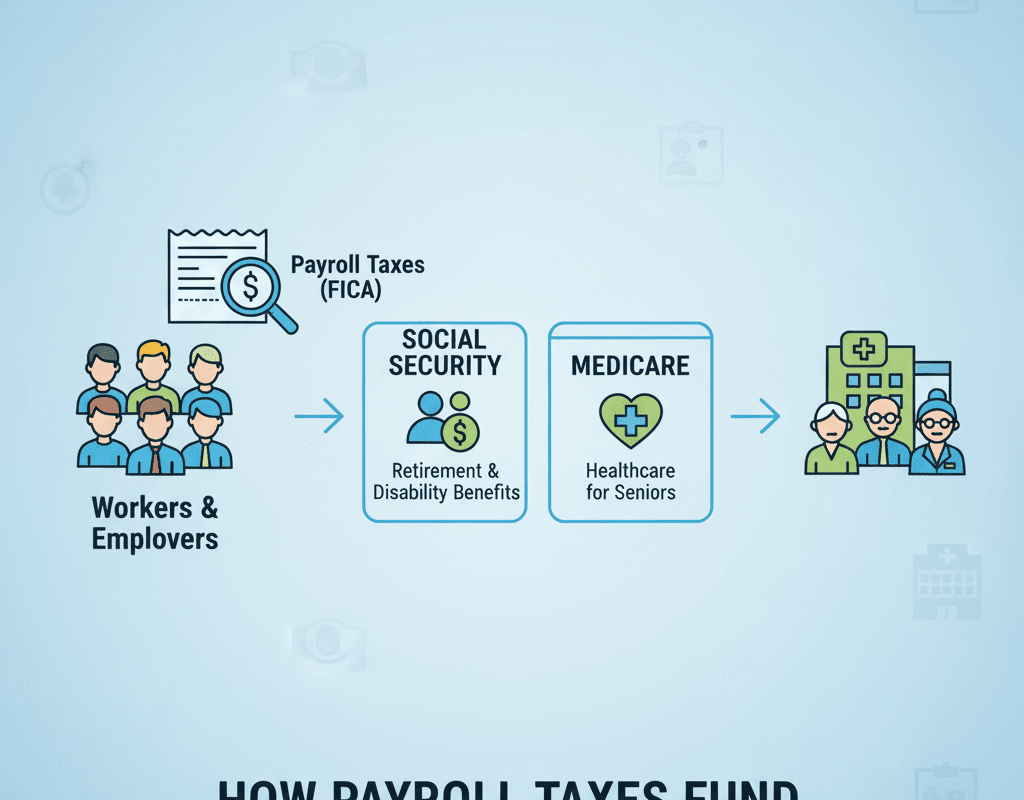
How Payroll Taxes Fund Social Security and Medicare?
How Payroll Taxes Fund Social Security and Medicare?
For millions of Americans, Social Security and Medicare represent the backbone of financial stability and healthcare security during retirement. These programs, which collectively serve nearly all U.S. workers and seniors, are largely funded through payroll taxes—a system that many employees pay into but might not fully understand.
This article explores how payroll taxes sustain Social Security and Medicare, the role they play in protecting Americans, and the impact of these contributions on the broader economy.
HSBC Cashback Credit Card 2025 – Benefits, Rewards & How to Apply?

What Are Payroll Taxes?
Payroll taxes are deductions from an employee’s wages that fund social insurance programs, primarily Social Security and Medicare. Unlike income taxes, which fund a broad range of government functions, payroll taxes are specifically earmarked for these social safety net programs.
In the United States, payroll taxes are collected under the Federal Insurance Contributions Act (FICA). These taxes are shared between employers and employees, with each party responsible for contributing a portion of the total amount.
Social Security: A Lifeline Funded by Payroll Taxes
Social Security is a federal program designed to provide financial protection to retired workers, disabled individuals, and surviving family members of deceased workers. It is funded almost entirely by payroll taxes, which go directly into the Social Security Trust Fund.
Every paycheck contributes to this fund, creating a pool of money that is used to pay current beneficiaries. Essentially, today’s workers are funding today’s retirees—a system known as pay-as-you-go financing.
The Role of Employers in Payroll Taxes
Employers are responsible for withholding payroll taxes from employees’ paychecks and submitting them to the Internal Revenue Service (IRS). But employers don’t just act as intermediaries—they also match employee contributions, effectively doubling the funds available for Social Security and Medicare.
This shared responsibility ensures that the financial burden of funding these programs is distributed between workers and businesses, which strengthens the sustainability of the system.
Payroll Taxes and the Social Security Trust Fund
The Social Security Trust Fund consists of two accounts:
- Old-Age and Survivors Insurance (OASI) – funds retirement and survivor benefits.
- Disability Insurance (DI) – funds disability benefits.
Payroll taxes flow into these accounts, and the Treasury invests the funds in special-issue government securities. These investments earn interest, which adds to the trust fund balance. The money is then available to pay benefits for current and future beneficiaries.
The trust fund acts as a financial buffer to ensure that Social Security can continue paying benefits even when payroll tax revenue fluctuates due to demographic or economic changes.
Medicare Trust Fund and Payroll Taxes
Medicare Part A’s financial foundation is the Hospital Insurance Trust Fund. The main source of income is payroll taxes, which are augmented by interest on trust fund assets, beneficiary premiums, and other sources.
The Medicare trust fund covers the following expenses:
- Hospital treatment
- Services provided by skilled nursing facilities
- Hospice treatment
- Services for home health
Millions of seniors who depend on Medicare for necessary medical treatments may be impacted by budget shortages if payroll tax contributions are inconsistent.
In conclusion: How Payroll Taxes Fund Social Security and Medicare?
Payroll taxes play a pivotal role in funding Social Security and Medicare, forming the backbone of America’s social safety net. By ensuring consistent funding, these taxes provide millions of Americans with retirement security, disability support, and healthcare access. Understanding how payroll taxes work—and why they matter—helps citizens appreciate the value of these programs and the importance of sustaining them for future generations.
Social Security and Medicare are more than just programs—they are commitments to a society where individuals are protected in their most vulnerable years, funded by the collective contributions of the workforce through payroll taxes.
How the U.S. Treasury Manages Daily Cash Operations: Insights into Federal Funds Management
How the U.S. Treasury Manages Daily Cash Operations: Insights into Federal Funds Management