 A K
A K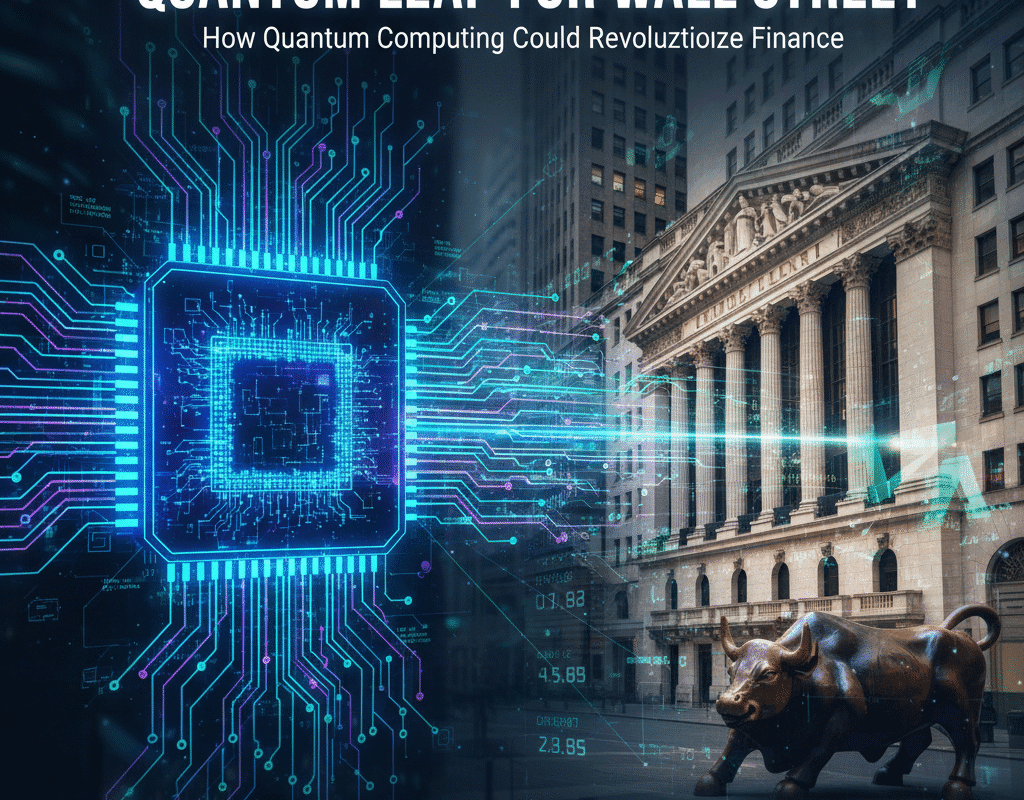
How Quantum Computing Could Revolutionize?
How Quantum Computing Could Revolutionize?
Quantum computing, once the stuff of science fiction, is rapidly moving toward mainstream finance. Wall Street, the heartbeat of global markets, has always thrived on speed, precision, and data-driven insights. With traditional computing reaching its physical and practical limits, quantum computing promises to unlock unprecedented potential in trading, risk management, and financial modeling.
HSBC Cashback Credit Card 2025 – Benefits, Rewards & How to Apply?

The Basics of Quantum Computing
Quantum computers differ fundamentally from classical computers. While traditional machines rely on binary bits—0s and 1s—quantum computers use qubits, which can exist in multiple states simultaneously due to superposition. This allows them to perform certain calculations exponentially faster than classical computers.
Another key concept is entanglement, where qubits become interconnected such that the state of one instantly affects the state of another, regardless of distance. This property enables quantum computers to process vast amounts of data and complex computations that were previously unimaginable.
High-Frequency Trading: Speed Meets Intelligence
High-frequency trading (HFT) relies on executing large volumes of trades in fractions of a second. Traditional algorithms can analyze market trends and execute trades at lightning speed, but they are limited by classical computing’s processing constraints.
Quantum computing could elevate HFT by performing multi-variable optimizations across thousands of assets simultaneously. This could lead to smarter, faster trades that account for market volatility, historical patterns, and global financial events in real-time.
Imagine an algorithm that can instantly evaluate millions of possible trading scenarios and choose the one with the optimal risk-reward ratio. This capability could redefine competitiveness on Wall Street, giving firms that adopt quantum strategies a significant edge.
Risk Management and Financial Modeling
Financial institutions constantly face risks—from credit exposure to market fluctuations and operational failures. Traditional risk modeling uses probabilistic simulations, often requiring approximations due to computational limits. Quantum computing could change that.
Quantum algorithms, particularly quantum Monte Carlo simulations, can process complex risk scenarios more efficiently than classical systems. This could lead to more accurate predictions of market crashes, portfolio losses, or exposure to global economic shocks.
Fraud Detection and Cybersecurity
In an era of increasing cyber threats, Wall Street requires robust fraud detection and cybersecurity measures. Quantum computing offers enhanced cryptographic methods that could secure sensitive financial data against even the most sophisticated attacks.
Quantum machine learning algorithms can also detect anomalies in trading patterns or transactional data, flagging potential fraud more effectively than traditional systems. This is particularly valuable for banks and investment firms that handle millions of transactions daily.
Portfolio Optimization
Investment strategies rely heavily on portfolio optimization—allocating assets to maximize returns while minimizing risk. Traditional optimization methods, like the Markowitz mean-variance model, face computational bottlenecks when scaling to large portfolios.
Quantum computing can revolutionize portfolio management by rapidly solving complex optimization problems. Quantum annealing, for example, allows for faster and more accurate asset allocation decisions. Hedge funds and investment banks could use these techniques to design portfolios that adapt dynamically to market changes, improving performance and resilience.
Obstacles and Restrictions
Despite the immense potential, quantum computing is not a silver bullet. The technology is still in its early stages, with hardware limitations, error rates, and scalability challenges. Qubits are highly sensitive to environmental interference, and building stable quantum systems remains expensive.
Integration with existing financial infrastructure is another hurdle. Wall Street relies on complex, established systems that must be compatible with quantum algorithms. Additionally, regulatory frameworks may need updates to address the ethical and operational implications of quantum-enhanced trading.
Conclusion: How Quantum Computing Could Revolutionize?
Quantum computing has the potential to revolutionize Wall Street by transforming trading, risk management, financial modeling, and cybersecurity. While challenges remain, the financial industry’s early experiments suggest that a quantum future is not just possible—it is inevitable.
For investors, traders, and financial institutions, understanding quantum computing is no longer optional.
Wall Street stands on the cusp of a technological revolution. Quantum computing is poised to turn that vision into reality, promising faster trades, smarter strategies, and a fundamentally new approach to understanding global markets.
How the Property Insurance Crisis Is Reshaping Coastal Economies in the United States
How the Property Insurance Crisis Is Reshaping Coastal Economies in the United States