 A K
A K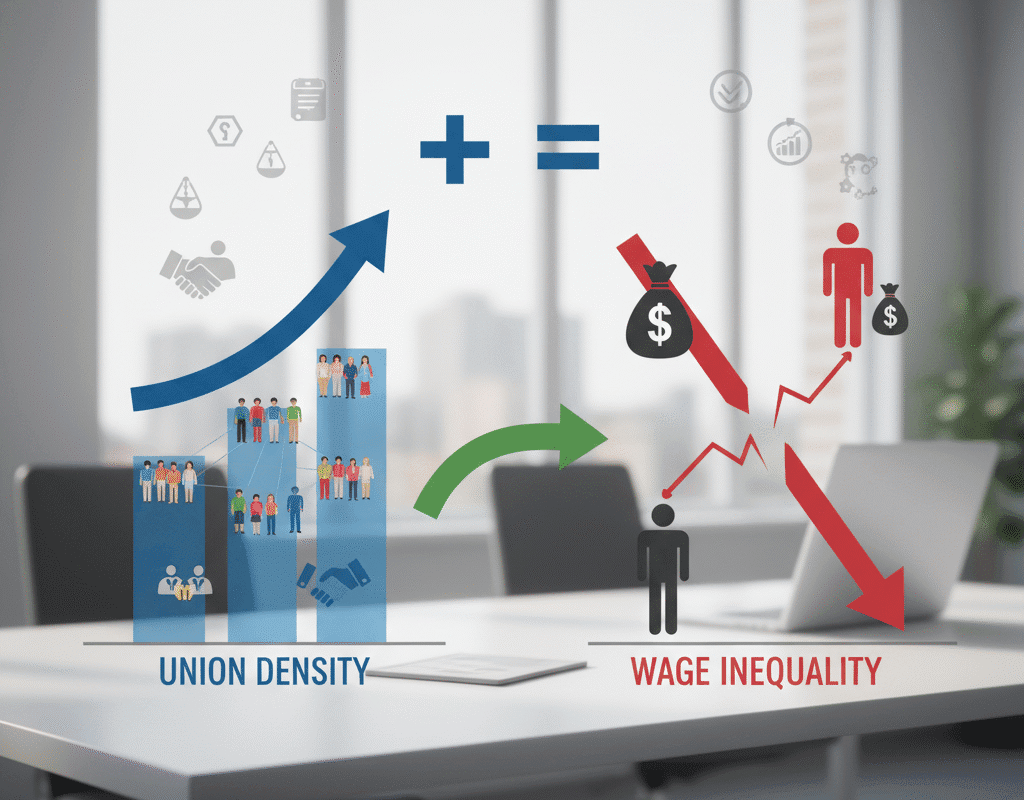
The Link Between Union Density and Wage Inequality
The Link Between Union Density and Wage Inequality
One of the most important economic and social issues facing the US today is wage disparity. The gap between the richest wages and the typical worker has grown dramatically over the last few decades, igniting discussions about how social institutions, market factors, and labor laws influence income distribution. Union density, or the percentage of workers in a certain labor market who belong to a union, is one important aspect that has continuously drawn interest from economists, legislators, and labor organizers.
In the past, unionized workers have been essential in promoting better pay, benefits, and working conditions. Wage gaps frequently increase when union membership falls in some industries, indicating a potential link between union density and and wage inequality.
HSBC Cashback Credit Card 2025 – Benefits, Rewards & How to Apply?

Understanding Union Density
Union density refers to the percentage of workers in a labor market who are members of a trade union. In the United States, union density has experienced a significant decline over the past fifty years. In the 1950s, nearly 35% of the workforce was unionized, but today, this number hovers around 10-11%, with variations across industries and regions.
Union density is not merely a statistic; it reflects the bargaining power of workers. A higher union density generally translates into stronger collective bargaining, enabling workers to negotiate better wages, secure benefits, and achieve safer working conditions. Conversely, low union density often correlates with weakened worker power, stagnant wages, and higher income inequality.
The United States’ Wage Inequality
The unequal distribution of revenue among employees is referred to as wage inequality. The United States has seen a dramatic rise in income inequality in recent decades, especially between typical workers and executive-level positions. The Economic Policy Institute claims that while median salaries have essentially stagnant, the wealthiest 1% of workers now receive a disproportionately significant part of overall income.
Globalization, technological development, deregulation, and changes in labor market structures are some of the factors causing wage inequality. But historically, labor unions have acted as a counterbalance, reducing severe inequalities through collective bargaining tactics and negotiated wage agreements.
Empirical Evidence
Several studies highlight the inverse relationship between union density and wage inequality. Research by the International Labour Organization (ILO) indicates that countries and states with higher unionization rates generally experience lower wage disparities. Similarly, a 2019 Economic Policy Institute report found that declining union density in the U.S. accounts for a significant portion of the rising wage inequality over the past four decades.
For instance, in unionized sectors like public education and transportation, wage disparities are considerably narrower than in low-union sectors like retail and hospitality. This suggests that unions play a stabilizing role in income distribution, particularly for middle- and lower-income workers.
Obstacles to Wage Equality and Union Density
Despite their significance, labor unions must overcome a number of obstacles to sustain their high density and power:
- Declining Membership: As a result of labor legislation changes, automation, and outsourcing, union membership in the private sector has been progressively declining.
- Legal Restrictions: The relationship between unionization and pay equality is weakened by policies such as “right-to-work” laws, which diminish union influence and bargaining power.
- Globalization: As a result of demand from international markets to reduce labor costs, union negotiations may become more difficult.
In industries with low or diminishing union density, these issues lead to an increase in wage inequality.
In conclusion: The Link Between Union Density and Wage Inequality
The evidence is clear: higher union density correlates with lower wage inequality. Labor unions, through collective bargaining, political influence, and wage standardization, play a crucial role in reducing income disparities and promoting economic fairness. While declining union membership and globalization pose challenges, targeted policies can reinforce the positive impact of unions on wage equality.
As the U.S. continues to grapple with rising income inequality, understanding and supporting the link between union density and wage equality becomes not just an economic necessity but a moral imperative. Strong unions are not just a legacy of the past—they are a key driver of a fairer, more equitable future.
The Role of Venture Debt in U.S. Tech Startups: Funding Beyond Equity
The Role of Venture Debt in U.S. Tech Startups: Funding Beyond Equity