 A K
A K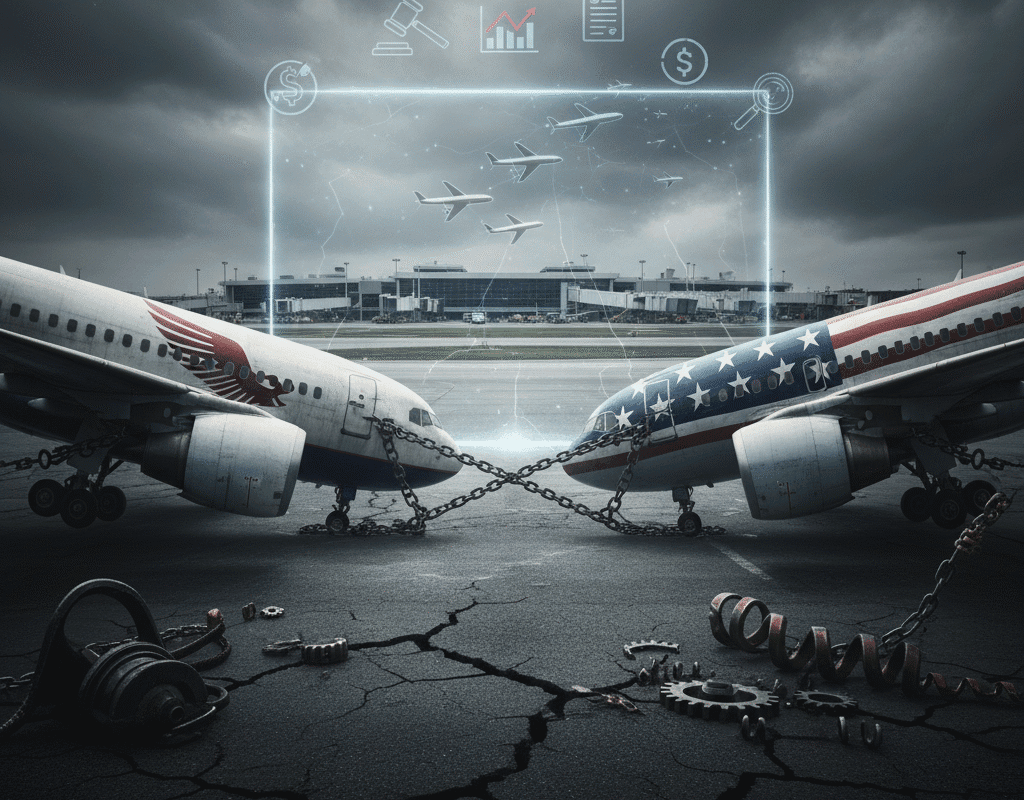
Why the U.S. Airline Industry Continues to Struggle
Why the U.S. Airline Industry Continues to Struggle?
The U.S. airline industry has spent the past two decades attempting to reshape itself through mergers, alliances, and strategic partnerships. Yet even after a wave of consolidations in the 2000s and early 2010s, the industry finds itself in a paradoxical position: too concentrated to avoid regulatory scrutiny, yet too fragmented to operate efficiently without considering additional mergers.
From the Department of Justice’s (DOJ) increasingly assertive antitrust actions to labor pressures, political pushback, and the complex economics of operating a modern airline, consolidation has become one of the most contentious and uncertain issues in U.S. aviation.
HSBC Cashback Credit Card 2025 – Benefits, Rewards & How to Apply?

The Big Four Are Already Too Big to Merge
Even if regulators did not step in, the sheer scale of the Big Four carriers makes further consolidation nearly impossible.
Merging two of these giants would:
- Give the resulting airline an overwhelming share of key hubs
- Reduce competition on major domestic routes
- Create labor and union conflicts across tens of thousands of employees
- Require the integration of massive fleets, IT systems, and frequent-flier programs
Every attempted merger among major carriers now triggers immediate political scrutiny. Lawmakers often argue that U.S. consumers already face:
- Higher ticket prices
- Limited seat space
- Add-on fees for essentials like baggage
- Reduced route options in smaller cities
Small yet Crucial to the Competitive Ecosystem: Low-Cost Carriers
Low-cost carriers have a significant influence on pricing and route competition, even though the Big Four control the majority of the market. Spirit, Frontier, Allegiant, and Breeze hold relatively small shares individually, but together they exert strong downward pressure on fares in dozens of markets.
The Significance of ULCCs to Regulators
To the DOJ and consumer advocacy groups:
- ULCCs keep fares low
- They serve cost-sensitive travelers
- They introduce competitive pressure on legacy airlines
- They often serve smaller cities abandoned by larger carriers
Removing a ULCC through consolidation—especially a major one like Spirit—is interpreted as a direct blow to travelers.
Why Despite the Challenges, Airlines Continue to Pursue Consolidation
Because the business model is still unstable, airlines are still looking into mergers and strategic alliances despite all the difficulties.
Among the main reasons are:
- Scale economies
Larger airlines can negotiate better deals on aircraft, fuel contracts, and maintenance.
- Route optimization
Merged networks eliminate redundancies and expand international reach.
- Stronger financial stability
A broader network and higher market share cushioned against market shocks.
- Survival in a volatile industry
Economic downturns, pandemics, and fuel spikes can devastate airlines—history has proven this repeatedly.
A Post-Pandemic Industry Under Pressure
The COVID-19 pandemic fundamentally changed the economics of the airline industry. While demand has rebounded strongly, airlines face:
- Persistent labor shortages
- Surging pilot salaries
- High fuel costs
- Aircraft delivery delays
- Increased regulatory scrutiny
- Greater political focus on consumer rights
All these factors make mergers less attractive—or at least less feasible.
Conclusion: Why the U.S. Airline Industry Continues to Struggle?
The U.S. airline industry operates in one of the most complex regulatory and operational environments in the world. Consolidation is attractive for financial and strategic reasons, but:
- Regulators fear reduced competition
- Consumers push back against higher fares
- Labor unions resist destabilizing changes
- Technology systems are fragile
- Infrastructure limits growth at major hubs
- Political scrutiny has intensified
For these reasons, consolidation remains an uphill battle, even when airlines argue it’s necessary for long-term survival.