 A K
A K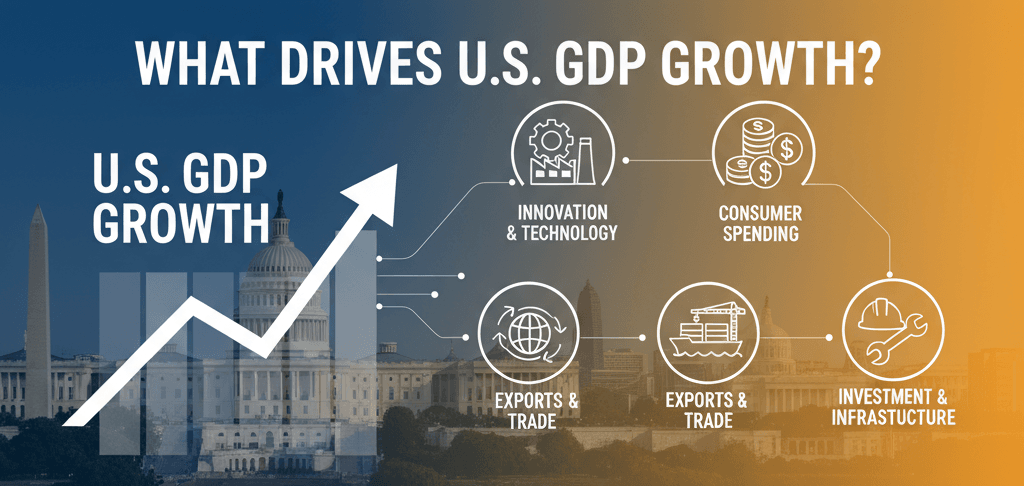
What Drives U.S. GDP Growth?
What Drives U.S. GDP Growth?
With the largest economy in the world, the United States’ Gross Domestic Product (GDP) is still a key indicator of its strength and global clout. To understand how economic trends impact their lives, legislators, investors, corporations, and regular Americans must understand the factors driving the rise of the U.S. GDP. Consumer behavior, governmental regulations, and the dynamics of international trade are just a few of the many variables that affect GDP growth, which is a measure of the economy’s total expansion. This article explores the main forces behind the growth of the US GDP, providing a thorough analysis of the roles that each element plays in the country’s economic success.
HSBC Cashback Credit Card 2025 – Benefits, Rewards & How to Apply?

1. The Economy’s Core: Consumer Spending
Usually making up over two-thirds of the overall economic output, consumer spending, sometimes referred to as personal consumption expenditures (PCE), is the largest contributor to the U.S. GDP.
Spending by consumers is influenced by several factors:
- Income levels: When wages rise, consumers have more money to spend on products and services.
- Employment rates: While high unemployment inhibits expenditure, full employment or low unemployment rates promote it.
- Consumer confidence: Measures of Americans’ optimism toward the economy include surveys and indexes like the Consumer Confidence Index (CCI). Higher spending is frequently associated with a high CCI.
- Interest rates: Reduced borrowing costs encourage expenditure on expensive goods like homes and cars, which boosts the economy.
2. Fiscal Policy and Spending by the Government
Another significant element of the US GDP is government spending. Federal, state, and local governments spend on infrastructure, defense, education, healthcare, and public services. These investments directly contribute to GDP and indirectly stimulate private sector activity.
Fiscal policy—the government’s approach to taxation and spending—plays a crucial role in shaping economic growth:
- Stimulus measures: Tax cuts or direct payments to households increase disposable income and spending.
- Infrastructure projects: Large-scale projects create jobs and improve long-term productivity, enhancing GDP growth.
- Social programs: Investments in healthcare, education, and social security strengthen human capital, indirectly supporting economic expansion.
3. Business Investing: Increasing Output
GDP growth is fueled by private sector investments in infrastructure, machinery, software, and equipment that raise output and productivity. When businesses predict future demand and favorable economic conditions, they make investments.
Among the elements affecting company investment are:
- Corporate profits: Strong earnings give funding for expansion and innovation.
- Interest rates: Businesses are encouraged to take out loans for capital expansion when borrowing costs are low.
- Technological developments: Investing in new technologies boosts competitiveness and productivity.
- Regulatory environment: While too much regulation may discourage investment, predictable policies and incentives can encourage it.
4. Technology and Innovation
Modern economic growth depends on innovation and technical advancement. New technologies boost productivity across industries, open up new markets, and increase efficiency. In the past, the United States has been at the forefront of technical innovation worldwide, propelling GDP development in fields including advanced manufacturing, biotechnology, information technology, and renewable energy.
Among the crucial elements of innovation-driven growth are:
- Investments in research and development (R&D) produce new goods and services that increase demand and generate employment.
- Automation and artificial intelligence: These cutting-edge technologies boost productivity and lower costs, increasing economic efficiency.
- Startups and entrepreneurship: Creative companies draw investment, upend markets, and generate jobs.
- Intellectual property: By safeguarding innovation, patents and copyrights promote ongoing investment in creative industries.
5. International Markets and Trade
The GDP of the United States is greatly impacted by imports and exports. GDP is directly impacted by net exports, which are the difference between imports and exports. GDP growth is increased by a positive trade balance, when exports surpass imports, and decreased by a trade deficit.
Trade-driven growth is influenced by the following factors:
- Global demand: Exports and GDP are increased by robust demand for American goods and services abroad.
- Trade agreements: International trade is supported by policies that lower tariffs and trade obstacles.
- Currency fluctuations: When the US dollar declines, American goods become more competitive internationally, leading to an increase in exports.
- Resilient supply chains: The capacity to satisfy global demand is improved by effective production networks and logistics.
6. Labor Market and Workforce Dynamics
A productive and growing labor force is fundamental to GDP expansion. The size, skill, and efficiency of the workforce determine how much output an economy can generate.
Key labor market factors include:
- Employment rates: Higher employment increases household income, spending, and overall GDP.
- Productivity: Workers who produce more per hour contribute more to GDP growth.
- Labor force participation: Policies encouraging participation among women, older adults, and minorities expand the workforce.
- Education and skills: Investment in education and training improves workforce quality, enabling higher-value economic activities.
7. Monetary Policy and Financial Conditions
The Federal Reserve plays a vital role in shaping economic growth through monetary policy. By controlling interest rates and money supply, the Fed influences borrowing, spending, and investment decisions.
- Interest rates: Low rates stimulate borrowing and spending, while high rates can slow economic activity to control inflation.
- Credit availability: Easier access to loans supports business expansion and consumer purchases.
- Inflation control: Stable prices preserve purchasing power and economic confidence, supporting sustainable growth.
8. Economic cycles and external shocks
Growth in GDP is not linear. Economic activity can be disrupted by external events including financial crises, pandemics, natural disasters, and geopolitical tensions. Recessions can momentarily impede GDP growth, but the U.S. economy has proven resilient in recovering from them.
Global trends, government policy, investment, and consumption all interact to shape economic cycles, which are times of expansion and decline. Businesses and politicians can better predict shifts in economic growth by having a better understanding of these cycles.
9. Growth in Productivity: The Long-Term Driver
Productivity, or how effectively resources are used to produce goods and services, is a key factor in long-term GDP growth. Increased productivity enables economic expansion without excessively raising labor or capital inputs.
- Adoption of technology: Streamlining procedures with technology increases productivity.
- Infrastructure upgrades: Productivity is increased by effective energy, communication, and transportation systems.
- Skills of the workforce: A skilled workforce increases productivity per worker.
10. Policy Implications and the Future of U.S. GDP Growth
Policymakers must consider multiple drivers of GDP growth to ensure a balanced and sustainable economy. Key priorities include:
- Investing in infrastructure and education to support long-term productivity.
- Encouraging innovation and R&D to maintain global competitiveness.
- Promoting trade and international collaboration to expand market opportunities.
- Balancing fiscal and monetary policies to manage inflation, employment, and growth sustainably.
In Conclusion
Consumer spending, government policy, corporate investment, innovation, trade, labor markets, and monetary policy are some of the many interrelated elements that influence the growth of the U.S. GDP. Long-term growth is dependent on productivity, innovation, and smart investments, even though short-term changes are typical. Americans can gain a better grasp of how economic patterns impact employment, income, and overall prosperity by comprehending these forces. The 21st-century growth trajectory of the U.S. economy will continue to depend on its capacity to adjust to changes in the global economy, population, and technology.
The Pros and Cons of Cashless Societies: Future of Digital Payments Explained
The Pros and Cons of Cashless Societies: Future of Digital Payments Explained