 A K
A K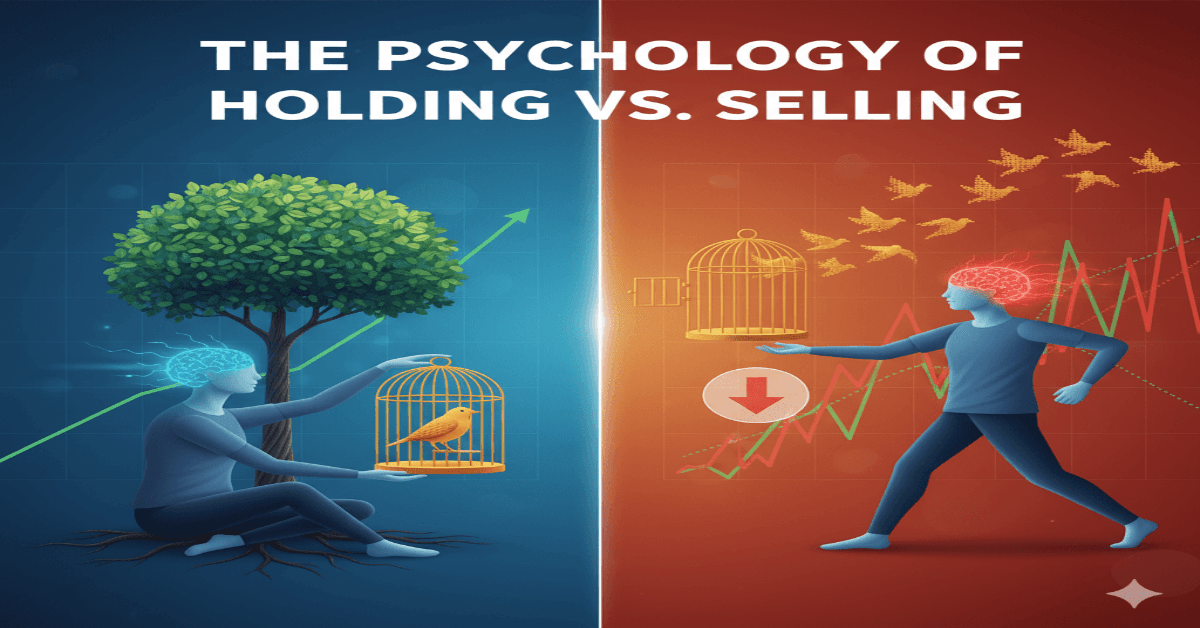
The Psychology of Holding vs. Selling:
The Psychology of Holding vs. Selling:
The same age-old dilemma confronts all investors: should I sell or hold?
On the surface, the choice would seem reasonable: retain an asset when there is room for growth and sell when it is no longer profitable. In actuality, however, this decision is highly emotive and influenced by psychology rather than strict logic.
The psychology of keeping versus selling is examined in this article, along with how investor behavior is influenced by cognitive biases, fear, greed, and loss aversion. With more than 2000 lines of analysis, we reveal the hidden factors that influence market choices and show how knowing them can lead to better long-term financial outcomes.
HSBC Cashback Credit Card 2025 – Benefits, Rewards & How to Apply?

Every Investor’s Emotional Dilemma
Earnings reports, price-to-earnings ratios, and growth projections are some of the ways that investing is sometimes presented as a numbers game. Real-world investment decisions, however, are rarely emotionless.
Optimism and greed make holding look appealing as markets climb. An drive to sell is sparked by panic and dread when markets decline. Investors are always torn between:
- The expectation of future profits → encourages them to retain.
- They sell because they are afraid of suffering larger losses.
Even experienced investors occasionally behave irrationally, which can be explained by this ongoing tug-of-war.
Loss Aversion: Why It Seems Harder to Sell Than to Hold
Loss aversion is one of behavioral finance’s most potent ideas. The hypothesis, which was created by psychologists Amos Tversky and Daniel Kahneman, proposes:
“Gains feel good, and losses feel about twice as bad.”
For instance, it is significantly less satisfying to lose $1,000 on stocks than it is to make $1,000. This explains why instead of selling when they lose, many investors hang onto their lost equities in the hopes that they would rebound.
- Holding a loser: Prevents the agony of locking in a loss and gives hope.
- Even if it is reasonable, selling a loss causes psychological distress.
Long-term portfolio damage results from investors delaying important selling choices due to this emotional bias.
The Endowment Effect: Exaggerating Our Possessions
The endowment effect, which is the propensity to overvalue something only because we own it, is another psychological bias affecting the hold/sell decision.
For instance, you might think that shares of a company that you purchased for $50 are worth more than the current market price of $40 only because you own them.
This results in:
- Refusing to sell for less than what you bought is an example of unrealistic price anchoring.
- Treating assets as “special” instead of market instruments is a result of emotional attachment to them.
The endowment effect inhibits rational selling and promotes overholding.
Fear of Loss vs. Fear of Missing Out (FOMO)
Investor psychology is dominated by two strong emotions:
FOMO, or the fear of missing out:
- Investors hold (or purchase more) during stock rallies because of concern that they will miss out on future profits.
- For instance, many investors kept assets well above reasonable levels during the 2021 cryptocurrency boom because of concern that they would miss the “next big spike.”
Fear of Being Lost:
- Investors swiftly sell when markets decline in order to avoid suffering larger losses.
- For instance, panic selling during the COVID-19 pandemic or the 2008 financial crisis.
These competing anxieties promote market volatility by causing an emotional rollercoaster.
The Myth of Perfect Timing
Every investor dreams of selling at the peak and buying at the bottom. But in reality, market timing is nearly impossible.
Psychology plays a huge role:
- Overconfidence bias makes investors believe they can predict tops and bottoms.
- Hindsight bias makes past decisions seem obvious in retrospect.
- Regret aversion makes people delay action for fear of making the “wrong” choice.
These psychological traps mean most investors sell too late or hold too long, missing optimal outcomes.
The Role of Identity and Status in Holding
Investments are not just numbers on a screen—they often tie into personal identity and social status.
- Pride in being right: Selling feels like admitting a mistake, while holding preserves the hope of vindication.
- Social comparison: Investors may hold to “prove” their strategy to friends or peers.
- Status investing: Owning certain assets (like tech stocks or cryptocurrencies) becomes a point of pride, making it harder to sell.
This psychological connection transforms investing into more than financial management—it becomes personal.
Collective psychology and herd mentality
People are social beings. This results in herd behavior in markets, where people follow the herd instead of making their own decisions.
- People sell when others sell in a panic.
- People hold or purchase more when others buy in euphoria.
Market booms and crashes can be explained by this collective psychology. Holding or selling frequently becomes more about what “everyone else” is doing than it is about a logical assessment.
The Psychology of Making Money
Loss isn’t the only reason to sell. Investors may find it difficult to turn a profit.
Why?
- Greed bias: A stock may triple if it doubles.
- The fear of selling too soon and losing out on larger earnings is known as regret aversion.
- The idea that you can always sell at the “ideal” moment is known as the illusion of control.
Behavioral Finance Perspectives for More Astute Choices
Investors can overcome biases by having a solid understanding of psychology. Important tactics consist of:
- Predetermined guidelines: Establish exit plans, such as selling if the price falls 20%.
- Diversification: Lessens sentimental ties to individual assets.
- Losses should be reframed as reallocation rather than failure.
- Investing mindfully: Understand when feelings, not facts, influence choices.
According to behavioral finance, rational investing begins with an understanding of one’s own biases.
Case Studies: Practical Illustrations
The 1990s–2000 Dot-Com Bubble
- Despite cautions, a large number of investors kept internet equities due to herd mentality and FOMO.
- Because losers were not sold, losses increased when the boom burst.
The Financial Crisis of 2008
- Because fear of losing exceeded sound judgment, panic selling predominated.
- The intricacy of hold/sell psychology was demonstrated by the ultimate recovery of certain long-term holders of high-quality equities.
The COVID Crash of 2020
- There was widespread panic selling in March 2020.
- The quick comeback for those who persevered during the slump demonstrated how emotional timing can undermine portfolios.
Holding vs. Selling: A Neuroscience Analysis
Investing decisions engage the same parts of the brain as survival instincts, according to recent brain scans.
- Holding a loser triggers brain patterns similar to denial and avoidance.
- Selling a winner activates areas linked to reward and regret.
- Fear and greed are hardwired into decision-making, making rationality difficult without structured strategies.
This neuropsychology explains why financial advice often fails—logic cannot easily override emotion.
Building a Rational Framework
To combat biases, investors should adopt structured approaches:
- Dollar-cost averaging: Removes timing pressure.
- Stop-loss and stop-gain orders: Automate sell decisions.
- Periodic rebalancing: Ensures discipline regardless of emotion.
- Consulting advisors: Provides external rationality against emotional impulses.
The goal is not to eliminate emotion but to design systems that minimize its damage
Different Generations: Holding vs. Selling
Age-group differences in investor psychology also exist:
- Younger investors: More prone to own riskier investments due to FOMO and optimism.
- Older investors: More wary, more likely to liquidate in order to preserve capital.
- Cultural influences: While risk-averse cultures tend to sell early, societies with higher risk tolerance typically retain longer.
Market behavior is made more difficult by generational psychology.
An attitude towards long-term investing
In the end, the argument over whether to sell or keep the market frequently ignores the larger picture: time in the market is more important than market timing.
Success is frequently determined more by psychological resilience—patience, discipline, and detachment—than by financial expertise.
- “Forever is our favorite holding period,” according to Warren Buffett’s attitude.
- Balance is encouraged by modern psychology; cling onto valuable assets but sell when logical cues point to weakness.
In Conclusion
The psychology of holding vs. selling reveals that investing is as much an emotional journey as a financial one. Fear, greed, loss aversion, and social pressure push investors in conflicting directions, often against their best interests.
By understanding these psychological forces, investors can build strategies to make rational choices—minimizing regret, maximizing long-term gains, and reducing stress.
In the end, successful investing isn’t just about choosing the right stocks. It’s about choosing the right mindset.
The Benefits of Long-Term Investing: Why Patience Builds Wealth
The Benefits of Long-Term Investing: Why Patience Builds Wealth