 A K
A K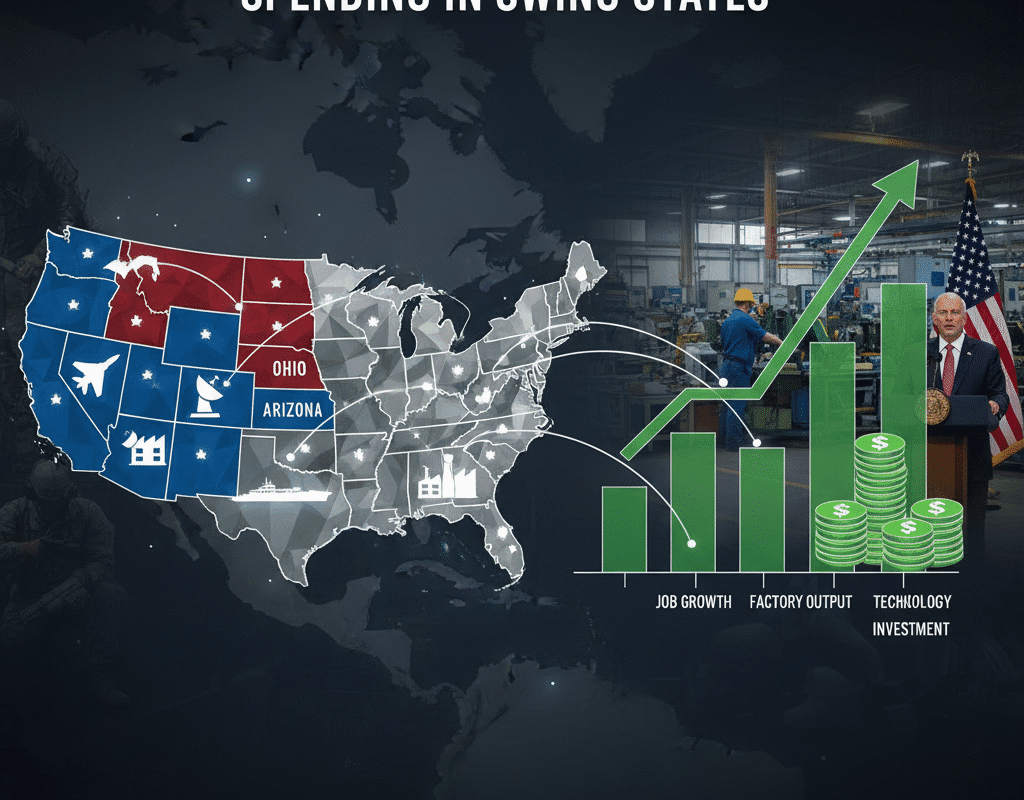
The Economics of U.S. Defense Spending in Swing:
The Economics of U.S. Defense Spending in Swing:
The connection between U.S. defense spending and swing states’ political and economic environments has gained increasing attention. Federal defense funds are frequently allocated disproportionately to swing states, which are crucial battlegrounds that have the power to determine the outcome of presidential elections. While defense spending is typically framed in terms of national security, its economic implications at the state level are equally significant, affecting jobs, local industries, and political dynamics
HSBC Cashback Credit Card 2025 – Benefits, Rewards & How to Apply?

Defense Spending and Swing States: A Mutually Beneficial Association
During election cycles, politicians tend to pay more attention to swing states, which are areas where electoral outcomes are hotly contested. This attention is not limited to campaign visits and advertising; it extends to federal spending priorities, including defense. Historically, states like Florida, Pennsylvania, Michigan, Ohio, and Virginia have been battlegrounds where the allocation of defense contracts can sway voter sentiment indirectly.
Defense spending often benefits these states through job creation and infrastructure investment. Military bases, defense contractors, and related supply chains inject billions of dollars into local economies. The Pentagon’s procurement process tends to favor states with existing industrial capacity and political influence, which often aligns with key swing states.
The Scale of U.S. Defense Spending
The United States consistently ranks as the world’s largest defense spender. According to the Department of Defense, the federal defense budget for 2024 exceeded $850 billion, covering personnel costs, weapons development, military operations, and research and development. A significant portion of this budget is distributed through contracts with private defense contractors, many of which operate heavily in swing states.
For example, Northrop Grumman, Lockheed Martin, Raytheon, and Boeing all maintain major facilities in states such as Virginia, Pennsylvania, and Florida. These companies employ tens of thousands of workers directly and indirectly support smaller businesses in their supply chain. The infusion of federal dollars often stabilizes local economies, particularly in areas where manufacturing or high-tech employment may be otherwise
Challenges and Criticisms
While defense spending benefits swing states economically, it is not without criticism. Key concerns include:
- Unequal Distribution: Critics argue that defense spending disproportionately favors swing states, potentially neglecting regions with strategic or economic needs.
- Overdependence: Local economies reliant on defense contracts can suffer if federal priorities shift, creating economic vulnerability.
- Political Influence: The intertwining of defense spending and electoral politics raises ethical concerns about whether funds are allocated for strategic needs or electoral advantage.
The Future of Defense Spending in Swing States
With evolving geopolitical threats and technological advancements, defense spending is likely to continue growing, but the distribution may shift toward emerging technologies such as cyber defense, artificial intelligence, and space systems. Swing states that adapt to these trends by fostering high-tech industries may continue to benefit economically and politically.
Investments in workforce development and infrastructure will be critical to ensuring that defense spending continues to provide sustainable benefits. Additionally, policymakers will face increased scrutiny over balancing national security priorities with local economic interests.
Conclusion: The Economics of U.S. Defense Spending in Swing States
The intricate relationship between politics, economics, and national security is exemplified by the economics of U.S. defense spending in swing states. These investments have real impacts on local communities, employment markets, and election results that go beyond the headlines of defense spending and military contracts. Voters, legislators, and business executives must all comprehend this dynamic since it emphasizes how national military policies affect society as a whole.
More than just a financial tool, defense expenditure in swing states is a strategic lever that influences the country’s political and economic climate. The difficulty for policymakers is making sure that investments support local economic growth and national security objectives without succumbing to political expediency.
The Pivotal Role of the U.S. Chamber of Commerce in Shaping U.S. Public Policy
The Pivotal Role of the U.S. Chamber of Commerce in Shaping U.S. Public Policy