 A K
A K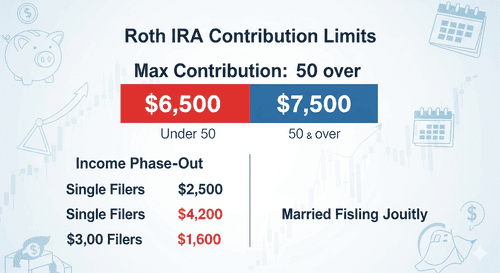
Roth IRA Contribution Limits Explained for 2025:
Roth IRA Contribution Limits Explained for 2025:
Few accounts provide as much long-term value for retirement savings as the Roth IRA. Roth IRAs are one of the most effective tools for future financial stability because, in contrast to standard retirement accounts, they allow your money to grow tax-free and to be withdrawn tax-free in retirement.
However, it’s essential to comprehend the Roth IRA contribution caps, income restrictions, and eligibility requirements in order to optimize the advantages. Keeping up to date guarantees that you don’t miss out on making the maximum contribution because these restrictions are subject to frequent changes due to inflation adjustments.
The Roth IRA contribution caps for 2025 are thoroughly explained in this article, along with information on income phase-out ranges, high earner techniques, tax advantages, and typical pitfalls to avoid. To maximize investment flexibility, contribution caps, and tax benefits.
HSBC Cashback Credit Card 2025 – Benefits, Rewards & How to Apply?

What Is a Roth IRA?
A Roth IRA (Individual Retirement Account) is a retirement savings account that allows you to contribute after-tax dollars. Unlike a traditional IRA, contributions to a Roth IRA are not tax-deductible in the year you make them. However, the payoff comes later—when you retire, you can withdraw both your contributions and your investment earnings completely tax-free, provided you meet IRS requirements.
Key benefits include:
- Tax-free growth of investments.
- withdrawals in retirement that are tax-free.
- No Required Minimum Distributions (RMDs) during the account holder’s lifetime.
- Flexible withdrawal rules (you can withdraw your contributions anytime without penalties).
Because of these advantages, Roth IRAs are often considered one of the best retirement accounts, particularly for younger savers and those expecting to be in a higher tax bracket in the future.
Roth IRA Contribution Limits for 2025
For tax year 2025, the IRS has set the following Roth IRA contribution limits:
- Maximum Contribution: $7,500 if you are age 50 or older (catch-up contribution included).
- Standard Contribution: $6,500 if you are under age 50.
These limits apply to the combined total you contribute to all of your IRAs (both traditional and Roth) in a single year.
Example:
- If you are 35 years old, you can contribute up to $6,500 to your Roth IRA in 2025.
- If you are 55 years old, you can contribute up to $7,500 (the extra $1,000 is a “catch-up” contribution).
2025 Roth IRA Income Caps and Phase-Out Ranges
Not everyone is able to make a Roth IRA contribution in full. Based on your tax filing status and Modified Adjusted Gross Income (MAGI), the IRS establishes income eligibility restrictions.
The 2025 Roth IRA income limits are as follows:
Individual Filers:
- Contributions are fully permitted if MAGI is less than $146,000.
- contributions made in part if MAGI falls between $146,000 and $161,000.
- Contributions are prohibited if MAGI exceeds $161,000.
Jointly Filing Married:
- Contributions are fully permitted if MAGI is less than $230,000.
- If MAGI falls between $230,000 and $240,000, a partial payment is made.
- Contributions are prohibited if MAGI exceeds $240,000.
Filing Separately as Married:
- If MAGI is more than $10,000, the contribution is severely restricted.
How to Determine Your Eligibility to Contribute to a Roth IRA
The IRS mandates that the amount of your contribution be determined by your MAGI and earned income. You must figure out the decreased contribution limit if your income is within the phase-out range.
Formula for Reduced Roth Contribution:
Contribution Limit × (Upper Phase-Out Limit – Your MAGI) ÷ (Phase-Out Range)
For instance:
- You have a $150,000 MAGI in 2025 and are single.
- The phase-out range for single filers is $146,000–$161,000 (a $15,000 range).
- You are $4,000 into the phase-out.
- Calculation: $6,500 × ($161,000 – $150,000) ÷ $15,000 = $4,333.
- That means you can contribute $4,333 instead of the full $6,500.
Roth IRA Contribution Rules
To maximize your Roth IRA benefits, it’s essential to follow IRS rules:
- Earned Income Requirement – You must have earned income (wages, salary, self-employment income). Investment income does not count.
- Contribution Deadline – You can make contributions for the 2025 tax year until April 15, 2026.
- Age Rules – Unlike traditional IRAs, you can contribute at any age, as long as you have earned income.
- Spousal Roth IRA – If your spouse has no income, you can contribute on their behalf, doubling your household contributions.
Roth IRA vs Traditional IRA Contribution Limits
While both Roth and traditional IRAs share the same contribution limits, the key difference lies in tax treatment:
- Traditional IRA: Contributions may be tax-deductible now, but withdrawals in retirement are taxed.
- Roth IRA: Contributions are made with after-tax money, but withdrawals are tax-free later.
For many savers, choosing a Roth IRA makes sense if they:
- Expect to be in a higher tax bracket during retirement.
- Value tax-free withdrawals.
- Want flexibility without RMDs.
Tax Benefits of Roth IRA Contributions
Roth IRAs are particularly powerful because of their unique tax structure:
- No taxes on qualified withdrawals (both contributions and earnings).
- Tax diversification – Having both Roth and traditional accounts helps balance future tax burdens.
- Estate planning advantages – Roth IRAs can be passed down to heirs tax-free (though beneficiaries may face RMDs).
Methods for Increasing Roth IRA Contributions
- Start Early: Your investments will have more time to compound tax-free the earlier you make your contributions.
- Make the Most Contribution Every Year: Over decades, even modest, regular contributions build up.
- Use a Spousal Roth IRA: If you’re married, double your household contributions.
- High incomes have the option to switch from a traditional IRA to a backdoor Roth IRA.
- Mega Backdoor Roth (via 401(k)): A Roth IRA may be funded using after-tax contributions from certain employers.
- Automate Contributions – Set up automatic monthly deposits to stay consistent.
Conclusion: Why Understanding Roth IRA Contribution Limits Matters
A Roth IRA is a powerful retirement savings account that offers unmatched tax advantages. But to maximize its benefits, you must understand the contribution limits, income thresholds, and rules that apply each year.
- For 2025, the maximum contribution is $6,500 (under 50) and $7,500 (50+).
- Income limits restrict who can contribute, but backdoor Roth strategies provide options for high earners.
- Contributing consistently and early can lead to substantial tax-free wealth in retirement.
By staying informed about Roth IRA contribution limits, you can take full advantage of this retirement account and secure a stronger financial future.
How to Build a Long-Term Wealth Portfolio in 2025: Expert Strategies for Financial Success
How to Build a Long-Term Wealth Portfolio in 2025: Expert Strategies for Financial Success