 A K
A K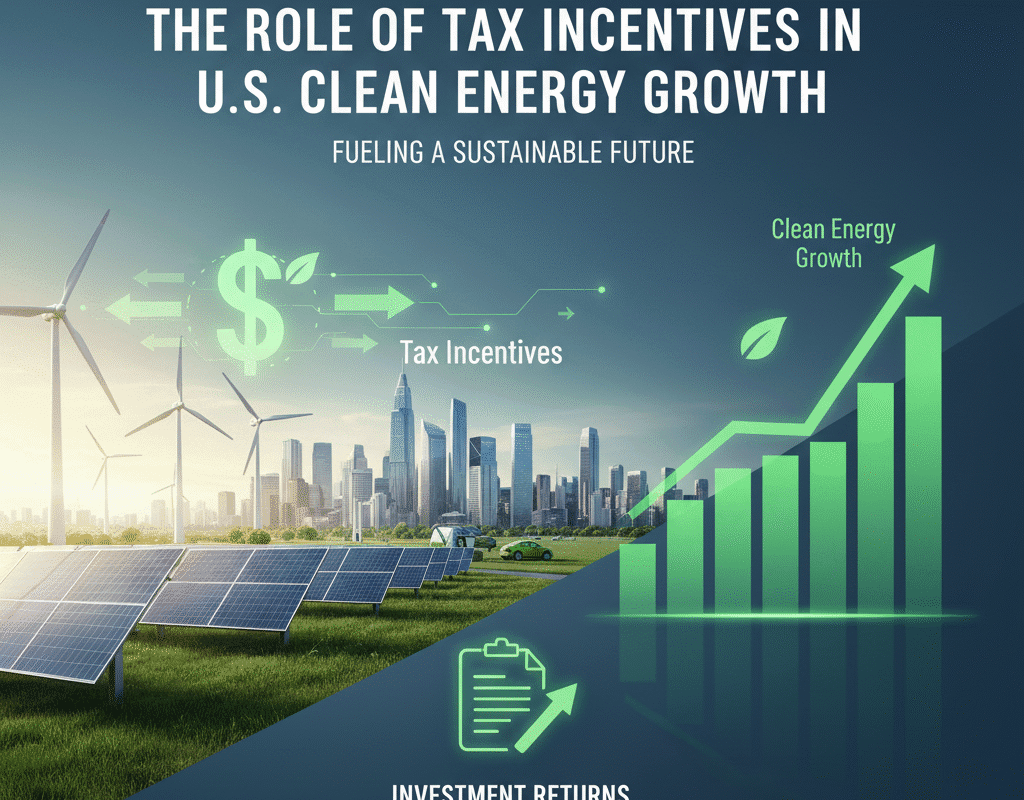
How Tax Incentives Are Fueling America’s Clean?
How Tax Incentives Are Fueling America’s Clean?
The clean energy industry in the United States has drastically changed over the past ten years, particularly since significant federal climate legislation was passed. Wind turbines dominate Midwestern skylines, solar farms span enormous tracts of land in the Southwest, and battery storage projects are spreading quickly throughout the grid. On American roadways, electric cars are becoming more prevalent, and domestic clean-tech production is gradually bringing back what was formerly almost entirely done abroad.
One of the most effective strategies employed by the federal government to promote the creation, acquisition, and application of sustainable energy technologies are tax credits, rebates, and manufacturing incentives.
HSBC Cashback Credit Card 2025 – Benefits, Rewards & How to Apply?

The Foundation: How Clean Energy Tax Incentives Work
Tax incentives reduce the cost of producing or using clean energy technologies. The federal government offers several types of incentives:
Investment Tax Credits (ITC)
These credits allow companies or households to deduct a percentage of the cost of installing clean energy systems—such as solar panels or battery storage.
Production Tax Credits (PTC)
Rather than subsidizing the upfront cost, these credits reward the actual energy generated, particularly for wind, geothermal, and some forms of bioenergy.
Consumer Tax Credits
Consumers receive tax reductions for purchasing electric vehicles, installing home solar systems, improving efficiency, or switching to clean heating.
Tax Incentives for Manufacturing
Companies who manufacture solar panels, batteries, wind components, semiconductors, and other clean technology in the US are rewarded with these credits.
Credits for Clean Fuel and Hydrogen
By offering cost offsets for alternative fuels and new energy carriers, these aid developing businesses.
When combined, these incentives make renewable energy more affordable, competitive, and appealing to consumers and companies. Now, the impact can be seen in every significant area of the American energy industry.
Tax Incentives and the Solar Boom The explosive growth of solar
One of the electricity sources in the US with the quickest rate of growth is solar energy. While declining hardware costs have helped, tax incentives have played an equally significant role.
The Investment Tax Credit (ITC)—first introduced in 2006—has repeatedly proven to be one of the most effective policy tools for renewable adoption. It allows homeowners and businesses to reduce the cost of solar by a substantial percentage, often determining whether projects are financially viable.
Battery storage enters the spotlight
For the first time, federal policy now treats battery energy storage systems as standalone assets—no longer requiring them to be paired with solar to qualify for incentives.
Resurgence of domestic manufacturing
Tax incentives for U.S.–made solar components have led to dozens of new factory announcements since 2022. Panels, inverters, and supporting materials are increasingly produced domestically, reducing reliance on overseas supply chains and bringing manufacturing jobs back to the U.S.
Wind Power: Production Credits Shape Industrial Investment
Why PTCs are so important to wind
Wind energy has historically benefited most from the Production Tax Credit (PTC), which rewards developers for every unit of electricity generated. This performance-based structure has encouraged high-output, high-efficiency wind farms across the Midwest, Great Plains, and Texas.
Offshore wind: A sector in transition
Offshore wind projects, while facing supply-chain pressures and financing challenges, are benefiting from enhanced incentives designed to stimulate investment in coastal areas and support domestic turbine component manufacturing.
Conclusion: How Tax Incentives Are Fueling America’s Clean?
As of 2025, tax incentives have emerged as the most significant and pervasive force behind the expansion of clean energy in the US. They influence consumer purchasing patterns, business investment locations, and the speed at which new technologies are introduced to the market.
The outcomes are evident throughout the country:
- Quick expansion of renewable energy
- Revived domestic manufacturing
- Accelerating EV adoption
- Expanding hydrogen and clean-fuel industries
- Modernized grid infrastructure
- Reduced emissions and pollution
- Economic growth in emerging sectors
As the U.S. continues its transition to a cleaner, more resilient, and more competitive energy economy, tax incentives will remain at the heart of the nation’s strategy.
How Semiconductor Subsidies Are Transforming the U.S. Industry and Boosting Innovation
How Semiconductor Subsidies Are Transforming the U.S. Industry and Boosting Innovation