 A K
A K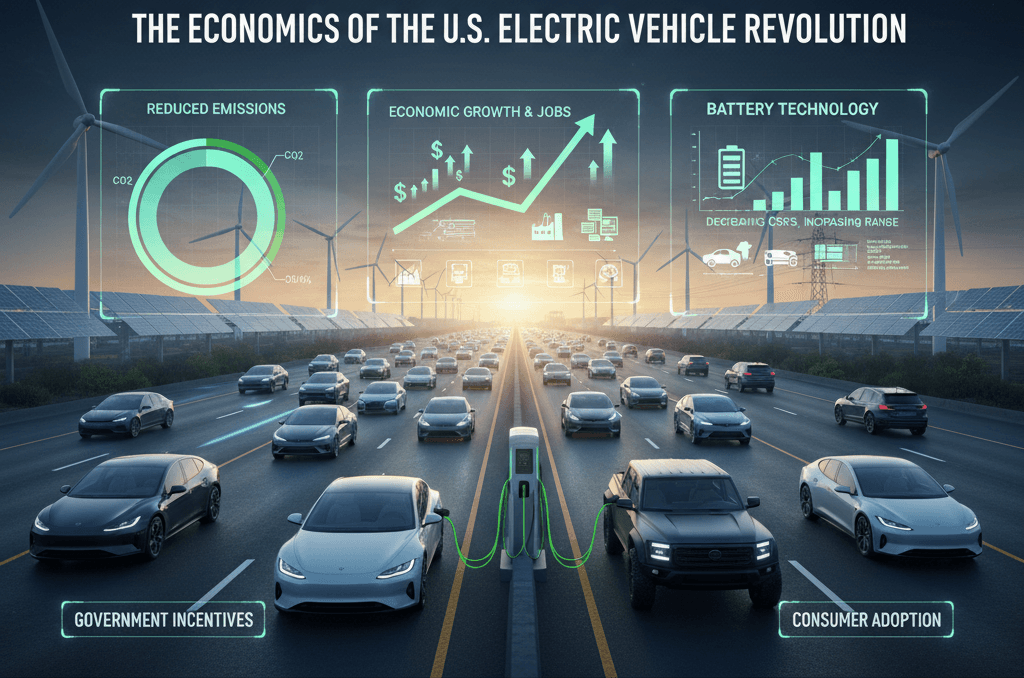
The Economics of the U.S. Electric Vehicle Revolution
The Economics of the U.S. Electric Vehicle Revolution
One of the most significant industrial changes in American history is the transition from gasoline-powered automobiles to electric vehicles (EVs). What started out as an early adopter-dominated niche market has quickly grown into a nationwide economic movement influencing labor markets, manufacturing, energy consumption, and environmental legislation. The U.S. EV revolution, which is backed by federal incentives, significant corporate investments, and international competition, signifies a restructure of the entire automobile industry rather than just a change in how Americans travel.
Economics and environmental necessity are the driving forces behind this shift. The EV movement is changing the U.S. economy on many fronts, from consumer savings and statewide charging networks to job creation and new supply chains.
HSBC Cashback Credit Card 2025 – Benefits, Rewards & How to Apply?

A Market Accelerating Despite Uncertainty
Electric vehicles have steadily increased their share of the U.S. auto market. While growth rates fluctuate year to year due to high interest rates and consumer hesitations, the overall upward trend remains intact. EV sales now account for millions of vehicles on American roads, supported by expanding product lines from traditional automakers and startups alike.
Economically, EV expansion has triggered a surge in investment. Companies are pouring billions into battery factories, research labs, and new production lines. States like Michigan, Georgia, Tennessee, and Texas are competing fiercely to attract EV and battery manufacturing plants by offering tax breaks, land deals, and other incentives.
The Manufacturing Transition: New Investment of Billions
Manufacturing is the economic core of the EV revolution. Particularly in light of recent legislation supporting U.S.-made components, automakers and battery manufacturers are rushing to set up local supply chains.
- Investment Levels in History
Tens of billions of dollars have been invested in the following since the early 2020s:
- Gigafactories manufacturing solid-state and lithium-ion batteries in the United States EV assembly plants constructed or converted from gasoline vehicle facilities
- New graphite, nickel, and lithium supply networks
- Development of autonomous systems and software
- Job Creation and Labor Market Shifts
While EVs have fewer moving parts than gasoline vehicles — sparking concerns about long-term job losses in engine and transmission manufacturing — new sectors are opening up:
- Battery production jobs
- Electrical engineering and software roles
- Charging infrastructure maintenance
- Mining and refining positions
- Renewable energy integration jobs
Consumer Economics: Do EVs Cost Less Than Gas-Powered Vehicles?
Cost is one of the main issues surrounding the EV revolution. EVs are still too costly for working families, according to critics. Proponents argue that EVs are more economical than many people realize thanks to long-term savings and federal subsidies.
In the middle is where the truth is found.
- Long-Term Savings vs. Upfront Costs
Although expenses have constantly decreased as battery prices have decreased, EVs often have higher sticker prices than gasoline-powered vehicles. However, EVs provide financial advantages like:
- Reduced fuel expenses in comparison to gasoline
- Reduced maintenance costs because there are fewer moving parts
- Eligibility for federal tax credits
- State-level rebates or utility discounts
Over the lifespan of a vehicle, many owners save thousands of dollars by switching to electric.
- The Price Difference Is Closing
Over the past ten years, battery costs have significantly decreased, and breakthroughs like lithium iron phosphate (LFP) batteries are lowering the cost of producing EVs. Economists predict that many car types will probably reach parity with gasoline-powered vehicles by the late 2020s, which means equal initial costs.
Environmental Economics: The Benefits of Cutting Emissions
Most economists concur that cutting transportation-related emissions results in significant long-term savings through:
- Better public health
- Reduced expenses from climate-related calamities
- Decreased dependence on foreign oil
- An increase in the country’s energy independence
Although environmental benefits are often discussed in sustainability circles, their economic value is equally significant. A cleaner transportation sector reduces the financial burden of pollution-related health issues and stabilizes the nation’s long-term energy economy.
The Workforce Challenge: Re-skilling for the EV Era
While the EV transition creates new jobs, it also disrupts traditional auto manufacturing roles. Gasoline vehicles require workers for engine production, fuel systems, exhaust systems, and transmission assembly — all of which decrease in an all-electric future.
Retraining Programs
To avoid job displacement, states and automakers are investing in:
- Technical education programs
- Partnerships with community colleges
- Apprenticeships in battery manufacturing
- Grants supporting workers in transitioning industries
The economic success of the EV revolution will depend in part on whether workers are able to transition into new roles rather than be left behind.
The Road Ahead: Economic Predictions for the Next Decade
Economists predict the next decade will bring transformative EV milestones:
- Cost parity between EVs and gas cars
- Nationwide expansion of rapid charging
- More affordable battery technologies
- Significant growth in U.S. battery manufacturing
- Declining maintenance and insurance costs
- Rapid fleet electrification for delivery and government vehicles
The U.S. EV market is expected to move from an early-adoption phase to mainstream acceptance. As infrastructure becomes visible, costs drop, and vehicles become more efficient, consumer hesitancy will likely fade.
Conclusion: The Economics of the U.S. Electric Vehicle Revolution
The electric vehicle revolution in the United States is an economic shift that is influencing the country’s workforce, competitiveness, and energy future. It goes well beyond a simple technological trend. Although there are still issues with supply chain reliability, pricing, and infrastructure, the long-term financial advantages are already evident.
The economics of the EV transition indicate that America stands to benefit much from this change, from increased manufacturing employment and cleaner air to lower fuel prices and improved national security.
Whether the United States leads the world in electric mobility or loses ground to foreign rivals will be decided over the next ten years. However, the EV revolution is clearly gaining traction and is already changing the American economy.
The Impact of Shadow Banking on U.S. Credit Markets: Risks, Growth, and Future Outlook
The Impact of Shadow Banking on U.S. Credit Markets: Risks, Growth, and Future Outlook