 A K
A K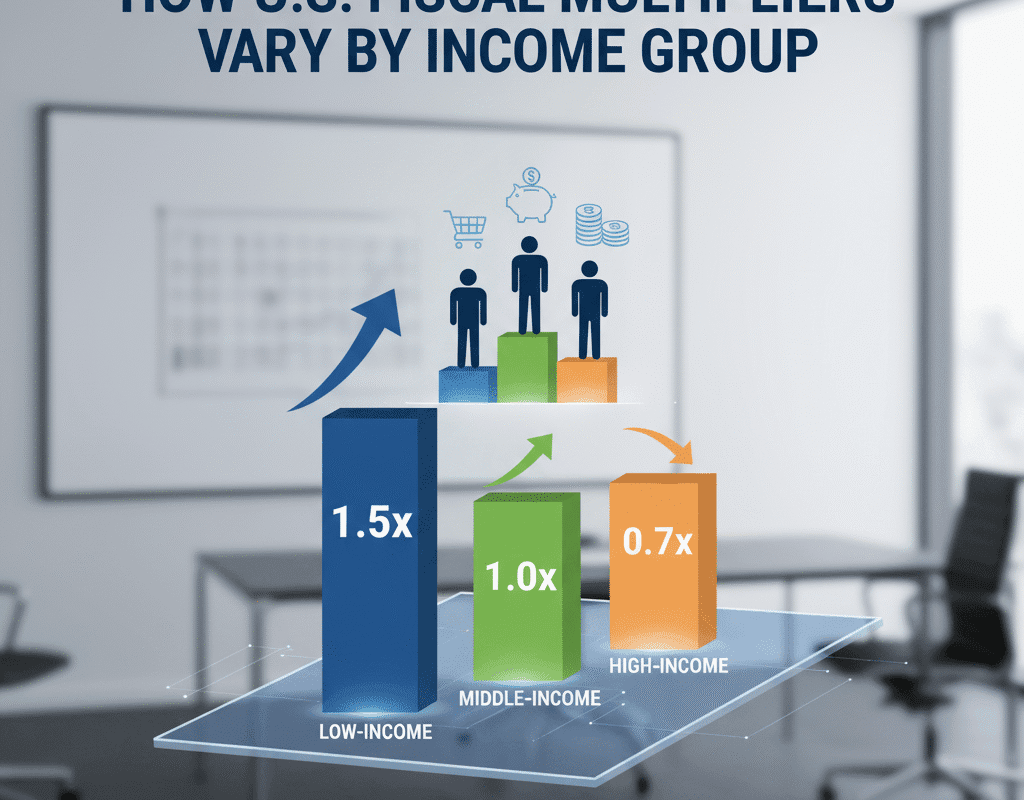
How U.S. Fiscal Multipliers Differ Across Income Groups?
How U.S. Fiscal Multipliers Differ Across Income Groups?
The United States government employs fiscal policy as a key tool to influence economic growth, stabilize markets, and respond to crises. Central to understanding fiscal policy is the concept of the fiscal multiplier—the measure of how much economic output changes in response to government spending or tax adjustments. However, recent research suggests that fiscal multipliers are not uniform across the population. Instead, they vary significantly depending on income group, revealing crucial insights for policymakers, economists, and the public.
HSBC Cashback Credit Card 2025 – Benefits, Rewards & How to Apply?

Fiscal Multipliers: What Are They?
An economic indicator that measures how changes in taxes or government expenditures affect the economy as a whole is called a fiscal multiplier. To put it simply, it calculates the amount of economic activity produced for every dollar spent by the government. For example, if the U.S. government spends $1 billion on infrastructure, and the economy grows by $1.5 billion as a result, the fiscal multiplier is 1.5.
Fiscal multipliers come in a variety of forms:
- Government spending multipliers: Measures the effect of direct government expenditures, such as infrastructure projects or public services.
- Tax multipliers: Assesses the economic impact of tax cuts or increases on consumer spending.
Case Studies: U.S. Fiscal Policy and Income Groups
The 2009 American Recovery and Reinvestment Act (ARRA)
The ARRA aimed to combat the Great Recession through government spending, tax cuts, and social support programs. Studies found that fiscal multipliers were significantly higher for low-income households, as stimulus payments and unemployment benefits were quickly spent, boosting consumer demand.
COVID-19 Economic Impact Payments
During the pandemic, the U.S. government issued direct payments to millions of Americans. Data showed that low-income recipients spent a larger share of their payments immediately, contributing to a more rapid economic recovery than if payments had been distributed evenly across all income groups.
Tax Cuts and Jobs Act of 2017
This legislation primarily benefited high-income households and corporations. Research indicated that the short-term fiscal multiplier was smaller, as much of the additional income was saved or invested rather than spent, resulting in limited stimulus to domestic consumption.
Implications for Policy
Understanding the variation in fiscal multipliers by income group has major implications for U.S. economic policy:
Targeted Stimulus
Policies aimed at low- and middle-income households generate stronger short-term economic impacts, making them ideal for stimulating consumption and recovery during downturns.
Progressive Fiscal Measures
Targeted support through progressive taxation or direct transfers can enhance multiplier effects, reduce income inequality, and support social safety nets.
Long-Term Growth vs. Short-Term Stimulus
While high-income households generate smaller short-term multipliers, policies directed toward investment and innovation may yield long-term economic benefits, suggesting a balanced approach is necessary.
Measuring Income-Based Fiscal Multipliers: Difficulties
When evaluating fiscal multipliers by income group, economists encounter a number of difficulties:
- Data Restrictions: Real-time access to comprehensive household-level consumption data is challenging.
- Dynamic Behavior: Households may alter their spending or saving habits in response to economic uncertainty.
- Policy Interactions: Multipliers can be influenced by concurrent monetary policies, global economic conditions, and local government actions.
Despite these challenges, empirical studies consistently show that income-targeted fiscal policies can maximize the stimulative effect of government spending.
Future Directions
Policymakers can leverage insights on income-specific fiscal multipliers to design more effective economic strategies:
Real-Time Data Analytics
Utilizing big data and AI to track household spending patterns can help tailor fiscal measures dynamically.
Integrated Policy Approaches
Combining fiscal support with programs in healthcare, education, and housing can amplify multipliers, particularly for low-income households.
Equity-Focused Stimulus
Policies that prioritize economically vulnerable groups can reduce inequality while stimulating economic growth.
In conclusion: How U.S. Fiscal Multipliers Differ Across Income Groups?
Fiscal multipliers are not uniform across the U.S. population. Low-income households exhibit the highest multipliers due to higher spending propensities, followed by middle-income households, while high-income households show the smallest multipliers. Understanding these variations is crucial for crafting effective, equitable, and efficient fiscal policies. By targeting fiscal measures strategically, policymakers can maximize economic growth, support vulnerable populations, and ensure that government interventions deliver tangible results.
In a time of economic uncertainty, the lesson is clear: who receives government support matters as much as how much is spent. Tailored fiscal policy can not only stimulate the economy but also promote long-term prosperity and social equity.