 A K
A K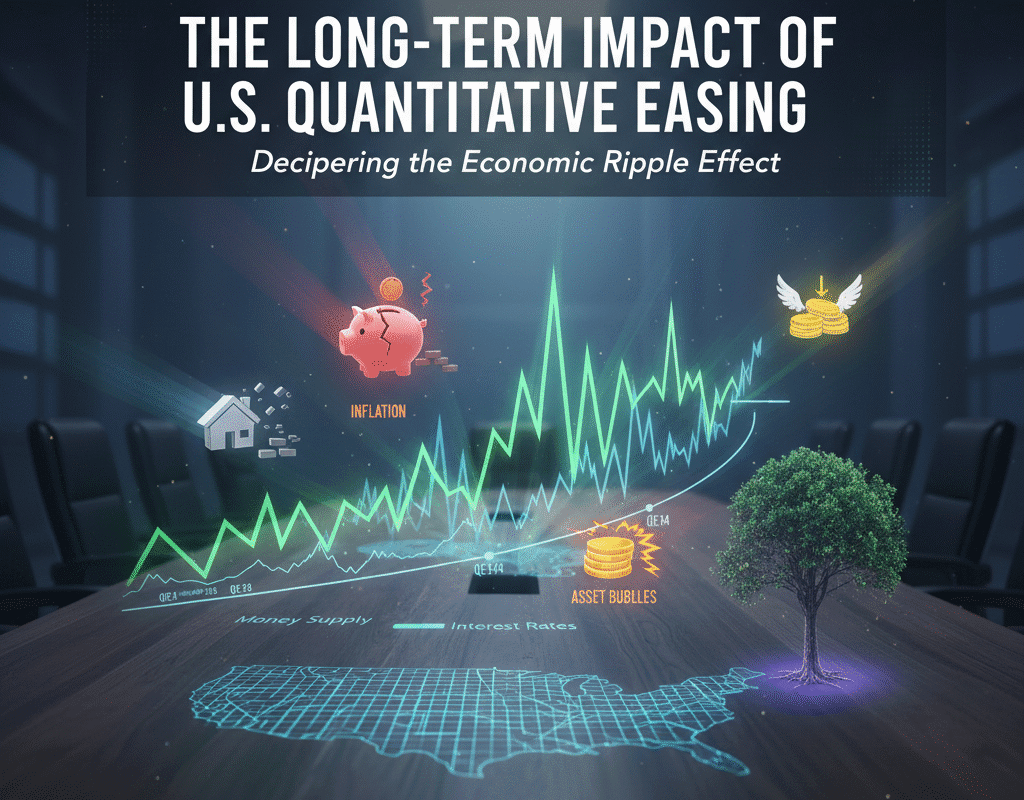
The Long-Term Impact of U.S. Quantitative:
The Long-Term Impact of U.S. Quantitative:
Over the past two decades, the U.S. economy has faced multiple financial crises, prompting the Federal Reserve to implement an unconventional monetary policy known as quantitative easing (QE). Designed as a tool to stimulate the economy when traditional policy measures, such as lowering interest rates, become insufficient, QE has had profound and far-reaching effects on economic growth, financial markets, and long-term fiscal stability.
HSBC Cashback Credit Card 2025 – Benefits, Rewards & How to Apply?

Quantitative Easing: What Is It?
When traditional techniques, such as decreasing the federal funds rate, are no longer effective, central banks might utilize quantitative easing as a monetary policy instrument to add liquidity to the economy. In order to expand the money supply, lower long-term interest rates, and promote lending and investment, the Federal Reserve buys long-term government bonds and other securities from financial institutions.
QE mostly affects short-term borrowing costs indirectly, in contrast to traditional monetary policies. By increasing demand for bonds, QE drives up asset prices, lowers yields, and encourages investors to seek higher returns in riskier assets like stocks, corporate bonds, and real estate.
Historical Background of Quantitative Easing in the United States
The Federal Reserve first implemented QE in response to the 2007-2008 Global Financial Crisis. Traditional monetary tools had reached their limits as the federal funds rate approached zero. Over several rounds of QE, the Fed purchased trillions of dollars in Treasury securities and mortgage-backed securities to stabilize financial markets and prevent a deep recession.
Following the financial crisis, the U.S. economy experienced slow growth, and unemployment remained high. To accelerate recovery, the Fed continued QE through multiple programs, including QE1 (2008-2010), QE2 (2010-2011), and QE3 (2012-2014). During the COVID-19 pandemic in 2020, QE was reintroduced on an unprecedented scale to support the economy amid widespread lockdowns and financial market volatility.
Short-Term Effects of QE
In the short term, QE has successfully prevented deeper recessions and stabilized financial markets. By increasing liquidity, QE encouraged banks to lend, supporting consumer spending and business investment. Equity markets responded positively, with stock prices rising due to increased investor confidence and lower borrowing costs.
Additionally, QE helped reduce long-term interest rates, making it cheaper for households to finance mortgages and for companies to invest in capital projects. This boost in credit availability supported housing markets, corporate investment, and overall economic activity.
Case Study: The Post-2008 Recovery
Following the 2008 financial crisis, the U.S. experienced a slow but steady recovery. QE1 helped stabilize financial markets, while QE2 and QE3 supported further economic expansion. The unemployment rate gradually declined, and GDP growth resumed, though at a slower pace than historical recoveries. Critics note that while QE prevented another Great Depression, it may have contributed to asset bubbles and rising income inequality, demonstrating the trade-offs of this unconventional policy.
QE During the COVID-19 Pandemic
The COVID-19 pandemic prompted an unprecedented scale of QE, with the Fed purchasing trillions of dollars in securities to maintain market stability. This action helped prevent a severe economic collapse during the early months of the pandemic, supported corporate liquidity, and facilitated government stimulus programs. However, the massive monetary expansion also contributed to the inflationary pressures experienced in 2021-2022, highlighting the delicate balance policymakers must strike.
Policy Implications and Lessons Learned
The long-term impact of QE has important implications for U.S. monetary policy:
- Timing and Scale Matter: The effectiveness of QE depends on when and how aggressively it is implemented. Too little QE may fail to stabilize the economy, while excessive QE can create financial distortions.
- Exit Strategies Are Critical: As QE programs wind down, the Fed must carefully manage interest rates and balance sheet reductions to avoid market disruption.
- Coordination With Fiscal Policy: QE works best when combined with targeted fiscal measures that support productive investment rather than fueling speculative asset purchases.
- Monitoring Inflation and Inequality: Policymakers must weigh the benefits of economic stimulus against potential inflation and rising inequality. Balancing these factors is essential for sustainable growth.
In conclusion: The Long-Term Impact of U.S. Quantitative
U.S. quantitative easing programs have been a powerful tool for stabilizing financial markets and supporting economic recovery during periods of crisis. While QE has clear short-term benefits, its long-term impact is more complex, influencing inflation, asset prices, wealth distribution, and financial stability. As the U.S. continues to navigate economic challenges, including inflationary pressures and rising government debt, understanding the nuanced consequences of QE is essential.
Ultimately, QE is not a panacea; it is a tool that, when used judiciously and in combination with sound fiscal policy, can promote economic stability. The lessons learned from decades of QE implementation provide valuable guidance for future policymakers tasked with balancing growth, stability, and equitable outcomes for all Americans.