 A K
A K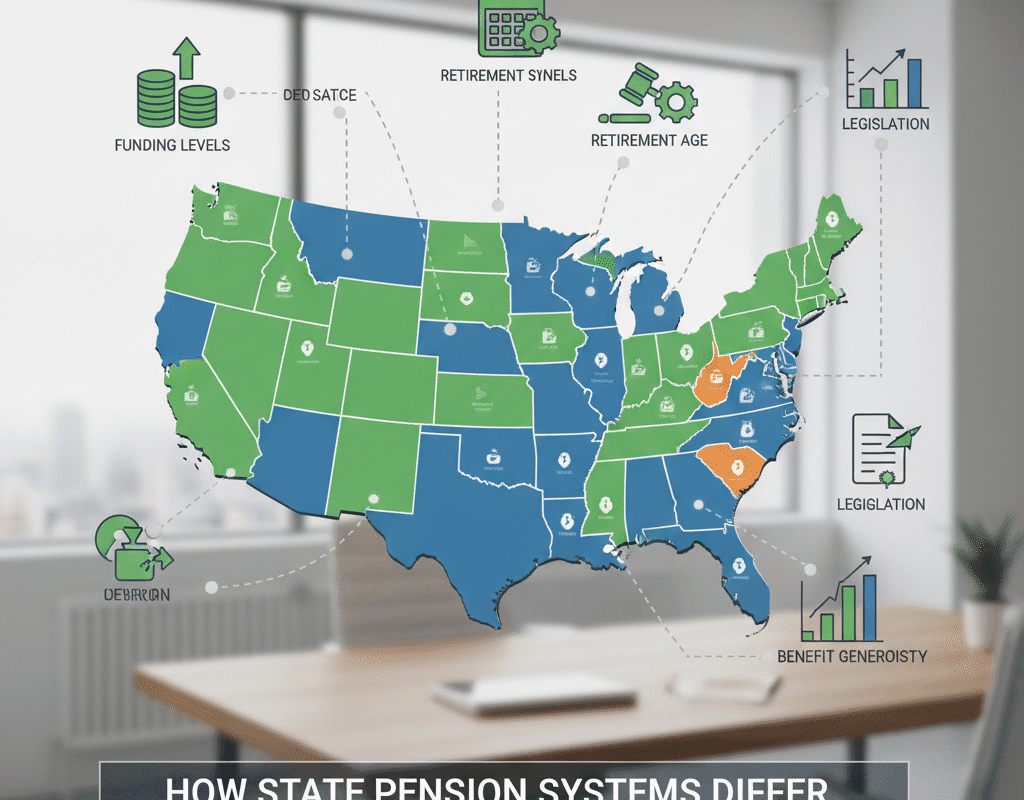
How State Pension Systems Differ Across?
How State Pension Systems Differ Across?
Not every state is created equal when it comes to retirement, particularly for those in the public sector. There isn’t a single, consistent “state pension system” in the US that works in every one of the 50 states. Rather, every state manages its own pension plans (sometimes many systems), differing greatly in terms of design, funding, eligibility, generosity of benefits, tax treatment, contribution policy, and reform initiatives.
For public employees who might relocate across states, taxpayers and legislators monitoring the financial stability of those systems, and retirees or prospective retirees who need to make appropriate plans, it is crucial to comprehend these distinctions.
HSBC Cashback Credit Card 2025 – Benefits, Rewards & How to Apply?

In the United States, what is a “state pension system”?
First, it’s important to define the term “state pension system” in this context.
- Many states offer defined benefit (DB), defined contribution (DC), or hybrid pension systems to workers in the public sector, such as state government officials, teachers, law enforcement personnel, and municipal government employees.
- The term “state pension system” frequently refers to the plan or plans run by a state government, which, depending on the state, may also involve local government or education systems.
- There are thousands of public sector retirement systems in the United States, both locally and state-administered, according to the Public Plans Database and other sources.
- States and even individual states differ in terms of funding status, benefit guarantees, investment plans, demographic presumptions, and contribution methods.
Illustrative state comparisons
To illustrate how these differences play out, here are select examples:
Illinois
The state has been widely cited as having a severe pension funding shortfall—the Illinois Teachers’ Retirement System, the State Employees’ Retirement System and other plans have been funded at 30-40 % levels.
In 2024 the state’s Supreme Court upheld the consolidation of many local police/fire pension systems into statewide accounts, as part of reform efforts.
This underscores how benefit design, reform and funding status converge to create state‐specific challenges.
Kentucky
Kentucky’s pension systems (covered by the Kentucky Public Pensions Authority) had one of the lowest funding levels. Some funds reportedly only 14 % funded.
The larger picture: current conditions and national tendencies
While our focus is on variation by state, it’s useful to step back and view the national context.
- According to national data, state and local defined-benefit pension plan assets were about $5.7 trillion at the end of 2024.
- States and local governments collectively administer thousands of retirement systems, each with distinct features.
- A recent “State of Pensions 2025” report projected that the average funded ratio would increase from ~78.1 % to ~83.1 % in 2025 — signalling improvement but also highlighting that large risks remain.
- Key drivers of unfunded liabilities remain: underperforming investment returns, changes to actuarial assumptions, interest on existing debt.
Concluding remarks: How State Pension Systems Differ Across?
The variety among state pension systems in the U.S. is vast. While all are intended to deliver retirement income to public workers, the devil is in the details: how generous the benefit is, how well funded the plan is, how the tax system treats retired workers, how the plan is governed and how responsive the state is to reform.
In some states, public workers can look forward to a well-funded, stable pension with clear expectations. In others, the risks are higher: large unfunded liabilities, uncertain benefit design, and tax/taxpayer pressures that may result in future adjustments.
The key takeaway for anyone concerned with public-sector retirement — whether a worker, policymaker or taxpayer — is to recognise that state matters.
Two public employees doing similar work in different states may have very different retirement outcomes. And likewise, two taxpayers in different states may face very different fiscal burdens stemming from those pension systems.
For your retirement planning, your state’s pension system (and its health) should be front of mind. For those crafting policy, the divergence in pension systems across states offers instructive lessons — what works, what doesn’t, and what the consequences are of postponing reform.