 A K
A K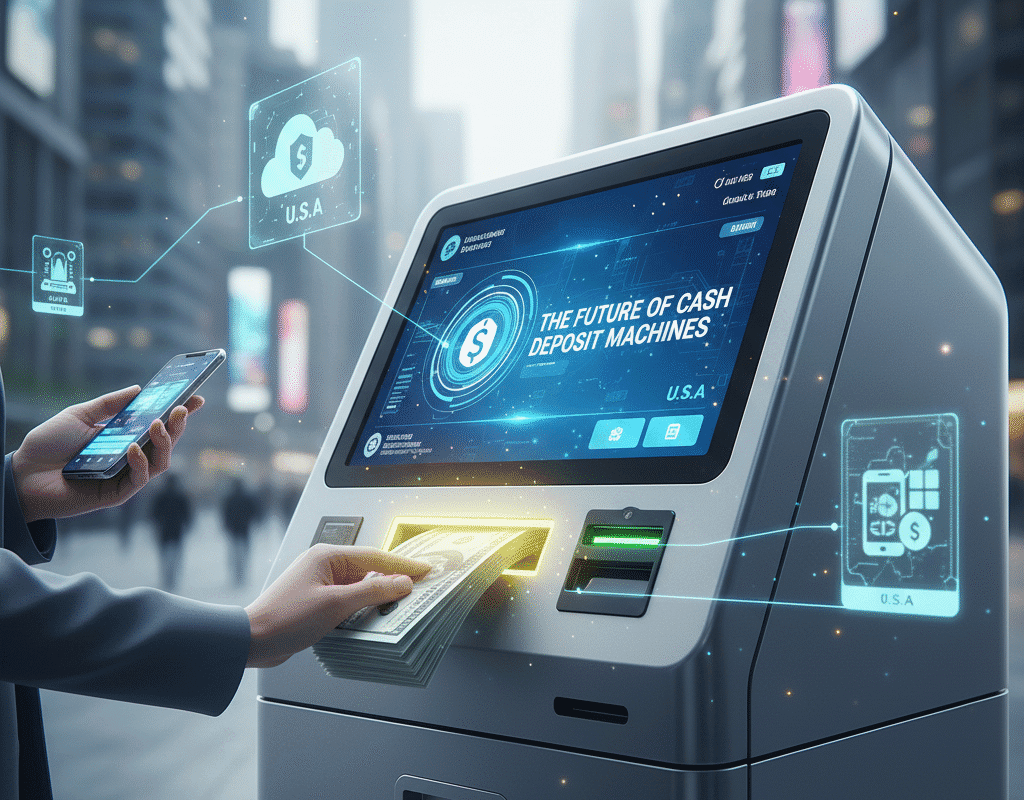
The Future of Cash Deposit Machines:
The Future of Cash Deposit Machines:
The American banking industry is changing quickly. Every aspect of financial services is evolving due to digital payments, mobile banking, branch closures, and shifting consumer expectations. The cash deposit machine (CDM) or cash-deposit-enabled ATM is an unsung hero at the center of this revolution.
While much of the conversation focuses on cardless withdrawals and mobile wallet integrations, cash deposit machines are quietly evolving — and their future is far more interesting than one might expect.
HSBC Cashback Credit Card 2025 – Benefits, Rewards & How to Apply?

The Significance of Cash Deposit Machines
Cash is still an essential component of the U.S. payment ecosystem despite the predominance of digital transactions, particularly for small enterprises, unbanked and underbanked individuals, elderly demographics, and rural locations.
Cash is still “king” for many small-value transactions and for people who are unable to access digital financial services, according to industry opinion.
1.1 Providing liquidity and supporting deposits
Deposits are an essential source of funding for banks and other financial organizations, not only a way to collect money.
Sophisticated deposit management continues to be one of the most important levers for retail bank profitability, according to a recent McKinsey & Company report. In this regard, cash deposit machines assist organizations in drawing in and keeping depositors, strengthening their financing base.
1.2 Access in branch-light environments
Branches continue to close in many parts of the U.S., owing to cost pressures and the migration of many services online. At the same time, consumers still need access to self-service terminals for cash deposits, especially as bank branches shrink in rural or low-density locations.
Therefore, CDMs act as physical touchpoints—often unattended but strategically located in retail, branch-lobbies or off-site kiosks.
What the Industry Pulse and Numbers Show
Despite the lack of particular U.S. data on deposit-only machines, a number of signs point to more general trends:
- Including deposits and dispensing, the global ATM industry was valued at USD 25.29 billion in 2024 and is expected to expand at a compound annual growth rate (CAGR) of approximately 3.6% between 2025 and 2030.
- Due to the growth of digital banking, the number of physical ATMs in North America and Europe has been gradually decreasing (~1-3% annually).
- Regulations pertaining to cashless retail: more states are outlawing “cash-less stores,” indicating social and political acknowledgement that cash and, consequently, access to deposit machines are still important.
- Retail banks are turning their attention to deposit management as a strategic priority, indicating the importance of deposit channels (which cash deposit machines support).
Important Questions for Operators and Banks
Institutions should consider the following before determining how aggressively to invest in cash deposit machines:
- What is our target market’s cash-in and cash-out profile? Are there any communities, business sectors, or demographics where cash is still strong or even increasing?
- Can we deploy machines cost-effectively? Consider capex/opex for CDMs vs digital alternatives. What is the expected usage and revenue (or cost-saving) from deposit machines?
- How will we differentiate the machine service? Will the CDM simply accept deposits, or also offer value-added services (video teller, account opening, bill payment, multi-bank access)?
- How will we ensure uptime, maintenance and cash logistics? Smart monitoring, recycling and remote service are essential.
4. Forecasts: What to Anticipate by 2030
By roughly 2030, the U.S. CDM market is expected to look like this:
- Fewer but more capable machines: The total number of deposit-enabled machines may shrink modestly, but those remaining will be high-capability kiosks offering deposits, withdrawals, checks, video teller services, deposit recycling and contactless interfaces.
- Wider adoption of cash recycling: Deposit machines will increasingly recycle banknotes to reduce transport and fill cost, improve uptime and reduce cost per transaction.
- Smart placement strategy: Retailers, transit hubs, convenience locations and underserved communities will see greater machine density than affluent digital-heavy zones.
- Enhanced security and user-experience: Biometric, AI-based fraud controls, remote monitoring and predictive maintenance will become standard; machines will be sleeker and user-friendly.
Conclusion: The Future of Cash Deposit Machines in the U.S.
The narrative of “cash is dead” is misleading. Even as digital payments surge and financial technology proliferates, cash remains embedded in the U.S. economy in multiple ways: in small-value transactions, in businesses that rely on notes, and with consumers who prefer or rely on physical money.
For banks and operators, the challenge is to recognise that while the role of cash is shifting, so too must the means of serving it.
Cash deposit machines are at a strategic crossroads. If they remain outdated—they risk obsolescence. But if they evolve—embracing recycling, self-service features, biometric security, smart placement and integration with digital channels—they become a critical part of the modern banking network.
The Future of Retirement in America: Trends, Challenges, and Planning for Financial Security
The Future of Retirement in America: Trends, Challenges, and Planning for Financial Security