 A K
A K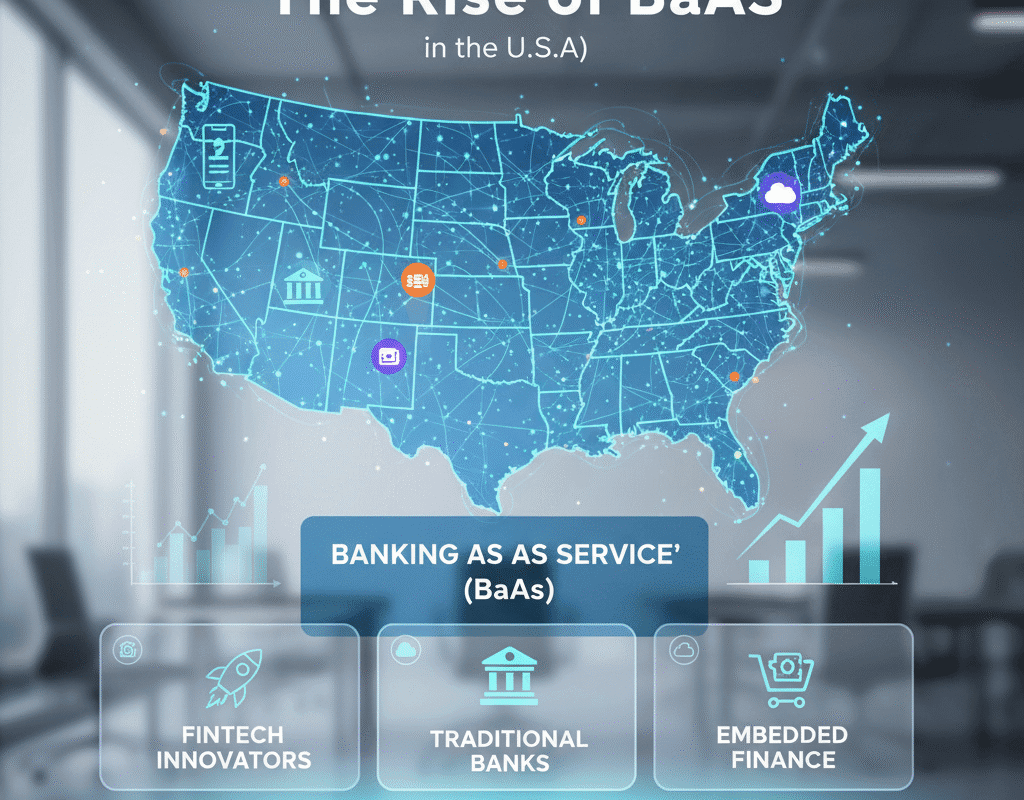
The Rise of Banking as a Service (BaaS):
The Rise of Banking as a Service (BaaS):
The rapid advancement of technology, consumer expectations, and regulatory changes have all contributed to the significant transformation of the financial services industry in the United States in recent years. Banking as a Service (BaaS) is one of the biggest breakthroughs changing the banking industry.
Through collaborations with authorized banks and advanced API-driven platforms, this paradigm enables non-bank businesses to provide banking services. With fintech startups, large tech companies, and even traditional banks entering the BaaS ecosystem, the U.S. is witnessing a financial revolution that is redefining the way Americans access banking services.
HSBC Cashback Credit Card 2025 – Benefits, Rewards & How to Apply?

Banking as a Service (BaaS): What is it?
The term “banking as a service” (BaaS) is a business model in which authorized banks use application programming interfaces (APIs) to directly incorporate their digital banking services into third-party companies’ products.
These services can include everything from payment processing, savings accounts, lending products, and debit or credit card issuance to more advanced financial tools like investment accounts and compliance management.
Traditionally, businesses that wanted to offer banking services had to obtain a bank charter, navigate strict regulatory requirements, and build expensive infrastructure. BaaS platforms eliminate these barriers by allowing non-banking companies to plug into an existing bank’s infrastructure.
Leading BaaS Providers in the U.S.
In the US, a number of BaaS providers have become industry leaders, providing reliable infrastructure to both established companies and fintech startups.
- Synapse: Synapse serves both enterprise clients and fintech startups by providing banking, payment, lending, and investing APIs.
- Solarisbank (via partners in the United States): Solarisbank, which was founded in Europe, is extending its business model to encourage fintech innovation in the United States.
- Green Dot: Known for prepaid cards, Green Dot provides BaaS solutions for companies seeking banking-as-a-service capabilities.
- Marqeta: Specializes in card issuing and payment processing, enabling fintech companies to launch innovative debit and credit solutions.
- Stripe Treasury: Stripe extends beyond payments, offering banking services through API integrations for platform-based companies.
Benefits of Banking as a Service
The BaaS model offers multiple benefits for businesses, banks, and consumers:
For Businesses:
- Faster time-to-market for financial products
- Reduced compliance and regulatory burden
- Access to advanced banking infrastructure without heavy capital investment
- Enhanced customer engagement through integrated financial services
For Banks:
- New revenue streams via partnerships
- Increased customer reach without heavy marketing
- Opportunities to leverage technology and innovation without developing in-house solutions
For Consumers:
- Convenient, embedded financial services
- Personalized banking experiences tailored to specific platforms
- Greater access to financial tools for underserved populations
Challenges Facing the BaaS Industry
Despite its rapid growth, BaaS faces several challenges:
- Regulatory Complexity: Navigating U.S. federal and state banking regulations remains a significant hurdle for BaaS providers and their partners.
- Data Security: Protecting sensitive financial data across multiple platforms requires robust cybersecurity measures.
- Competition: As more players enter the market, differentiation becomes challenging, especially for smaller fintechs.
- Bank Dependency: Non-bank companies rely heavily on partner banks, meaning any disruption or regulatory action can affect their services.
BaaS’s prospects in the United States.
BaaS appears to have a bright future in the US. As more fintech companies, big IT organizations, and even traditional enterprises investigate embedded financial solutions, analysts anticipate sustained development. Important patterns to observe are as follows:
- Growth of Embedded Finance: Customers will increasingly use the apps and platforms they already use to access financial services directly.
- Enhanced Cooperation Between Banks and Tech Companies: Collaborations will spur innovation and wider uptake.
- Enhanced AI Integration: Artificial intelligence will personalize financial services, improve fraud detection, and enhance customer experiences.
- Regulatory Evolution: U.S. regulators are expected to provide clearer frameworks for BaaS, enabling safer and faster market growth.
- Global Expansion: U.S. BaaS providers may increasingly offer cross-border services, tapping into global markets.
In conclusion: The Rise of Banking as a Service (BaaS)
Banking as a Service is revolutionizing the financial industry in the United States. By lowering barriers to entry, enabling digital-first experiences, and promoting financial inclusion, BaaS is empowering fintech companies, traditional banks, and consumers alike.
As technology evolves and partnerships deepen, the U.S. financial ecosystem will continue to see innovative products and services that redefine banking for a digital era.
In essence, BaaS is not just a trend—it is a paradigm shift. The question for the future is no longer whether businesses should leverage BaaS, but how they can best integrate it to deliver seamless, innovative, and customer-centric financial solutions.
How Required Minimum Distributions (RMDs) Work: 2025 Rules, Deadlines, and Tax Strategies Explained
How Required Minimum Distributions (RMDs) Work: 2025 Rules, Deadlines, and Tax Strategies Explained
1 Comment