 A K
A K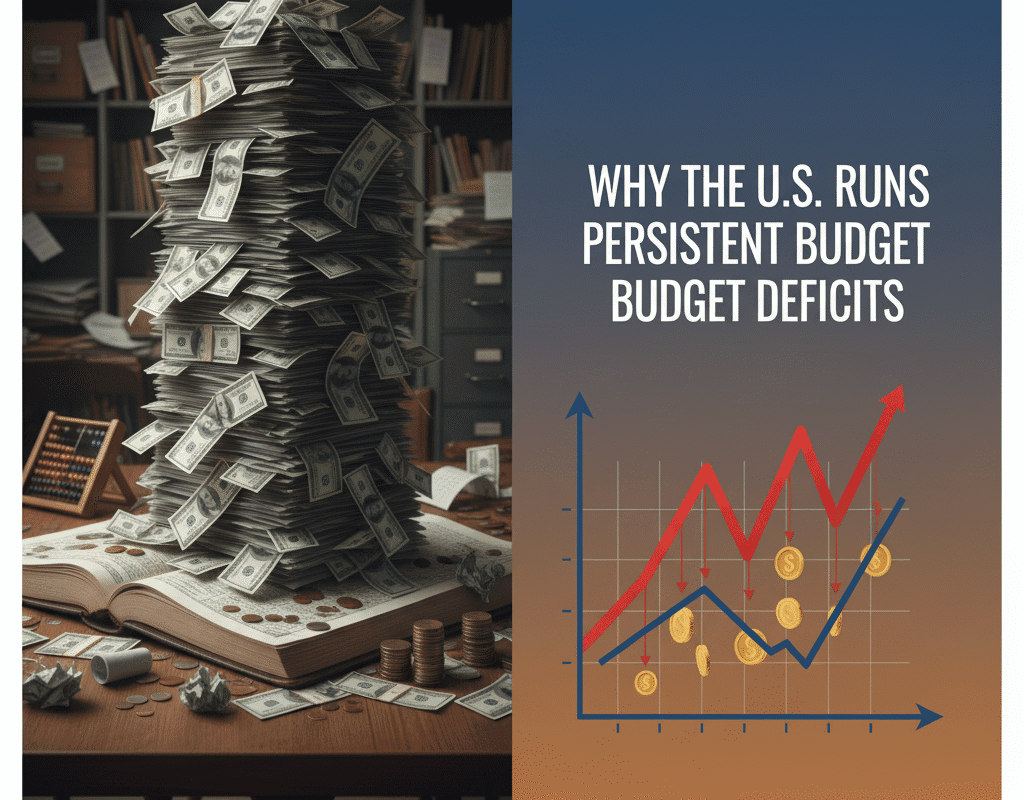
Why the U.S. Runs Persistent Budget Deficits?
Why the U.S. Runs Persistent Budget Deficits?
For decades the federal government of the United States has consistently spent more than it collects in revenues. That gap—commonly referred to as the budget deficit—has become a near-permanent feature of U.S. fiscal policy. According to the Government Accountability Office (GAO), the U.S. has run a budget deficit every fiscal year since 2002.
Why does this keep happening? And what are the deeper drivers behind this structural imbalance? This article explores the forces—economic, demographic, political and policy-based—that contribute to the persistent U.S. budget deficit, and outlines what risks and implications these deficits portend for the economy.
HSBC Cashback Credit Card 2025 – Benefits, Rewards & How to Apply?

What is a budget deficit?
A budget deficit happens when the government’s expenditures (spending) exceed its receipts (taxes, fees, etc.) in a certain time. When that happens, the government must borrow money—typically by issuing treasury securities—to make up the difference. Over time, repeated deficits raise the cumulative federal debt.
In the U.S. context, the size of the annual deficit—and the stock of debt—are often compared to Gross Domestic Product (GDP), a measure of the overall size of the economy. When deficits persist and debt grows faster than GDP, the burden becomes harder to manage.
The US Deficit in Context
Recent data suggest that the US deficit remains large. For example, in its analysis the Peter G. Peterson Foundation notes that federal spending is projected to rise from around 23.3 % of GDP in 2025 to about 26.6 % by 2055, while revenues are expected to increase more slowly—from about 17.1 % to 19.3 % of GDP.
Similarly, the Brookings Institution notes that many recent deficit rises are due to structural issues rather than cyclical downturns.
Thus, we can think of the US budget deficit as having two major components: cyclical and structural.
Why Aren’t Deficits Being Fixed?
Given these structural pressures, why hasn’t U.S. policy adjusted more aggressively? Several factors contribute:
- Short-term political incentives: Cutting spending or raising taxes is unpopular. Many policy-makers defer hard decisions for future years.
- Economic growth optimism: There is hope that growth will outpace debt growth, making the deficit manageable without drastic action.
- Low cost of borrowing (historically): When interest rates are low, deficits seem less threatening, reducing urgency.
- Complexity of entitlement reform: Social Security and Medicare are politically sensitive and technically complex to reform.
- Crisis mentality: Policy often reacts to crises (for example, recessions, pandemics) rather than planning ahead to structural balance.
Consequences of Persistent Deficits
Unchecked deficits and growing debt carry risks. Some of the likely consequences include:
- Reduced national saving and investment: According to Brookings, ongoing deficits decrease national saving, which in turn can reduce domestic investment and hamper productivity growth.
- Higher interest rates: As government borrowing increases, interest rates may rise—crowding out private investment.
- Increased vulnerability to shocks: High debt limits the ability of the government to respond to crises (economic downturns, wars, pandemics) with additional spending.
- Tax burden shifts: Future taxpayers may face higher taxes or reduced benefits to service the debt.
- Fiscal-market risks: If investors lose confidence, borrowing costs may spike; in extreme cases, a fiscal crisis could follow.
What Has Changed Recent Years
Several recent developments have further influenced the deficit landscape:
- The pandemic triggered massive spending and revenue losses—causing large deficits even in otherwise healthy economic times.
- More recently, interest costs on the debt have grown rapidly, constituting a larger shre of federal expenditures.
- The structural gap between spending and revenue remains large—and under current policy projections, deficits are expected to persist or even rise relative to GDP.
Pathways to Reducing the Deficit
Addressing persistent deficits is challenging, but economists and fiscal watchdogs identify several possible pathways:
- Raise revenues: Reform tax policy to increase collections relative to GDP.
- Slow spending growth: Particularly on entitlement programs and interest costs.
- Boost economic growth: Higher growth raises tax revenues and makes debt smaller relative to GDP.
- Structural reforms: Reform Medicare, Social Security, healthcare pricing, and defense spending.
- Improve fiscal framework: Establish multi-year budgeting, accountability measures, and debt-stabilization targets.
The GAO has recommended that Congress and the administration develop a “strategy for fiscal sustainability” because the longer action is delayed, the steeper the eventual cuts or tax increases will need to be.
Why This Is Important for the World and the United States
The U.S. budget deficit is not only a domestic concern—it has global implications. A major economy running large structural deficits and rising debt can affect global financial markets, exchange rates, and investor confidence. Moreover, U.S. fiscal health influences its ability to project economic and geopolitical power.
From a domestic standpoint, persistent deficits may slow growth, reduce investment in infrastructure, education and innovation, and shift the burden to future generations. The structural nature of the problem makes clear that simply waiting for a recovery will not close the gap.
In conclusion: Why the U.S. Runs Persistent Budget Deficits?
“Why does the United States run persistent budget deficits?” does not have a single solution; rather, it is the result of the convergence of numerous underlying factors, including demography, the rise in healthcare costs, interest costs, taxation, economic cycles, and political decisions.
Together, this lead to a fundamental mismatch between revenues and spending commitments.
Although economic downturns and crises make deficits worse, the structural deficit is the underlying cause.
Deficits are expected to continue and possibly worsen in the absence of significant reforms. For policymakers and citizens alike, understanding these drivers is key to evaluating fiscal policy, debt sustainability and economic prospects.
In short: the U.S. budget deficit is less a temporary glitch and more a structural challenge. Acknowledging that reality is the first step toward managing it.
How State Sales Taxes Differ Across the U.S. – A Deep Dive Into Rates, Bases & Local Variations
How State Sales Taxes Differ Across the U.S. – A Deep Dive Into Rates, Bases & Local Variations