 A K
A K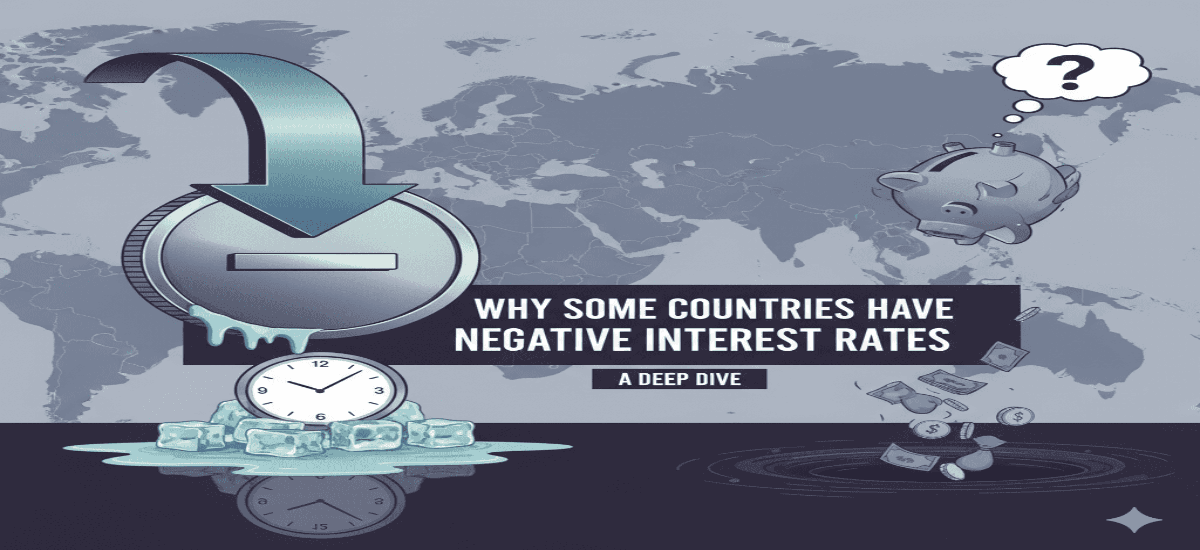
Why Some Countries Have Negative Interest Rates?
Why Some Countries Have Negative Interest Rates?
The idea of negative interest rates has baffled both financial specialists and regular savers in the realm of contemporary economics. Instead of paying banks to retain their money, people are used to getting interest on their savings. However, negative interest rate policies (NIRP) have been implemented as an unusual monetary tool in a number of industrialized economies, most notably in Europe and Japan.
However, why would a nation implement such a novel policy? What advantages and disadvantages come with negative interest rates? And what impact does it have on corporations, banks, and regular people? This in-depth analysis explores the reasons behind negative interest rates, their global impact, and the lessons they offer about today’s economic challenges.
HSBC Cashback Credit Card 2025 – Benefits, Rewards & How to Apply?

Comprehending Negative Interest Rates
An interest rate is fundamentally the price of borrowing money. Banks often charge borrowers for loans at positive interest rates, giving savers a return.
This idea is reversed when interest rates are negative:
- Depositors may have to pay banks to keep money in savings accounts.
- Banks may be charged for holding excess reserves with the central bank.
- Borrowers could receive loans at extremely low or even negative rates, effectively being paid to borrow money.
This counterintuitive policy is usually a last resort for central banks when traditional monetary tools fail to stimulate the economy.
For what reason would nations employ negative interest rates?
Although they are uncommon, negative interest rates are a reaction to extreme deflationary pressures or economic stagnation. Among the main causes are:
Combating Deflation
An economy may suffer from deflation, which occurs when prices continuously decline. Expecting prices to drop, consumers postpone purchases, which lowers demand and slows growth. Central banks discourage currency hoarding and promote spending by enacting negative interest rates.
Promoting Investment and Borrowing
Consumers may borrow for homes, vehicles, or education when borrowing costs fall below zero, while corporations are more inclined to take out loans for expansion. The economy is energized by this increased activity.
Declining Exchange Rates for Exports
Because investors look elsewhere for greater returns, negative rates frequently devalue a nation’s currency. A weaker currency boosts a nation’s industrial and commerce industry by lowering the cost of exports on international markets.
Motivating Banks to Make Loans
Excess reserves are usually parked at central banks by commercial banks. Because it costs money to keep reserves idle when interest rates are negative, banks are more inclined to lend to families and businesses.
Nations With a History of Negative Interest Rates
A number of economies have experimented with negative interest rates in the last ten years. These consist of:
- Japan: In order to fight decades of slow growth and deflation, the Bank of Japan (BOJ) implemented negative interest rates in 2016.
- European Central Bank (ECB): To stimulate inflation and increase lending throughout the Eurozone, the ECB set interest rates below zero in 2014.
- Sweden: In 2009, the Riksbank became one of the first banks to try negative rates.
- Switzerland: To keep the value of the Swiss franc from rising too much, negative rates were introduced.
- Denmark: Maintained its currency peg to the euro by using negative rates.
Although each nation’s choice was influenced by particular difficulties, they all aimed to restore economic development.
Negative Interest Rates’ Effects
Regarding Customers and Conservers
For savers, negative rates are typically terrible news. People might have to pay fees in place of receiving returns on their deposits. Borrowers gain, though, since personal loans and mortgages may become more affordable.
On the Banks
Because their profit margins contract, banks frequently suffer when interest rates are negative. Charging depositors might turn off clients and make lending riskier. Some banks do not pass on the costs; instead, they absorb them.
Regarding Companies
Cheaper loans could help businesses by facilitating their ability to hire staff, engage in new initiatives, and grow internationally.
Regarding Asset and Real Estate Prices
Low-cost borrowing frequently increases demand for real estate and raises property values. As investors look for higher returns than bank deposits, stock markets may also climb.
Regarding Public Debt
Investors effectively pay to own government bonds since governments may borrow money at negative interest rates. This lowers borrowing costs and may lessen the burden of governmental debt.
Negative Interest Rates’ Advantages
Negative rates are debatable, yet they have several obvious benefits:
- Encourages borrowing and spending, which boosts economic growth.
- Keeps long-term deflation from harming industries.
- Increases investment and consumption to support employment.
- Allows for increased fiscal spending by lowering the cost of government funding.
The Dangers and Rebuttals
There are disadvantages to negative interest rates. Several risks are highlighted by economists:
- Hurts savers: Regular folks who have savings accounts can feel like they’re being punished.
- A drop in bank profitability could result in less robust financial systems.
- promotes excessive risk-taking since investors seek out riskier assets in an effort to increase returns.
- distorts markets, possibly leading to stock or housing bubbles.
- limited efficacy if businesses and consumers continue to be pessimistic.
The Reasons the US Has Steered Clear of Negative Interest Rates
Even during the 2008 financial crisis and the 2020 pandemic, the US has never imposed negative rates. The Federal Reserve instead used quantitative easing, or nearly zero interest rates, and massive asset purchases.
The United States avoids negative rates for several main reasons:
- Better economic foundations than those of Europe or Japan.
- A dependence on the US dollar as the global reserve note.
- Worries about the money markets and financial system becoming unstable.
Lessons Learned Worldwide from Negative Interest Rates
Several lessons can be learned from nations that have implemented negative rates:
- They are most effective when used as a short-term solution rather than a permanent one.
- Central banks cannot solve every problem on their own; fiscal measures must be used in conjunction with monetary tools.
- Confidence is important; negative rates might not encourage spending if businesses and consumers are still unsure.
- Reverting to positive rates can cause market disruption, thus exit strategies are challenging.
Negative Interest Rates’ Future
Many nations have abandoned negative rate strategies as a result of recent increases in inflation. However, central banks might give them another look if there is a significant global downturn. The question of whether negative rates are risky experiments or novel instruments is still up for debate among economists.
In Conclusion
The fundamental tenets of conventional finance are called into question by negative interest rates. They seek to promote growth in times of deflation and stagnation by reversing the relationship between savers and borrowers. Although nations such as Japan, Switzerland, and Eurozone members have experimented with such policies, it is still unclear what the long-term effects will be.
Negative rates have brought stability and relief to certain countries. Others have expressed worries about asset bubbles, banking profitability, and savings. Although there is ongoing discussion on their efficacy, one thing is certain: in the connected world of today, central banks’ decisions, especially those that are not conventional, have an impact on the entire world economy.
The Role of Business Mentorship in Financial Growth: Unlocking Success for Entrepreneurs
The Role of Business Mentorship in Financial Growth: Unlocking Success for Entrepreneurs