 A K
A K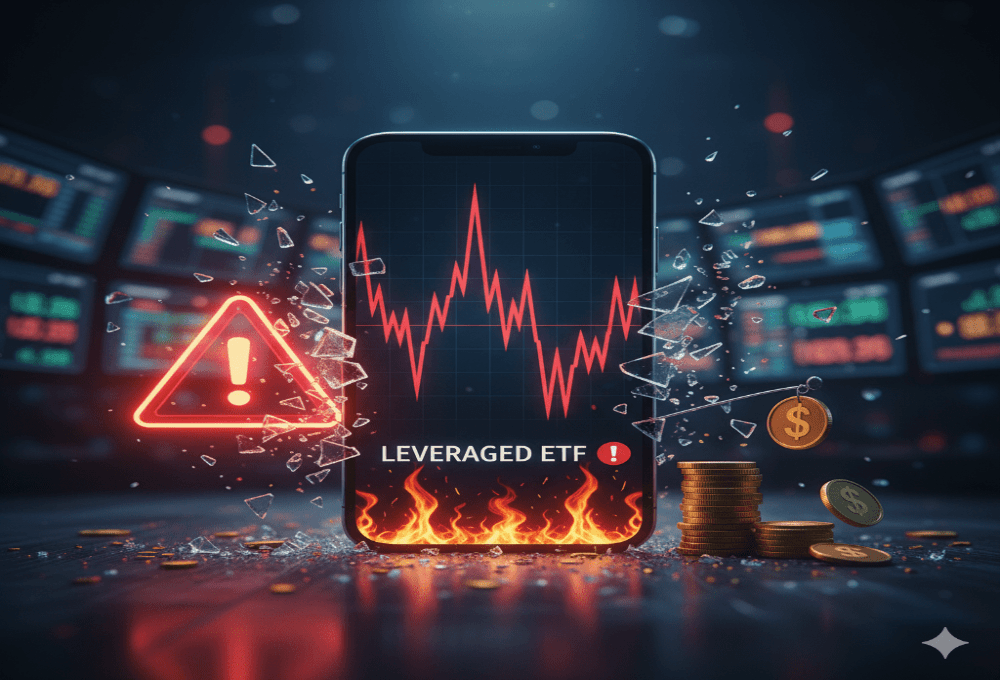
The Hidden Dangers of Leveraged ETFs:
The Hidden Dangers of Leveraged ETFs:
Because they provide cost-effectiveness, liquidity, and diversity, exchange-traded funds (ETFs) have grown to be one of the most well-liked investment vehicles in the US. Leveraged ETFs, however, are a high-risk subset of this universe. These funds promise higher returns, but they also come with unspoken risks that could fool unsuspecting investors.
The definition of leveraged exchange-traded funds (ETFs), their operation, and the main hazards that investors encounter when utilizing them will all be covered in this article. By the end, you’ll know why regulators frequently advise against long-term holdings of leveraged ETFs and why traders, not investors, might be a better fit for them.
HSBC Cashback Credit Card 2025 – Benefits, Rewards & How to Apply?

Leveraged ETFs: What Are They?
Specialized exchange-traded funds known as leveraged ETFs use debt and financial derivatives to boost an underlying index’s performance.
- The goal of 2x ETFs is to provide twice the benchmark’s daily return.
- Three times the daily return is the goal of 3x ETFs.
- Often employed for hedging, inverse exchange-traded funds (ETFs) aim to provide the opposite performance of an index.
- When markets rise, losses are magnified by leveraged inverse ETFs.
For instance, a 3x leveraged S&P ETF could theoretically appreciate by roughly 3% if the S&P 500 rises 1% in a day. On the other hand, the identical ETF would decrease 3% if the index fell 1%.
For short-term traders, this daily compounding offers opportunities, but for long-term investors, it poses significant hazards.
Principal Dangers of Leveraged ETFs
The Silent Killer: Volatility Decay
Volatility decay, sometimes referred to as the “erosion effect,” is the most well-known danger. Leveraged ETFs’ performance over weeks, months, or years may deviate significantly from the index they monitor because they reset every day.
For instance:
- Day 1: 3x ETF earns 30% as the index increases 10%.
- Day 2: 3x ETF loses 27.27% as the index drops 9.09%.
- As a result, the leveraged ETF investor is down roughly 6%, while the index is back at break-even.
Even when the market is trending upward, leveraged ETFs frequently underperform their benchmarks over time due to this compounding effect.
Unsuitable for Extended Storage
Leveraged ETFs are intended for daily trading, not long-term investing, as the majority of issuers make clear. Yet many retail investors buy them thinking they will simply multiply market gains.
Regulators like the SEC and FINRA have repeatedly cautioned that holding leveraged ETFs for weeks or months exposes investors to unexpected outcomes.
High Costs and Fees
Leveraged ETFs come with expense ratios that are much higher than standard ETFs—often exceeding 0.90% annually, compared to 0.03%–0.10% for plain index ETFs.
These costs eat away at returns, especially when combined with volatility decay.
Risk of Market Timing
An investor must accurately time the market in order to profit from leveraged ETFs. Significant losses may arise from an ill-timed entrance or holding during sideways volatility.
While regular investors usually have difficulty anticipating market movements, professional traders may utilize them for intraday chances.
Increased Losses
Losses are exaggerated in the same way that wins are.
- A 6% decline in a 3x ETF corresponds to a 2% decline in the index.
- Significant capital can be lost in a matter of days due to consecutive downturns.
Leveraged ETFs are therefore frequently referred to gambling tools rather than investments.
Examples of Leveraged ETF Risks in the Real World
Shares of Direxion Daily Financial Bull 3X (FAS)
- Market volatility in 2008–2009 caused extreme swings, leading to long-term underperformance compared to the financial index it tracked.
UltraPro QQQ by ProShares (TQQQ)
- Hugely popular during the tech boom, but investors who held it during sharp Nasdaq corrections faced devastating drawdowns.
Inverse Oil ETFs (e.g., SCO, DWTI)
- During the oil market crash of 2020, extreme volatility caused leveraged ETFs to diverge significantly from oil prices.
Why Leveraged ETFs Are Still Purchased by Investors
Leveraged ETFs draw billions of dollars in assets under management in spite of the dangers. Why?
- Fear of missing out (FOMO) and greed: traders seek out large, quick profits.
- Accessibility: ETFs are simple to purchase because they trade similarly to equities.
- Marketing: Novice investors are seduced by the “triple your money” offer.
- Strategies for Day Trading: These can work well for experienced traders in brief spikes.
Regulatory Alerts
Major brokerage firms, FINRA, and the SEC have repeatedly warned:
- Leveraged exchange-traded funds (ETFs) are “unsuitable for retail investors holding for more than one trading session,” according to the Securities and Exchange Commission.
- Daily resets may “cause returns to deviate significantly from the performance of the underlying benchmark,” according to FINRA.
- Brokerage Restrictions: Before trading leveraged ETFs, investors may be required to sign risk disclosures on certain platforms.
ETFs with leverage versus Margin Trading
Leveraged ETFs are sometimes falsely thought of by investors as a “safe” option to trade on margin. Actually:
- Direct borrowing with interest is possible through margin trading.
- Even while leveraged exchange-traded funds (ETFs) incorporate leverage, investors are still subject to increased risk.
- In contrast to margin, leverage in ETFs is fixed (2x or 3x) and cannot be changed.
Therefore, even though leveraged ETFs may seem easier, they are frequently riskier than margin trading for the typical investor.
Safer Options for Investing
Rather than pursuing leveraged ETFs, investors should think about:
- ETFs with a plain index (SPY, QQQ, and VOO): inexpensive, long-term growth.
- Options strategies: minimal downside and controlled leverage.
- Sector ETFs: Focus on sectors free from the danger of daily resets.
- A diversified portfolio uses stocks, bonds, and commodities to balance risk.
Concluding remarks
ETFs with leverage are not always “bad.” They give seasoned traders practical tools for hedging or short-term speculating.
However, these products frequently result in unanticipated losses, volatility decay, and financial hardship for the typical investor trying to “triple” their returns.
“Leverage is a double-edged sword,” as the phrase goes. Never confuse leveraged ETFs for a long-term investment strategy, and exercise caution if you decide to use it.
Budgeting as a Student: Smart Money Habits to Make It Work in 2025
Budgeting as a Student: Smart Money Habits to Make It Work in 2025